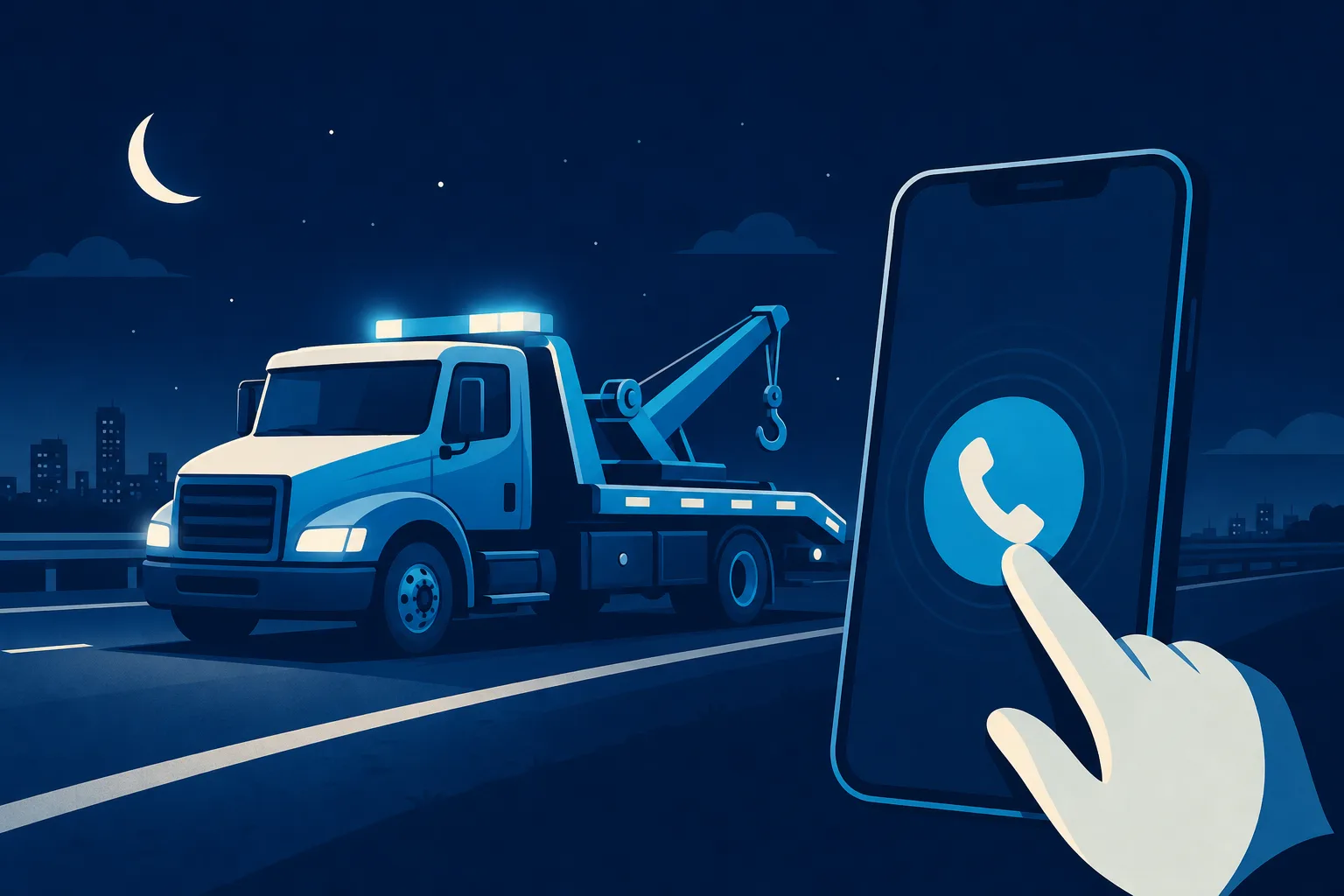
Picture the person who needs you right now. They are parked on a gravel shoulder with the hazards ticking, a dead battery or a flat or a fender they just crumpled, and they are holding their phone with one hand while traffic pushes air past the door. They type "tow truck near me" and they tap the very first thing that looks like it will answer. That entire decision takes about eight seconds. A website for a towing company only has one real job, and it is to win that call in those eight seconds.
If you have never had a website before, this is good news. You are not building a brochure or an online magazine. You are building the fastest possible bridge between a scared person on the roadside and the phone in your truck. That is a much simpler thing to get right, and this guide walks you through it in plain English.
The one moment your whole website is built around
Almost every towing search starts from a bad place. A breakdown, a lockout, an accident, a car that will not start in a parking lot at 11pm. The searcher is not comparing five companies and reading your history. They are stressed, often standing outside, and they want a human on the phone who will say "I can be there in twenty-five minutes."
That mindset changes everything about how you build. On most small-business sites the goal is to slowly build trust and get a form filled out next week. On a towing site the goal is to remove every second of friction between landing on the page and hearing your voice. If a visitor has to scroll, squint, or think, you have already lost them to the next result.
So the test for every single thing on your site is simple. Does this help someone on the shoulder call me faster? If yes, keep it. If no, it can wait or go away entirely.
Put the call button where a thumb already is
The most important element on a towing website is a giant tap-to-call button, and it needs to sit at the top of the screen the instant the page loads, before any scrolling. On a phone, that button should be wide, high-contrast, and impossible to miss with a thumb held one-handed. The words matter too. "Call now for a tow" beats a bare phone number, because it tells a rattled person exactly what happens when they press it.
A few things that make the difference between a button people tap and one they skip:
- Make it a real phone link, not just printed digits. On a phone, tapping it should start the call in one motion. Never make someone copy a number and paste it into the dialer.
- Keep it stuck to the screen. A call bar that stays pinned at the bottom as they scroll means the call is always one tap away, no matter where they are on the page.
- Repeat it. Put a call button in the header, after the first block of text, and again at the bottom. People decide at different moments, and the button should be waiting whenever they do.
- Add a text option next to it. Some people cannot talk on a busy roadside or a loud accident scene. A "text us your location" link catches the callers who would otherwise give up.
If you want to go deeper on the mechanics of that button, we have a whole piece on the click-to-call button, but for towing the short version is this: bigger, higher, and more of them than feels normal.
Say 24/7 like you mean it
Breakdowns do not keep business hours. A huge share of towing calls come at night, on weekends, and in the ugly weather that causes wrecks in the first place. The person searching at 2am is quietly terrified that everyone is closed and they are stuck until morning. Your website has to answer that fear in the first line they read.
Do not bury "24/7" in a footer. Put "24 hour towing" or "open now, day or night" right in the headline at the top, next to the call button. It is the single most reassuring thing a stranded driver can see, and it is often the reason they pick you over a competitor whose site is silent about hours.
Two honest cautions. First, only say 24/7 if you actually answer the phone at 2am, or have someone who does. Nothing kills a towing reputation faster than a promise of round-the-clock service that goes to voicemail. Second, if you do not run overnight, say your real hours plainly and clearly. "Serving the area 6am to midnight" still wins calls, because it is honest and specific, and it beats making a promise you cannot keep.
Nail your service area so the right people call
Towing is brutally local. You want the calls inside your tow radius, and you genuinely do not want the ones two counties away that tie up a truck for an hour with a long deadhead back. Your website should draw that line clearly.
Name your towns. Not "we serve the greater metro region," but the actual list: the city you are based in, the neighboring towns, the stretch of interstate you cover, the exits and mile markers if that is how people describe where they are stuck. A stranded driver reading their own town's name on your page feels an instant "these people can reach me," and that feeling is what turns a visitor into a caller.
If you cover a wide area or several towns, it is worth giving the main ones their own short pages so they show up when someone searches "tow truck in [that town]." Keep each one specific and real, mentioning the local highways, the big shopping centers, the landmarks people actually name when they are lost. We cover how to do that without sounding like a robot in our guide to service area pages that rank in nearby towns.
One more thing that quietly matters: make sure your service areas are set on your Google Business Profile too. For emergency searches, the map results and your website work together, and a stranded person often taps whichever one names their location first.
Be the first result someone taps on the roadside
Winning the call starts before the click. When someone searches "tow truck near me," the map pack at the top and the first couple of results get almost all the taps. Nobody scrolls to page two while standing on a shoulder. So a big part of your website's job is simply to help you show up in that top handful.
You do not need to become an SEO expert. For a towing company, a few basics carry most of the weight:
- A claimed, complete Google Business Profile with your phone, your service area, your hours, and real photos of your trucks. For emergency searches this is often more important than the website itself, and the two reinforce each other.
- Reviews, and a steady trickle of new ones. A driver in a panic trusts a company with 140 recent reviews far more than one with three. Ask every customer at the moment you hand them their keys back, when the relief is fresh.
- Fast pages. If your site takes five seconds to load on a weak roadside signal, they are gone before they see your button. Big heavy background videos and slideshows are the enemy here. Lean and quick wins.
- Clear text that names what you do and where. "24 hour towing and roadside assistance in [your city]" tells Google exactly which searches you belong in.
Speed deserves one extra sentence because towing is the one industry where it is life-or-death for the sale. Your visitor is often on one bar of signal in a dead zone. A stripped-down, fast-loading page is not a nice-to-have. It is the whole game.
The pages a towing site actually needs (and the ones it does not)
First-time website owners often think they need a dozen pages. A towing company needs very few, and each should push toward the call.
- A home page that is basically a call machine. Headline with your city and "24 hour towing," a giant call button, your service area, and a short list of what you tow. That is the page most people will ever see, so make it do the work.
- A services list. Light-duty and heavy-duty towing, roadside assistance, jump starts, lockouts, tire changes, fuel delivery, winch-outs, accident recovery, and whether you do private property or police-rotation work. People search for the specific thing that went wrong, so name each one.
- A service area page or a few town pages if you cover a wide radius.
- A short reviews or testimonials section so a nervous caller sees that real people got helped fast.
What you can skip at the start: a blog, a long company history, a photo gallery of every truck, a team page. None of that helps the person on the shoulder. You can add depth later. The launch version should be lean enough to load fast and focused enough to point every visitor at the button.
If you want a broader checklist that applies to any trade, our piece on what every local business website needs covers the fundamentals, but for towing, the four pages above are genuinely enough to start winning calls.
Photos and words that make a stranded person trust you
You do not need a photographer. A few clean phone photos of your actual trucks, taken in daylight, do more than any stock image. A real flatbed with your company name on the door tells a stranded driver that a real, local operator will show up. Stock photos of shiny generic tow trucks quietly signal the opposite.
For the words, write the way you would talk to someone you are about to help. Short, calm, direct. "Stuck on the side of the road? Call now and we will get a truck to you." Avoid the puffed-up language that plagues so many trade sites. A person in trouble does not want "premier roadside solutions." They want to know you will answer and you can reach them. Plainness reads as competence here.
Two trust signals are worth calling out for towing specifically. Say whether you are licensed and insured, because people worry about who is handling their vehicle. And if you work with insurance or motor clubs, or offer flat, honest pricing with no surprise fees, say so clearly. Surprise tow bills are a well-known fear, and naming it directly sets you apart.
Getting this built without becoming a web designer
Here is the honest part. You run a truck, you take calls at odd hours, and you do not have evenings to spend fighting with a website builder. You have a few real paths.
You can do it yourself with a builder like Wix or Squarespace. It is genuinely doable for a simple towing site, and if you enjoy tinkering, go for it. Just hold every choice against the one test: does this help someone call me faster? Resist the templates that want big scrolling galleries and slow animations, because for towing those work against you.
You can hire a web designer or a towing-specific marketing shop, which many operators do. That costs more, but you get it handled.
Or you can let it be done for you without the agency price tag. This is where a tool like Saynovo fits a towing operator well. If you already have a Google Business Profile, Saynovo can import it and generate your site around what is already there, free for the first build, so your phone number, photos, and reviews land on a real page without you starting from a blank screen. Your 24/7 promise and the exact towns you cover were never on Google, so you say those and they appear. And because you change it by talking to it, you can say "make the call button bigger and add 24 hour towing to the headline" from the cab between jobs, and it changes. No dashboards to learn, no evening lost to a builder. For an owner whose actual job is answering the phone and driving the truck, having the website handled that way keeps your attention where it belongs.
Whatever path you pick, the goal never changes. Build the fastest bridge you can between a person stuck on the shoulder and the phone in your truck.
Your next step
If you do nothing else this week, do this: open your phone, search your own service the way a stranded customer would, and see what shows up. If you have no site, or the one you have hides your phone number below a fold, that is the leak. Start by getting a fast, honest, call-first page live with your city in the headline and a button a thumb cannot miss. Everything else is polish. Winning the call is the whole job, and a towing website that does that one thing well will keep your trucks moving.