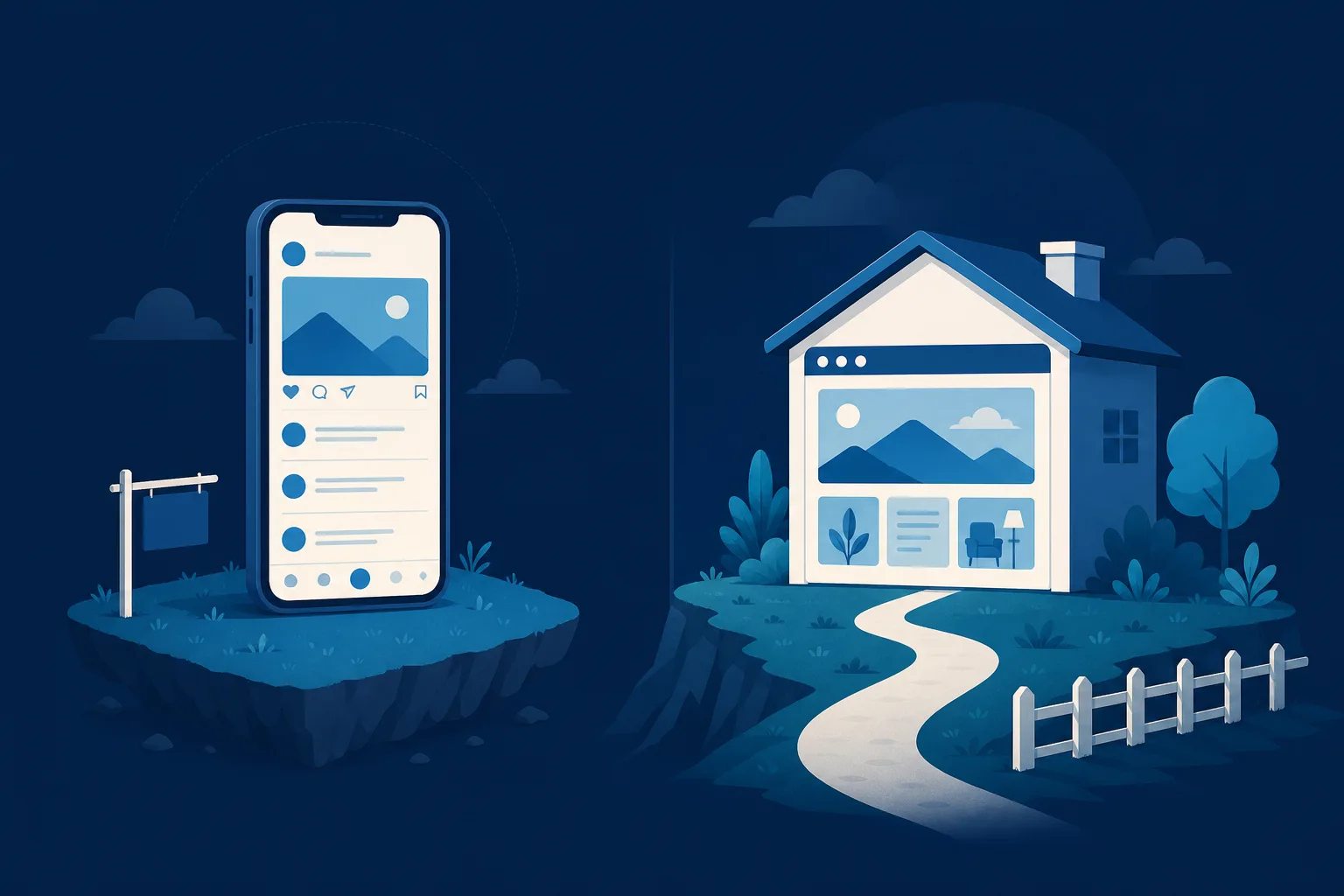
If you already post on Instagram, Facebook, or TikTok and the phone still rings, it is fair to ask: do I need a website or is social media enough? You are not being lazy for asking. Building a website used to be a real project, and if your feed brings in work, adding another thing to manage feels like busywork. So this post gives you a straight answer instead of a sales pitch. It lays out the actual choices in front of you, judges each on the same criteria, names the cases where social-only genuinely works, and helps you pick based on your business rather than what a web designer wants to sell you.
Most articles on this question end with "you need both" and stop there. That is broadly true, but it is not useful on its own. A busy plumber, cleaner, or landscaper needs to know which gaps a website fills, whether those gaps cost jobs today, and what the cheapest honest path looks like. That is what we cover.
The short answer, and why it depends
For most local service businesses, a website earns its keep. But the honest version is that it depends on how customers find you and how they decide.
Here is the split that matters, and nearly every expert who studies this lands on the same line:
- Social media helps people discover you. It is where you show up while someone is scrolling and not necessarily looking for you yet.
- A website helps people decide on you. It is where someone who is ready to hire checks that you are real, priced fairly, and worth a call.
Social media is very good at the first job and weak at the second. A website is the reverse. When people say "you need both," this is what they mean. The useful question is which job your business is currently failing at. If you get plenty of attention but few bookings, your problem is the deciding step, and that is where a website lives.
The real options on the table
This is not a two-way fight between "social media" and "a website." There are several realistic paths, and they cost very different amounts of money, time, and control. Judge them on the same five criteria: ownership, credibility in search, effort to launch, ongoing control, and what they cannot do.
Option 1: Social media only
Free to start, fast, and built for reach. You keep it no matter what else you do.
- Ownership: weak. Your audience and reach live on a platform you rent.
- Credibility and search: low. A profile rarely ranks for "plumber near me," and many buyers still look for a real site to confirm you are legitimate.
- Effort: low. You already know how to post.
- Control: limited to what the app allows.
- Cannot do: rank in search, present prices and service areas cleanly, or survive an account lockout.
Option 2: A do-it-yourself website builder
Tools like Wix, Squarespace, or WordPress. You own the site and control everything, in exchange for doing the work.
- Ownership: strong. The domain and content are yours.
- Credibility and search: good once it is set up well.
- Effort: high. Expect evenings of drag-and-drop, copywriting, and image work, and a real chance it ends up looking generic and then sits untouched.
- Control: total, which is also the burden.
- Cannot do: build itself. The blank canvas is the hard part for most owners.
Option 3: A done-for-you site you steer yourself, like Saynovo
Saynovo sits between the DIY builder and a full agency. It is aimed at local and small businesses, home services first, roofing, HVAC, plumbing, cleaning, landscaping, electrical, and restoration, with wellness next. You connect your Google Business Profile, and an AI pipeline generates a complete, agency-style site around the details already there, with the parts Google never stored, your services and your prices, waiting for you to say them. You then change anything by talking to it: say "swap the hero photo" or "fix my Saturday hours," and it changes.
- Ownership: strong on the part that matters to customers. It publishes on your own custom domain, so your web address is yours. Note that customers do not download or own the underlying source code; it is a hosted product, not a code handoff.
- Credibility and search: good. You get a real site tied to your Google Business Profile instead of a rented profile.
- Effort: low. The first generation from your Google Business Profile is free, and editing by voice skips both the blank canvas and the designer email chain.
- Control: you steer content by describing changes, but it is not a pixel-level design tool where you move every element by hand.
- Cannot do: act as an online store, replace your free social listings, or give you full manual design control. Your first build is free whichever way you start it; building again needs a subscription, and pricing is subscription tiers plus metered AI edits.
Option 4: A fully managed website, done for you by an agency
If you would rather not touch the site at all, you hire a team to design, build, and maintain it for you. Done well, this is the strongest and most tailored result, and it is the highest touch and highest cost of the paths here.
SyntroAI is the in-house version of this route. It is the parent company behind Saynovo, a full-service agency that designs and builds a bespoke website for you, hands-off, and can maintain it over time and go beyond a website into custom software when your needs grow past a template. Where Saynovo is the self-serve product you steer by voice, SyntroAI is the same company at a higher tier of service: the work is handled for you rather than by you. You can also hire an independent freelancer or a local agency for the same kind of custom build.
- Ownership: strong.
- Credibility and search: usually the best, with a design tuned to your brand.
- Effort for you: low once you have briefed the team, though expect back-and-forth up front and a larger investment than a self-serve product.
- Control: the result is bespoke, but you rely on the team for future changes rather than editing on your own.
- Cannot do: fit the smallest budgets or the fastest timelines. This is the choice when the build is complex, brand-critical, or something you want handled end to end.
What social media does well (so you keep doing it)
Whatever you pick for a website, do not drop social. It does real work.
- Reach and discovery. Roughly 4 in 10 people find products and services through social, and it costs nothing but time.
- Proof you exist and do good work. A steady feed of finished jobs and happy customers is genuine social proof.
- Speed and personality. You can post a job you finished an hour ago. No platform beats it for showing you are active and human.
- Warm relationships. Comments and DMs keep you top of mind with past customers who refer you.
None of that changes when you add a website. Social stays your front door for attention. The question is only whether attention alone is enough.
What social media cannot do (and why it costs jobs)
This is the part the "just post more" advice skips. Three hard limits show up again and again.
You are building on land you rent
Your followers and reach live on a platform you do not own. The algorithm decides who sees you, rules change without warning, and an account can be suspended over a mistaken flag with no one to call. As Mailchimp puts it, a website is the one online asset you actually control. If your whole business runs through one account, you are one lockout away from starting over.
People check for a website before they trust you
For higher-cost or in-home work like roofing, HVAC, or restoration, the buyer is nervous about letting a stranger into their home. Around 84 percent of consumers view a business with its own website as more credible than one with only a social page, and Stanford research cited by Made For Web found 75 percent of people judge a company's credibility on its website alone. When someone gets your name as a referral, many search it first. Finding a real site is often what turns a maybe into a call.
Search traffic keeps working while you sleep
Someone searching "emergency plumber near me" at 11pm is ready to hire right now. That person is not scrolling your feed; they are on Google. A website tied to your Google Business Profile can show up in that moment. A social post from last Tuesday cannot, and as hosting.com notes, organic reach on most platforms has been falling for years while a website keeps earning search visits long after you publish.
The honest cases where social media really is enough
Plenty of articles pretend a website is always mandatory. It is not. Even a marketing agency admits, in this candid post, that some businesses do fine without one. Social-only can genuinely work when:
- A marketplace already is your storefront. If all your work comes through Thumbtack, Angi, a rental portal, or a referral network with its own listings, that platform does the deciding step for you.
- You are fully booked from word of mouth. If your calendar is full for weeks on referrals and repeat customers, new-customer discovery is not your bottleneck. Do not fix what is not broken.
- You are testing an idea. Brand new and unsure the business will stick? A free profile and a couple of social accounts are a fine way to prove demand first.
- Your work is genuinely visual and impulse-driven. A cottage baker or a maker selling on impulse can ride a strong Instagram or TikTok presence a long way.
Notice the pattern: social-only holds up when someone else owns the trust and the booking, or when you have more work than you can handle. The moment you want to grow beyond referrals, or a competitor with a real website outranks you, the math flips.
If you have to log into someone else's app to reach your own customers, you do not own the relationship. You are renting it, and the rent can go up or the door can close at any time.
Which is right for you
Skip the generic advice and match yourself to a path.
- Stay social-only (for now) if you are booked out on referrals, a marketplace already handles your trust and bookings, or you are still testing whether the business is real. Keep your money in your pocket until discovery becomes the bottleneck.
- Use a DIY builder if you enjoy the tinkering, have real time to spend, and want total hands-on control of every detail. It is the cheapest way to own a site if the work itself does not scare you off.
- Use a done-for-you tool you steer, like Saynovo, if you are a home-services or local owner who wants the trust-and-search benefits of a real website without the blank canvas or the multi-week agency project, and you are comfortable steering it by describing changes rather than dragging pixels. Because the first generation from your Google Business Profile is free, it is a low-risk way to see your own site before committing.
- Have it fully managed by an agency like SyntroAI if you would rather not touch the site yourself, brand is central to how you compete, or you need a custom, complex build that a self-serve product does not cover. SyntroAI is the higher-touch tier from the same company behind Saynovo: it designs, builds, and can maintain the site for you, and can extend into custom software. An independent freelancer or local shop can fill the same role. Expect a larger investment and a longer timeline in exchange for a bespoke, hands-off result.
- Pick a specialist platform instead if you need an online store, want pixel-level manual design control, or expect to download and own the source code. A commerce platform, a DIY builder, or a custom code handoff fits those needs better than either in-house route.
The honest summary: for a busy roofer, plumber, or cleaner who wants to be found and taken seriously without turning site-building into a second job, a done-for-you tool you steer is often the best fit. If you want the whole thing handled or need a bespoke build, a fully managed agency wins. For a hobby or fully-referral business, social-only is a defensible choice. Different readers, different picks.
The bottom line
So, do you need a website or is social media enough? Keep the honest framing: social media wins discovery, a website wins the decision, and most local businesses need both because they are quietly failing at the second one. If you are fully booked on referrals or a marketplace already handles your trust and bookings, social-only can hold for now. But the moment you want to grow, protect yourself from a lost account, or win the customer who checks you out before calling, a website stops being optional. The question is no longer whether you can afford a site. It is which path fits your budget, your time, and how much control you want: self-serve and steered yourself, fully managed for you, or a specialist platform where those win. Place yourself honestly, and act on the answer instead of the trend.