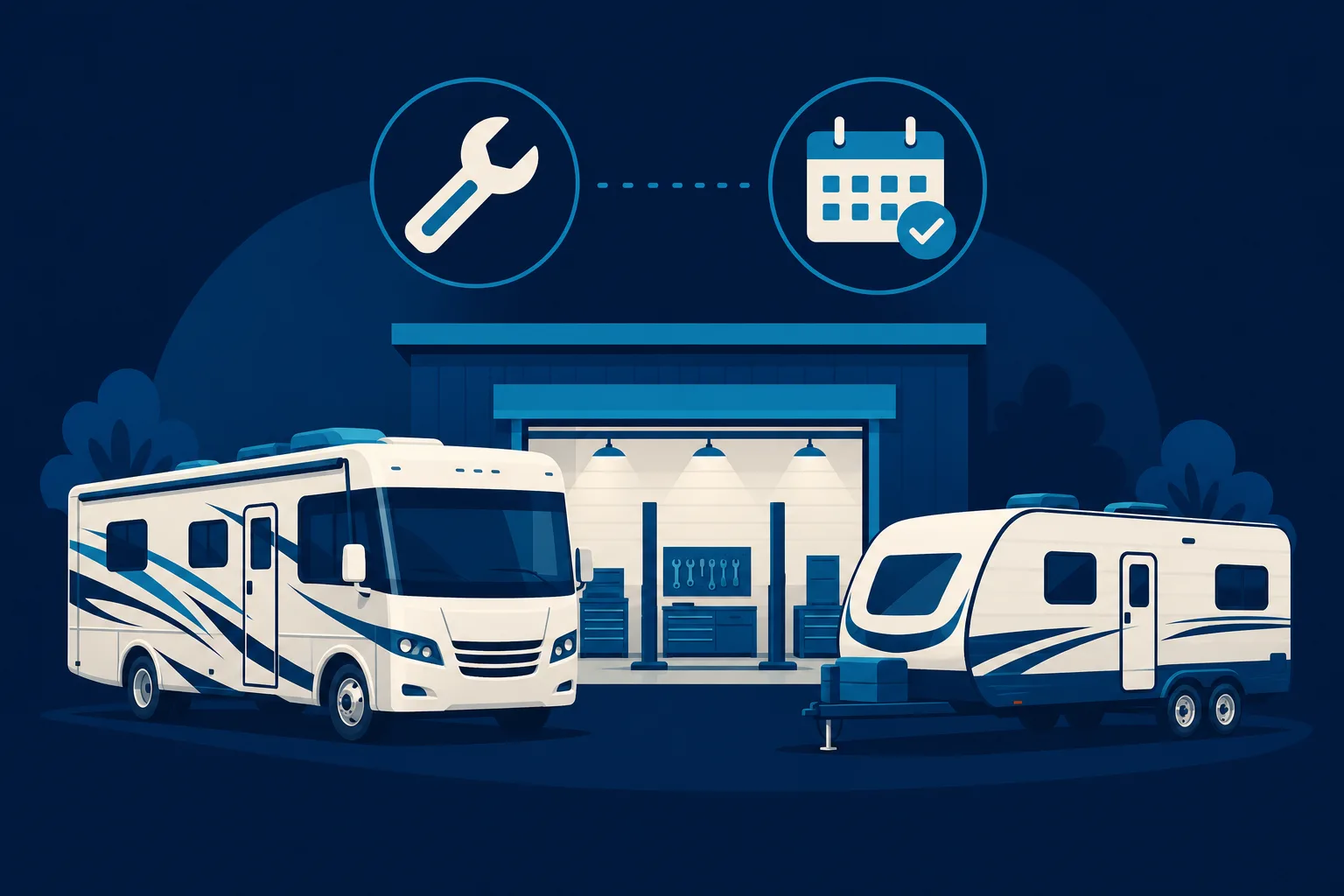
If you fix RVs, you already know the season runs you. From April to about October the phone will not stop, and you are turning away work you could have taken. Then November hits, the campers get winterized and parked, and suddenly you have open bays and quiet phones. A good website will not flatten that curve completely, but it can smooth it a lot. It can capture the summer overflow so you book it instead of losing it, and it can keep the winterizing and storage-prep work coming in when things slow down.
This is a practical guide to building a website for an RV repair shop that actually books service, not just a pretty online brochure. Whether you run a fixed shop with bays, a mobile rig that drives to the campsite, or both, the goal is the same: a stranger whose slide-out just quit finds you, trusts you in about ten seconds, and gets on your schedule without playing phone tag.
What an RV owner is actually thinking when they search
An RV owner searching for repair is rarely relaxed. They fall into a few very different mindsets, and your site has to speak to all of them:
- Stranded and panicking. The furnace died at 20 degrees, or the fridge stopped cooling on day one of a two-week trip. They are searching from their phone, in a campground, and they need to know right now whether you can come to them or how fast you can get them in.
- Snowbird on a schedule. They are passing through your area for a few weeks and something needs fixing before the next leg. They cannot wait three weeks for an appointment.
- Pre-trip prepper. It is March. They want the roof resealed, the brakes checked, and the appliances tested before the first big trip so nothing fails on the road.
- Insurance or warranty claim. They had a blowout, a tree branch, or a hailstorm, and they need someone who works with adjusters and knows the paperwork.
Notice how different these are. A tire shop customer wants speed and a price. Your customer wants to know you understand their specific rig and their specific fear: being broken down far from home. Build the site around that.
The pages that matter for an RV service shop
You do not need twenty pages. You need a handful that answer the real questions.
- Home. In the first screen a visitor should see what you fix, whether you come to them or they come to you, the area you cover, and one obvious button to book or request service. Do not make them scroll to figure out if they are even in the right place.
- Services. Break it out by system, because RV owners think in systems: slide-outs, awnings, roof and leak repair, appliances (fridge, furnace, water heater, AC), electrical and converters, plumbing and holding tanks, brakes and bearings, and winterizing. When someone with a busted slide sees "slide-out repair" spelled out, they relax.
- Mobile service area. If you drive to campsites, driveways, and storage lots, say exactly where. List the campgrounds, counties, and towns you cover, and be honest about a travel-fee radius. Vague coverage areas kill mobile bookings.
- RV types you work on. Class A, Class C, travel trailers, fifth wheels, truck campers, pop-ups. And critically, whether you touch motorized chassis work or strictly the "house" side. Owners want to know you have seen their kind of rig before.
- Book service / Request appointment. The heart of the site. More on this below.
- About. Who you are, your certifications, how long you have been doing this. RV owners are handing you a home on wheels worth more than most cars. Trust matters more here than in almost any other trade.
You do not need a blog or a sprawling gallery to start. You need these pages doing their job.
Build the booking around how RV repair really works
Here is where most RV shop websites fail. They slap a generic "contact us" form on the site and call it booking. That does not work for RV service, because you cannot promise a slot until you know what is wrong and where the rig is.
A booking flow that fits this trade asks the right things up front:
- What is the problem? A short description plus the system involved. "Slide-out stuck open" tells you more than "need service."
- What is the RV? Type, year, make, and length. A 40-foot Class A is a different job than a pop-up.
- Where is it? Coming to your bay, or parked at a campground, driveway, or storage lot for mobile service. If mobile, the address or campground name and site number.
- How urgent? Stranded and cannot travel, versus a routine pre-trip checkup. This lets you triage.
- Photos. Let them attach a picture of the leak, the error code, or the broken awning arm. One photo can save a whole phone call and help you bring the right parts.
That last point is the difference between a wasted trip and a first-visit fix, and it is worth building for. When the request lands in your inbox with a photo and a location, you can quote a realistic window instead of guessing.
If you would rather not build all of that from scratch, a done-for-you option like Saynovo can stand up a working RV service site with a booking flow tuned to your systems, your coverage area, and your rig types, so the request that reaches you is already useful.
Make the seasonal swing work for you
Your website is one of the few tools that lets you shape demand instead of just riding it. The trick is to change what the site pushes depending on the time of year.
- Spring (the rush is coming). Lead with pre-trip inspections, roof reseals, brake and bearing service, and appliance checkups. Owners who book maintenance in March are your best customers because they are not panicking, and the work is schedulable.
- Summer (you are slammed). This is when the emergency and mobile traffic spikes. Make the "stranded" path obvious and set expectations honestly about wait times so people book instead of bouncing to the next shop. If your bays are full, push mobile, and vice versa.
- Fall (winterizing). This is your bridge into the slow season. Promote winterizing packages, storage prep, and battery care early, before the first freeze, so you fill October and November.
- Winter (bays are open). Push the bigger jobs that owners put off during travel season: full slide-out rebuilds, floor and delamination repair, interior remodels, insurance and hail work. These are exactly the jobs that need an RV parked and off the road for a week, which is only realistic when nobody is using it.
When you can update the site's message yourself in seconds, you actually keep up with the seasons instead of leaving last spring's banner up in December. That is the real reason to care how easy your site is to edit. This is where Saynovo's approach fits an RV shop unusually well: you change the site by talking to it, so swapping the homepage from "book your summer emergency repair" to "reserve your winterizing slot" is a spoken sentence, not a support ticket or a call to a web guy who takes three days.
Prove you can be trusted with someone's home on wheels
RV owners are cautious for a good reason. A bad repair can strand them, cause a leak that rots the floor, or total the rig. Your website has to lower that fear fast.
- Show real work. Photos of actual repairs in your bay or at a campsite beat stock images of shiny motorhomes. A resealed roof, a rebuilt slide, a diagnosed electrical panel. Owners recognize their own problems in those pictures.
- Name your certifications. If you are RVIA or RVDA certified, or your techs hold specific manufacturer or appliance certifications, put it front and center. This is a field where credentials genuinely reassure.
- Be clear about warranty and insurance. Say whether you handle extended-warranty claims and insurance work, and whether you deal directly with adjusters. This alone wins the customer who just had a blowout or storm damage.
- Reviews that mention the fear and the fix. The most persuasive review is not "great service." It is "furnace died on a trip, they came to our campsite the next morning and had us warm by lunch." Pull those forward.
- Set honest expectations. Parts for RVs can take time. Saying so up front builds more trust than a promise you cannot keep, and it filters out the customer who expects same-day on a discontinued fridge board.
Get found by the owner who is broken down near you
Ranking for RV repair is very winnable because it is local and specific. A few things move the needle more than anything fancy:
- Claim and fill out your Google Business Profile. For a lot of stranded searches this is the first thing an owner sees. Hours, service area, photos, and reviews on that profile do heavy lifting. If your website matches it and reinforces it, you look legitimate.
- Use the words owners actually type. "Mobile RV repair near me," "RV slide-out repair," "camper furnace repair," "RV roof leak," plus your town and the campgrounds you serve. Put these naturally in your service pages, not stuffed into a wall of text.
- List your real coverage. Naming the campgrounds, state parks, and towns you serve helps you show up for the traveler searching from exactly those places.
- Load fast and work on a phone. Your customer is on a weak campground signal, on a cracked phone, in a hurry. If the page is slow or the buttons are tiny, they are gone. Mobile-first is not optional in this trade.
You do not need to become an SEO expert. You need a site that is fast, clearly local, honest about what you do, and pointed at a Google Business Profile you keep current.
Which path is right for your shop
Be honest with yourself about how much you want to touch a website.
- If you love tinkering and have the time, a do-it-yourself builder like Wix or Squarespace can get you online. Just budget real hours to make the booking flow actually fit RV work, because the default templates will not.
- If you want deep control and plan to add a lot over time, WordPress is flexible, but it needs upkeep, plugins, and someone to keep it from breaking.
- If you would rather fix RVs than fight software, a done-for-you route makes more sense. That could be a hands-on local agency, the fully-managed SyntroAI option if you want humans running everything, or a platform like Saynovo that builds the site for you and then lets you keep it current just by telling it what to change.
There is no shame in any of these. The wrong choice is the one that leaves you with a half-built site you never finish, or one you cannot update when the season turns.
Your next step
Pick the one thing that is costing you bookings right now. For most RV shops it is that the phone is the only way in, so summer overflow and after-hours strandeds just vanish. Fix that first: get a simple, fast site up with a booking request that captures the problem, the rig, the location, and a photo, and point your Google Business Profile at it.
If you want the fastest way to see what that could look like for your shop, start by importing your existing Google Business Profile so the site is generated around your real hours, photos, and reviews, then say the rest: the systems you service, the rig lengths you can take, and how far you travel. From there you can shape it around your systems and your season, and get back to the bays.