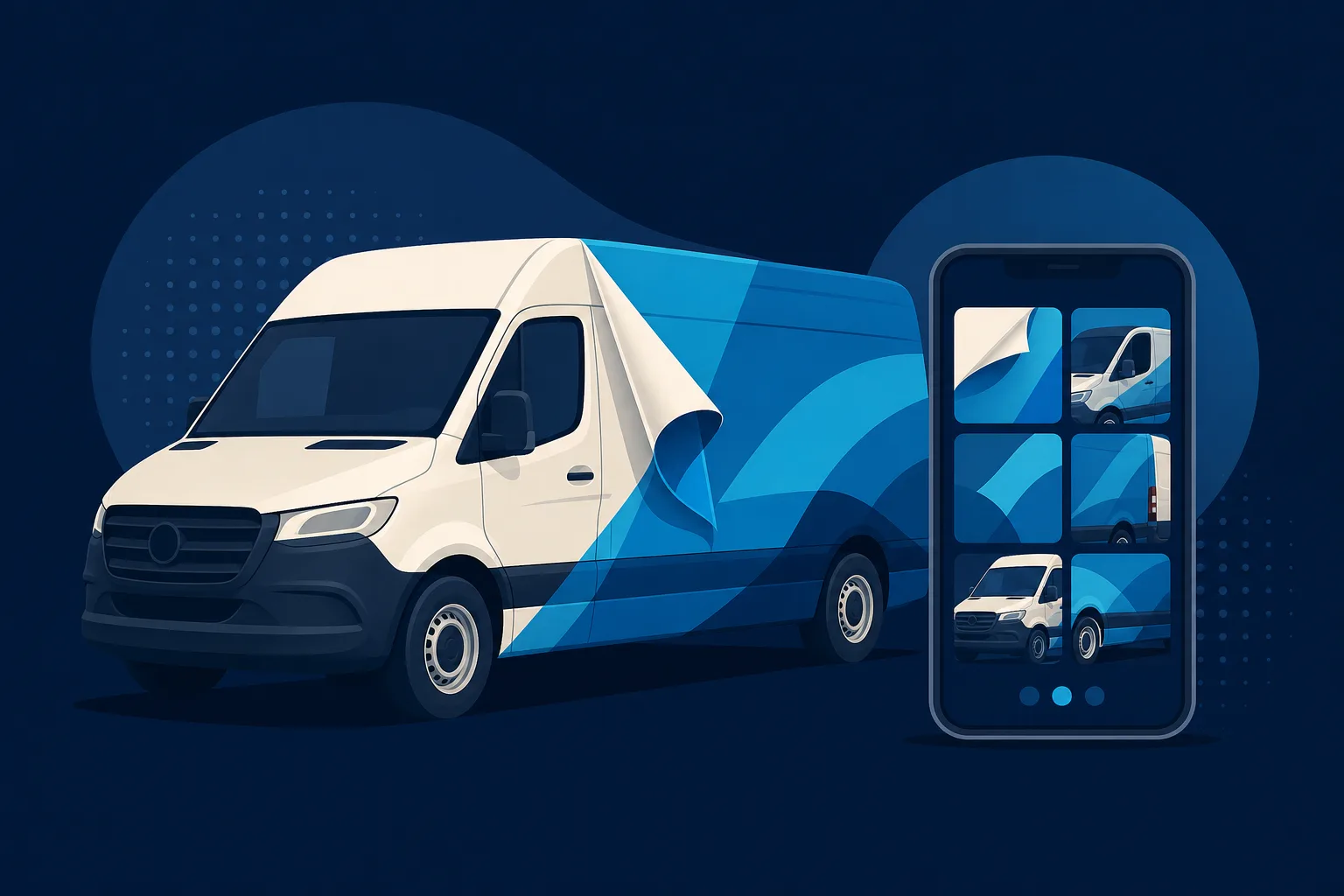
Your work is visual. That is the whole business. A color-change wrap on a GT-R, a full fleet of plumbing vans that match down to the door handle, a chrome delete that makes a truck look like it costs twice as much. People decide whether to hire you in about four seconds of looking at photos. And yet most wrap shops send those photos to die inside an Instagram grid, while their actual website is a stale one-pager that says "we do wraps, call us."
This is a guide to building a website for a vehicle wrap shop that does the opposite: shows the work at full strength, tells a fleet manager and a car enthusiast apart, and turns a curious visitor into a booked project on a lift. No web design degree required, and no jargon.
Why a wrap shop needs more than an Instagram grid
Instagram is a great scrapbook and a terrible salesperson. A fleet manager comparing three shops for a 12-van rollout is not going to scroll your feed for twenty minutes trying to guess whether you can handle the job. He wants a real page he can send to his boss, with your business name, your process, and a way to request a quote that does not involve DMing a stranger.
A website does three things a social feed cannot:
- It shows up when someone Googles "vehicle wrap shop near me" or "fleet wrap [your city]." Instagram almost never ranks for that.
- It lets you organize work by type so a buyer finds the exact thing they came for instead of everything you have ever posted.
- It captures a quote request with the details you actually need, so the first phone call is about scheduling, not twenty questions.
You do not need a huge site. You need five or six pages that do their jobs well.
Know your two buyers before you build anything
Here is the mistake that sinks most wrap shop websites: they are built for one customer when the shop serves two completely different people who want completely different things.
The personal / enthusiast buyer wants a color-change wrap, a satin finish, accent stripes, a chrome delete, or a full custom design on their own car or bike. This person is emotional and detail-driven. They care about the exact finish, whether you can do the mirror caps and door jambs, and how it will look in the sun. They are shopping the vibe of your shop as much as the price.
The commercial / fleet buyer wants vans, box trucks, or a whole fleet wrapped with their branding. This person is practical and deadline-driven. They care about turnaround time, whether you can do all the vehicles without pulling their crews off the road for a week, whether the design will match their brand, and how long the vinyl lasts before it fades. Price matters, but downtime matters more.
If your site speaks only to one, the other bounces. The fix is not two websites. It is a homepage that clearly points to two paths early, something as simple as "Personal vehicle" and "Business and fleet," so each buyer feels like the shop is built for them.
The portfolio is the whole website, so treat it that way
Everything else is supporting cast. In this business the portfolio is the store. Build it like one.
Split it by wrap type, not by date. A random stream of "recent work" forces the visitor to hunt. Give them named categories they can jump straight to:
- Color-change and full wraps
- Commercial and fleet wraps
- Partial wraps, accents, and racing stripes
- Chrome delete and trim
- Specialty (boats, trailers, equipment, storefronts if you do them)
Show the whole vehicle, more than one angle. A wrap looks different from the front three-quarter, the side, and the rear. One hero shot plus two or three angles beats a single glamour photo, because it answers "will it look good from every side" before the buyer has to ask.
Add before-and-after for the ones that transform. A tired white work van next to the finished branded version sells the fleet buyer instantly. A faded factory paint next to a fresh satin wrap sells the enthusiast.
Caption with the details that matter. Not a paragraph, just the facts a buyer wants: vehicle, wrap type, film brand and finish, and one line on what made it tricky if it was. "2022 Sprinter, full commercial wrap, cast vinyl, printed and laminated, wrapped around the rear doors and roof spoiler." That caption quietly tells a fleet manager you know what you are doing.
Keep the images sharp and let them load fast. Nobody waits on a slow gallery, and heavy uncompressed photos are the most common thing dragging a wrap site down.
Build a quote form that filters, not just collects
"Call us for a quote" throws away leads while you are on a lift with a heat gun. But a lazy contact form is almost as bad, because you get "how much for a wrap?" with zero context and have to play detective. Design the quote request to do the qualifying for you.
Ask for the few things that actually change the price and the plan:
- Vehicle year, make, and model (or "fleet" plus how many vehicles)
- What they want: color change, full print wrap, partial, chrome delete, or "not sure yet"
- Personal or business
- Timeline: this month, next few months, or just researching
- Photos of the vehicle if they have them
- Best way to reach them
That last group matters more than it looks. Timeline separates the person ready to book from the tire-kicker. Photos let you spot a vehicle with rust, peeling paint, or aftermarket panels that change everything before you quote. And "not sure yet" is a gift, because it is a hot lead who wants you to guide them.
One more thing: tell them what happens next. A single line under the button such as "We will review your details and send a ballpark within one business day" removes the fear of getting spammed and gets more people to hit submit.
The pages that earn their place
You do not need fifteen pages. You need these, each doing one job.
Home. Your single best wrap as the hero image, one clear sentence on what you do and where, and the two paths (personal and fleet) within the first screen. A prominent quote button. That is it.
Portfolio. The categorized gallery above. This is the page people will spend the most time on, so make it the easiest to browse.
Services. Plain descriptions of what you offer and, just as important, what is involved. Explain the difference between a color-change wrap and a printed wrap. Mention design help if you offer it. Note whether you handle removal of old wraps. Buyers who understand the process trust you more and haggle less.
Fleet. A dedicated page for commercial buyers is worth its weight in booked vans. Speak to their world: consistent branding across every vehicle, staged scheduling so their whole fleet is not off the road at once, design that matches their logo and colors, and film that holds up to daily driving and washing. This page is what a fleet manager forwards to a decision-maker.
About. Who runs the shop, how long you have been wrapping, your certifications or preferred film brands, and a real photo of the bay and the team. Wrapping is a craft and buyers are trusting you with a vehicle they care about. Faces build that trust.
Contact and quote. The form, your address with a map, hours, and phone. Make the address obvious. People want to know they can come see the shop and touch a sample.
Show that the wrap will last
The quiet objection in every wrap sale is "how long before this peels, bubbles, or fades and I regret it." You do not need to write an essay, but address it somewhere on the services or fleet page.
Talk about the film you use and why, whether you laminate printed wraps for UV protection, roughly how long a quality wrap lasts with normal care, and any warranty you or the film brand stands behind. Add a short care note: hand wash, avoid automatic brushes, park in shade when you can. This does two things. It reassures the buyer, and it sets expectations so you get fewer "my wrap is peeling" calls on a truck that lived through a hailstorm and a pressure washer.
Get found by the people searching right now
Ranking on Google for a wrap shop is not mysterious. It comes down to being clear about what you do and where, and backing it up.
- Put your city and the areas you serve in your page text, naturally, not stuffed. "Fleet and personal vehicle wraps in [city] and the surrounding metro."
- Claim and fill out your Google Business Profile completely, with your best portfolio photos, hours, and services. For a lot of wrap shops this profile shows up before the website does, so a strong one is not optional.
- Ask happy customers to leave a review that mentions what you wrapped. "They did a full color change on my Tesla" is worth more than five generic stars, because it matches what future buyers search.
- Keep the site fast and readable on a phone, since most people find you on one.
Consistency between your website, your Google profile, and your social feeds tells Google you are a real, established shop, and that is half the battle in a local search.
Two ways to actually get this built
You have real options here, and the honest answer depends on how much you want to touch it.
If you enjoy the design side and have time on slow weeks, a DIY builder like Squarespace or Wix can look sharp for a wrap shop, and their galleries are genuinely good for showing photos. Just budget the hours, because your work is on lifts, not laptops. If you want something highly custom with heavy design tooling, an agency or a WordPress developer can build exactly what you picture, for more money and a longer wait.
If you would rather your shop just showed up online without you learning web software, this is where a done-for-you option earns its keep. Saynovo builds an agency-quality wrap shop website for you, and the part that fits this business best is how you change it: you talk to the site. When you finish a jaw-dropping build and want it front and center, you just say "make the blue Sprinter fleet wrap the main photo on the homepage," and it changes. No dragging boxes around at midnight.
That talk-to-edit approach matters more for a wrap shop than most trades, because your portfolio is never finished. Every week there is a new project worth showing, and a site you can update by talking to it is a site that actually stays current. Saynovo's free first version is generated around your existing Google Business Profile, so you can see your shop as a real website before deciding anything. Your wrap portfolio, your material warranties, and your quote questions were never on Google, so you say those and they get built in. And because the parent company, SyntroAI, is a full agency, there is a path to more custom work later if the business grows into it.
Your next step
Do not try to build the whole thing tonight. Do one thing: gather your ten best wraps, mixed between personal and fleet, with a couple of angles each and a one-line caption on the film and finish. That single folder is 80 percent of what makes a wrap shop website book projects. Whether you build it yourself, hire it out, or let Saynovo generate a real site around your Google profile and say the rest, the shop with the strongest, clearest portfolio and an easy quote request is the one that ends up with the truck on the lift.