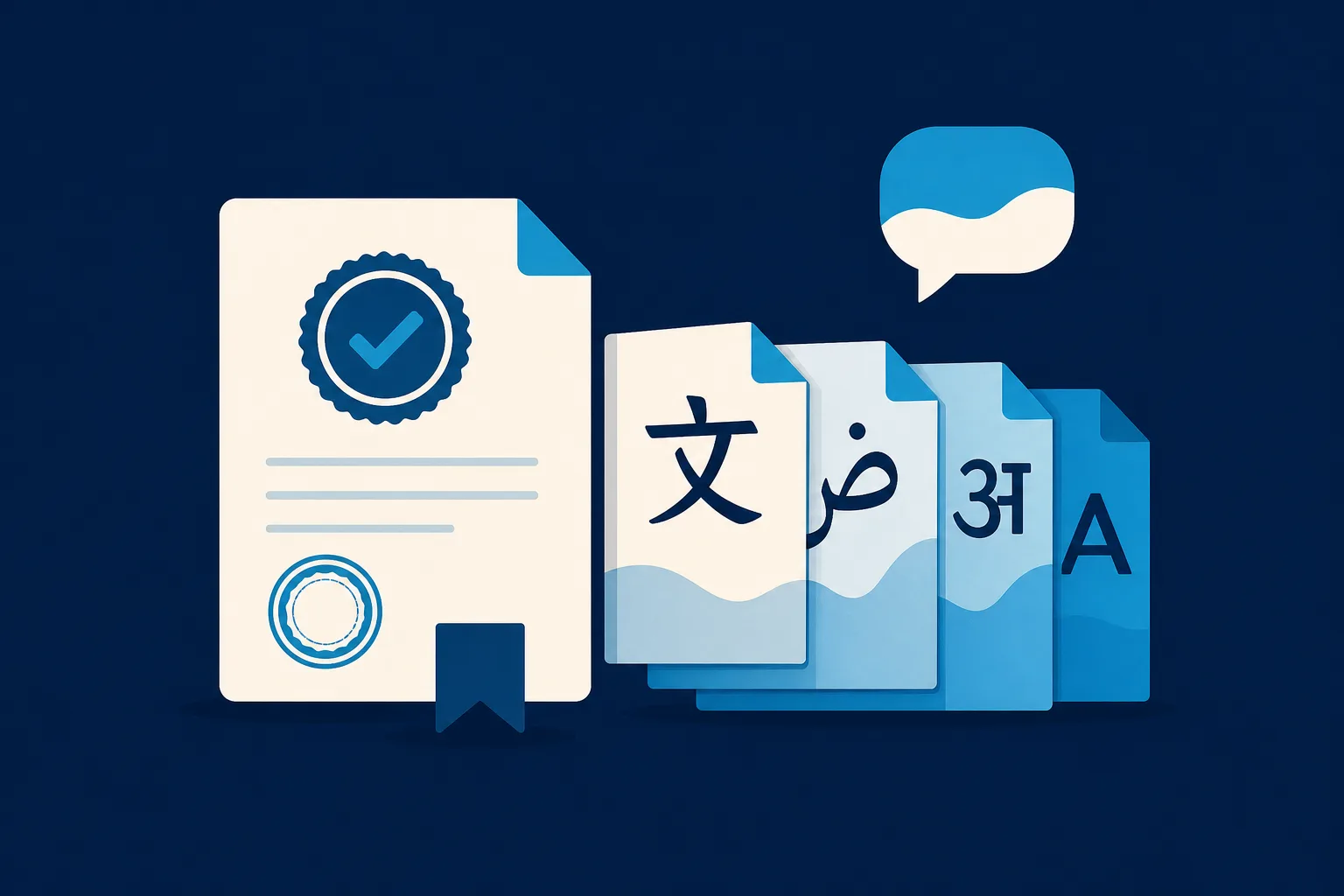
When someone needs a birth certificate translated for a green card interview, or a contract translated before a deal closes, they are not browsing. They are worried, on a deadline, and typing something like "certified Spanish translation near me" into their phone. If your translation service has no website, or a website that does not clearly say you handle exactly their situation, they hit the back button and land on a national brand that answers the question in one screen.
This guide walks through how to build a website for a translation service that does one job well: it names your languages, proves your work is accepted where it needs to be accepted, and makes it dead simple to send you a document and get a quote back. That is the whole game. Everything else is decoration.
Understand who is actually on your site
Translation buyers are not one crowd. Before you write a single line, picture the three people who land on your page, because they want different things and your site has to speak to all three without confusing any of them.
- The individual with one urgent document. A diploma, a marriage certificate, a driver's license, medical records. They need a certified translation for USCIS, a court, a university, or an employer. They care about two things: will it be accepted, and how fast can I get it. Price matters, but acceptance and speed matter more.
- The small business or law firm with ongoing work. Immigration attorneys, HR departments, medical clinics, freight companies. They send documents regularly and want a reliable partner, not a one-off vendor. They care about turnaround, confidentiality, and whether you can handle their specialty (legal, medical, technical).
- The price shopper comparing five tabs. They will fill out quote forms on several sites at once. You win this person by being the fastest and clearest to respond, not the cheapest.
Your website has to let the urgent individual self-qualify in seconds while giving the repeat business buyer enough proof to trust you with a stack of files. Keep both in mind as you build every page below.
Lead with the languages and specialties you actually serve
The single most common mistake on a translation website is being vague about languages. A visitor who needs Haitian Creole does not want to read "we translate all major world languages." They want to see the words Haitian Creole on the screen, because that tells them you are not going to farm their job out or turn it away.
Put your language pairs where nobody can miss them. Not buried in a paragraph, but as a clean, scannable list near the top of your home page and again on a dedicated languages page:
- The specific languages you translate to and from, named individually (Spanish, Portuguese, Mandarin, Arabic, Vietnamese, Russian, and so on).
- Your specialties, because a legal translator and a medical translator are not interchangeable. Call out the categories you handle: immigration and USCIS documents, legal and court filings, medical records, business and financial, academic transcripts, technical manuals.
- Any language pairs where you are especially strong or hard to find locally. If you are one of the few people in your city doing certified Farsi or Amharic, say so loudly. That is your edge.
If you take a document type you do not translate yourself and route it to a trusted partner, be honest about that too. Overpromising every language on earth reads as a red flag to anyone who has been burned before.
Make certified translation the centerpiece
For a huge share of your visitors, the word that matters most is "certified." But most owners never explain what that means, and the gap costs them projects. A worried applicant does not know the difference between a certified translation, a notarized translation, and a sworn translation. Your site should quietly teach them, because the business that explains the process is the business that gets trusted.
Create a page or a strong section that answers the questions running through their head:
- What a certified translation is in plain words: a complete, accurate translation with a signed statement attesting to its accuracy, which is what USCIS, courts, and universities require.
- Where your certified translations are accepted. Name the destinations that matter: USCIS and immigration, state and federal courts, universities and evaluation agencies, the DMV, employers. Specificity here is trust.
- The difference between certified and notarized, so someone who was told they need a notarized copy knows whether you can help.
- A plain-English acceptance promise. Something like: if a document we certify is rejected for translation reasons, we fix it. That single line removes the biggest fear a first-time buyer has.
This is also where testimonials earn their keep. A two-line quote from someone whose USCIS case went through, or an attorney who uses you for every filing, does more than any adjective you could write about yourself.
Build the quote request around a document upload
Here is the truth about a translation website: the quote request IS the booking. Nobody pays for translation without knowing the count, and you cannot count without seeing the document. So the entire site should funnel toward one action - upload your file, get a quote. Make that button impossible to lose, put it in the header and at the bottom of every page, and keep the form itself short.
A quote request that converts asks only what you truly need to price the job:
- Upload the document. Let people attach a photo, PDF, or scan right from their phone. This is the whole point. A form that makes someone type out details instead of uploading loses the urgent buyer.
- Source and target language. From what, into what.
- What it is for. A simple dropdown - USCIS or immigration, court, university, business, personal - so you know whether it needs certification.
- How fast they need it. Standard or rush.
- Name, email, phone. That is enough.
Every extra field is a person lost. If you are asking for a mailing address or a company tax ID before you have even quoted the job, you are filtering out the exact people who were ready to buy. And reassure them right on the form: their documents are confidential, and you delete or secure files after the job. People are handing you passports and medical records. Say the words that let them do it comfortably.
One more thing that matters more here than in almost any other trade: response speed. Because your buyer is often filling out three quote forms at once, the first clear reply frequently wins. Consider adding a line that sets the expectation - "quotes back within a few business hours" - and then actually beat it.
Answer the objections that stall the sale
Between landing on your site and hitting submit, a translation buyer runs through a short list of worries. Answer each one on the page and you remove the friction that sends them elsewhere.
- "Will this actually be accepted?" Your certified section and your acceptance promise handle this. Reinforce it near the quote button.
- "How much will it cost?" You cannot always give a flat number, but you can explain how pricing works - typically per page or per word - so the number that comes back does not feel like a surprise. Naming the logic builds trust even without a figure.
- "How fast can I get it?" State typical turnaround for standard documents and confirm that rush service exists. Deadlines drive most urgent jobs.
- "Is my private information safe?" Confidentiality is a real objection, not a nice-to-have, when the file is a divorce decree or medical history. Address it plainly.
- "Are you real and local?" A phone number, a real service area, a photo of you or your team, and reviews from named clients turn an anonymous form into a trustworthy person.
Get found for the exact searches your buyers type
Most of your future customers are searching with very specific phrases, and those specific phrases are where a small, focused translation service can beat the national sites. Someone rarely searches "translation." They search "certified marriage certificate translation for USCIS" or "legal document translation [your city]" or "Portuguese to English certified translation."
You capture that traffic by building pages around the real jobs people search for:
- A page per major service - certified document translation, immigration document translation, legal translation, medical translation.
- A page per high-demand language pair if those searches matter in your market.
- A short, honest FAQ that answers the acceptance, cost, turnaround, and confidentiality questions in the words people actually use. Search engines reward pages that answer the question directly, and so do readers.
Claim and fill out your Google Business Profile too. When someone searches for translation near them, that profile - with your languages, your hours, your reviews, and a link to your quote form - is often the first thing they see and the fastest path to a booked project.
Keep it current without it becoming a second job
A translation site is not "set it and forget it." You add a language, you start handling a new document type, USCIS changes a requirement, you want a seasonal note about tax-season financial translations or back-to-school transcript rushes. The problem is that most owners let those updates pile up because editing a website means wrestling with a builder or waiting on a freelancer.
This is exactly where a done-for-you approach earns its place. Saynovo builds your translation website for you, and instead of logging into a dashboard to change it, you just say what you want - "add Ukrainian to the languages list" or "put the USCIS acceptance promise at the top of the certified page" - and it changes. For an owner who would rather be translating than fiddling with web software, that is the difference between a site that stays accurate and one that quietly goes stale.
If you would rather build and maintain it yourself, that is a real option too - Wix and Squarespace can carry a simple translation site, and a hands-on agency makes sense if you want full custom control. Be honest with yourself about which owner you are. The best website is the one that actually gets updated.
Your next step
You do not need a big site. You need a clear one: your languages named, your certified work proven and accepted, and a quote form that turns an uploaded document into a project. Start there.
Gather the pieces this week - your language list, your specialties, the document types you certify, two or three client quotes, and the confidentiality promise you can stand behind. If you already have a Google Business Profile, Saynovo can import it and generate a first version of your translation website around it for free. Your language list and your certification were never on that profile, so you say those, then see them and your quote request live before you commit to anything. Get the front door open, make it easy to send you a file, and let the projects come to you.