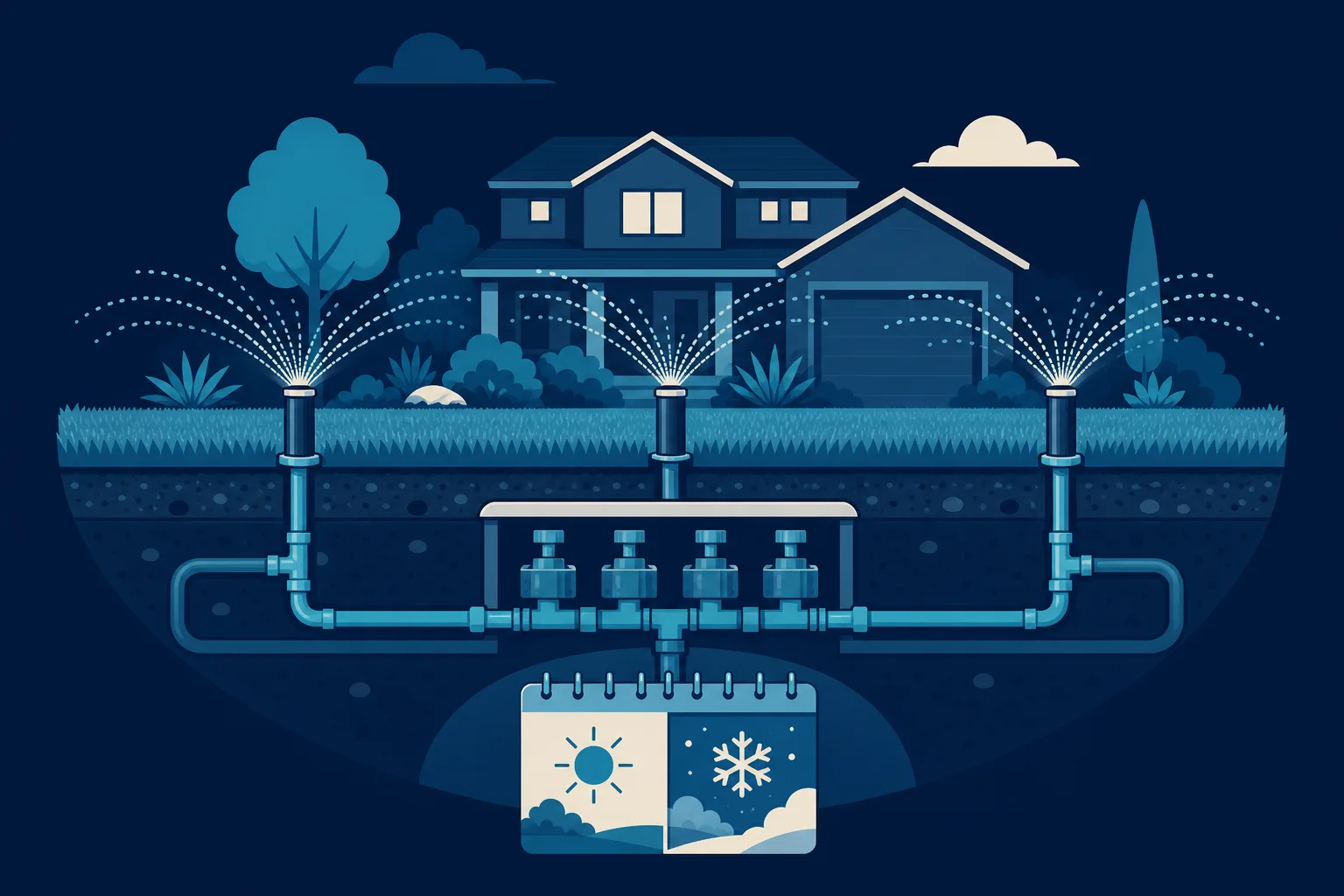
Most trades sell one thing over and over. You sell three, and they arrive in waves. In spring, phones ring for startups and repairs. Through summer, it is broken heads, stuck valves, and dry patches in the lawn. Then fall hits and everyone remembers, all at once, that a frozen pipe can crack a backflow preventer and flood a basement.
A website for a sprinkler and irrigation business has to do something a plumber's site never has to worry about: it has to sell the same customer twice a year, every year, and it has to be ready before the rush instead of during it. If your site treats you like a generic "lawn guy," you lose the exact thing that makes irrigation a great business: the same faces coming back every March and every October.
This guide walks through a site built around your real calendar, so it books jobs in both windows and turns one-time callers into customers you keep for a decade.
Split your site into install, repair, and seasonal from the first click
Someone whose sprinklers won't turn on in April and someone pricing a brand-new system for a bare yard are two completely different buyers. If they land on the same vague homepage, both feel like they are in the wrong place.
Give each of your three jobs its own clear path:
- New system installation. This is a considered purchase. The visitor wants to see finished yards, understand zones and coverage, and get a sense of what a design looks like before they call. They will read more and take longer to decide.
- Repair and troubleshooting. This is urgent and annoyed. A head is spraying the driveway, a zone is dead, or water is pooling. This visitor wants to know you fix exactly their problem and can come soon. They will not read three paragraphs.
- Seasonal startup and winterization. This is routine and calendar-driven. They are not shopping. They just want it on the schedule before it matters.
On your homepage, three plain buttons or cards beat one long wall of text: "New Sprinkler System," "Repairs and Adjustments," and "Startup and Winterization." A first-time visitor should know in two seconds which one is them, and reach the right page in one tap.
Say what "repair" actually means
"Irrigation repair" is invisible to a worried homeowner. They do not know the vocabulary. They know the symptom. List the symptoms in their words:
- One zone won't come on
- Sprinkler head is broken, tilted, or spraying the wrong way
- Water pooling or a soggy spot that won't dry
- System runs but the lawn is going brown
- Controller or timer is blank or acting up
- Backflow preventer is leaking or failed its test
When your page names the exact thing happening in their yard, they feel understood before they even call. That feeling is what makes them dial you instead of the next result.
Make the seasonal windows the spine of the whole site
Two short windows drive the majority of the year for most irrigation companies. Spring startup runs as the ground thaws and people want the system woken up. Fall winterization runs before the first hard freeze, when a forgotten blowout turns into an expensive crack. Your website should not treat these as afterthought services buried at the bottom of a menu. They are the heartbeat.
Build a real page for each one that answers the questions people actually type at 9pm:
- Startup: What does a spring startup include? Do you check every zone and adjust the heads? Do you find winter damage? How soon can you come out?
- Winterization: Why does a system need to be blown out? What happens if I skip it? When is the last safe week in my area? What does a blowout cost roughly, and how long does it take?
Answer those in plain language and you have done two things at once: you have helped someone who has never hired an irrigation company before, and you have shown Google that your site is genuinely about spring startups and fall blowouts in your town. That is how you get found when the searches spike.
Put a dated seasonal banner on the homepage
Because demand is so tied to the calendar, a single line at the top of your homepage does real work. In February and March: "Spring startups are booking now - reserve your week." In September and October: "Winterization is filling up - schedule your blowout before the first freeze." It creates urgency that is honest, because the freeze really is coming, and it tells a repeat customer they are in the right place and it is time.
Turn the booking form into a dispatch tool, not a suggestion box
A "Contact Us" box that only asks for a name and message wastes the visit. For irrigation, the form should collect what you need to actually schedule and price the visit:
- Which service: new install, repair, startup, or winterization
- Property address or at least the neighborhood, so you know it is in your route
- Number of zones if they know it, or "not sure" as an option
- Controller brand if it is a repair, since it hints at the fix
- Best window: this week, this month, or a specific date
- A spot to describe the problem, and to upload a phone photo of the leaking head or the flooded spot
A photo of a cracked backflow or a geyser head lets you quote and dispatch without a second trip. That is the difference between a lead and a booked job.
And keep the phone loud. In a repair panic, plenty of homeowners will not fill out a form at all. A tap-to-call button that follows them down the page on mobile catches the person who just wants to talk to a human right now.
Sell the service plan as the reason to build the site at all
Here is the part most irrigation sites miss, and the part that changes your business more than any other. The most valuable thing you can offer is not a single startup. It is a plan that bundles spring startup, a mid-season check, and fall winterization into one signup, so the customer never has to remember and you never have to chase them.
Your website is where that plan gets sold, because a plan is a promise and a webpage is where people compare promises. Give it a dedicated page that lays out plainly:
- What is included across the year (startup, one summer tune-up, winterization)
- That it locks in their spot before the seasonal rushes fill up
- That they get first priority on repairs during the busy weeks
- That they never get a surprise frozen pipe because the blowout is automatic
The single best moment to enroll someone is right after a new install or a repair, when the system is fresh in their mind and they trust you. A short line on your install and repair pages - "Ask about our year-round care plan so you never think about this again" - plants it. The plan page closes it.
A recurring plan is what turns an irrigation business from a stressful scramble twice a year into a predictable book of customers who renew. The website is the tool that sells and holds that promise.
Prove you know the system, not just the lawn
Irrigation buyers worry about specific, expensive things: a botched backflow test, someone who does not pull a required permit, a "repair" that just kicks the problem down the road. Your site should quietly answer those worries.
- Show real yards and real fixes. A before-and-after of a brown, patchy lawn next to a green, evenly watered one says more than any paragraph. So does a photo of a clean valve manifold you rebuilt.
- Name your credentials. If your state or city requires a backflow tester certification or an irrigation contractor license, say so, with the number. First-time buyers do not know they should ask, and seeing it removes a doubt they could not name.
- Be specific about equipment. Mentioning the controllers, valves, and smart timers you install and service tells a knowledgeable homeowner you are a real irrigation specialist, not a mow-and-blow crew adding sprinklers on the side.
- Reviews that mention the season help most. A review that says "came out the day my zone died in July" or "reminded me to winterize and saved my backflow" does more than a generic five stars, because it matches the moment the next reader is living in.
Make every town you serve a reason to be found
Irrigation is hyper-local. You drive a route, and a job forty minutes away in the wrong direction is not worth it. Your website should make your actual service area obvious, both to customers and to Google.
If you cover several towns or suburbs, a short, honest page for each one - what you do there, a job or two you have done nearby, the local watering restrictions or freeze timing that apply - helps you show up when someone in that town searches. Do not spin up empty pages for towns you would never drive to. A handful of real, specific area pages beats a fake list of thirty.
Tie the site to your Google Business Profile too. When someone searches "sprinkler repair near me," the map results often show before the regular links, and a complete profile that points to a matching website is what earns the click and the call.
Get it live before the season, not during it
The cruel timing of irrigation is that the moment you desperately need a website is the exact moment you have zero hours to build one, because you are already slammed with startups or blowouts. The fix is to have it ready in the quiet weeks between the two seasons.
If you already have a Google Business Profile with your name, service area, and photos, you are closer than you think. That profile is enough to stand up a first version of your site quickly, without you writing a word from a blank page.
This is where a done-for-you approach fits a working irrigation contractor better than a weekend spent fighting a page builder. Saynovo can generate a real, agency-quality site around your existing Google Business Profile, with the homepage, install and repair pages, startup and winterization pages, and a service-plan page all laid out, as a first version you can react to instead of create from nothing. Your seasonal windows and your plan pricing were never on Google, so you say those and they fill in.
Then, when you notice the part that only a season in the field teaches you, you change it by talking to the site. When spring startups open, you say "add a banner that we are booking spring startups now," and it changes. When the first freeze forecast lands, you say "put the winterization deadline at the top of the homepage," and it changes. No ticket, no waiting, no logging into a dashboard between service calls. For an owner who would rather be blowing out lines than fiddling with web software, that is the whole point.
Your next step
You do not need to build the whole thing today. Pick the single window that is closest on the calendar - the next spring startup rush or the next fall winterization - and make sure your site does three things for it: names the service in the words a worried homeowner uses, shows a dated banner that it is booking now, and offers a booking form that captures the address, the zones, and a photo.
Nail that one season, add the service plan so those callers become customers you keep, and the second window takes care of itself. An irrigation website that respects your calendar does not just get you found. It fills both rushes and keeps the same yards on your route year after year.