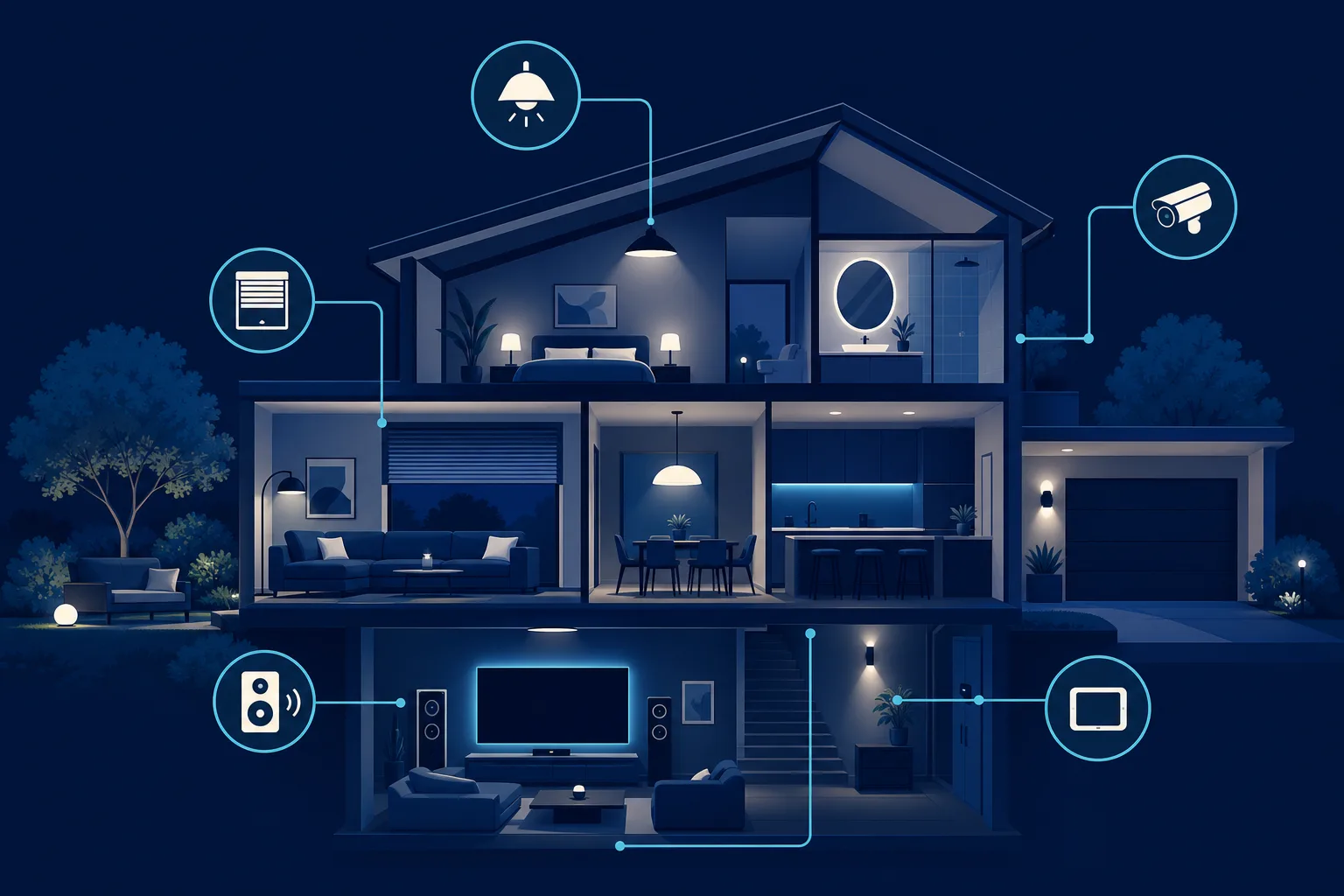
You do not sell a doorbell. You sell a house that listens. Lights that fade up when the alarm disarms in the morning, shades that drop before the afternoon sun cooks the living room, one clean app instead of eleven, and a network that does not fall over when everyone is streaming at once. That is a real thing you build with your hands and your head, and it is worth a lot of money.
The problem is that a homeowner cannot tell that from a search result. To them, a hundred-dollar plug-in camera and a full Control4 or Savant integration both show up as "smart home." So when someone lands on your site, the whole job is to move them from "which gadget do I buy" to "I need a professional to design this for my house." That is what a website for a smart home installer is really for: not to explain automation, but to prove you are the person who should own it.
This guide walks through the pages, the proof, and the one call to action that actually gets qualified projects on your calendar.
Know exactly who is reading before you write a word
Your website has to speak to a few very different people, and they do not want the same thing.
- The mid-remodel homeowner. They are already spending on a kitchen or a whole-house renovation and someone told them to "wire it while the walls are open." They are stressed about doing it wrong and never being able to do it again. Timing is everything for them.
- The new-construction buyer. Working with a builder or an architect, sometimes a year out from move-in. They want lighting control, audio, shades, and networking designed in, not bolted on.
- The frustrated owner of a half-smart house. They already have a pile of apps that do not talk to each other, a mesh router that keeps dropping, and a garage full of boxes. They want one system and one throat to choke.
- The referral. An interior designer or a builder sent them. This person is warm already. Your site just has to confirm you are legitimate and easy to work with.
Notice what none of these people are doing. Nobody is price-shopping a smart light switch. They are trying to decide whether to trust you with the nervous system of their home. Write every page to reduce that fear, not to list products.
The pages a smart home installer website actually needs
You do not need twenty pages. You need a handful that do their jobs.
Home page
Above the fold, say what you do and who you do it for in one honest line. Something like "Whole-home automation, lighting, audio, and networking for homes in [your metro]." Not "cutting-edge IoT solutions." Show a clean, real photo of your work: a discreet keypad by a doorway, a media room, a tidy equipment rack. Then one obvious button to book a consult. Everything else on the home page is a preview that leads deeper.
Systems and services
This is your core page, and it should be organized the way a homeowner thinks, not the way a distributor catalog is organized. Group it by outcome:
- Lighting and shades. Keypads that replace the wall of switches, dimming scenes, motorized shades that track the sun, tunable white light.
- Whole-home audio and video. Music in every room from one source, a real home theater, TVs that hide when off.
- Networking and WiFi. The unglamorous foundation. Enterprise-grade access points, wired backbone, a network that does not choke. Say plainly that this is what makes everything else reliable, because most bad "smart homes" are really bad networks.
- Security and cameras. Locks, cameras, alarm integration, and who gets notified when.
- Climate and energy. Thermostats, sensors, and automations that actually lower a bill.
- Control and voice. One app, one remote, one voice command that runs the whole scene.
For each, describe the everyday moment it creates, then note the platforms you are certified on. A homeowner does not know what Lutron or Josh.ai is, but "authorized dealer" and "certified" tell them you are not a hobbyist.
Portfolio or recent projects
For your work, this page sells harder than any paragraph. Show projects, not products. Three to six real installs, each with a couple of photos and two or three sentences: the home, what the owner wanted, what you delivered. A theater with hidden speakers. A lake house you can arm and check from the city. A new build where lighting was designed room by room. If you can show a before of a chaotic wall of switches and an after of a single elegant keypad, use it. That contrast does more than a spec sheet ever will.
About and trust
More on this below, but it is a real page. Who you are, how long you have done this, your certifications, and why you will still be around in five years.
Consultation and contact
One clear place to start the conversation, with a short form and your service area spelled out.
Sell the trust story, because that is the actual product
Here is the fear that kills more smart home deals than price: what happens when it breaks and you are gone. Homeowners have all heard the horror story of the installer who wired the whole house, moved on, and left them with a system nobody else can service. Your website has to answer that before they ask it.
Put these front and center:
- Certifications and dealer status. CEDIA membership, manufacturer certifications, authorized dealer badges. These are not decoration. They are the difference between you and the handyman with a screwdriver.
- How long you have been doing this. Years in business is a trust signal all by itself in a field where fly-by-night is common.
- Licensing and insurance. Low-voltage license where your state requires it, liability coverage, bonded. Say it plainly.
- Service and support after the install. This is the big one. Explain that you do not disappear. Remote monitoring, service plans, a real phone number, a promise that the system is documented so it can always be serviced. An owner paying for a serious system is buying a relationship, and the website is where you promise one.
- Real reviews. Pull a few genuine quotes from happy clients. Homeowners trust other homeowners more than they trust you.
When your trust story is strong, price stops being the first question. That is exactly where you want the conversation to start.
Make the call to action a consult, never a cart
Do not put prices on the site, and do not pretend a smart home is something you order off a menu. Every serious job is custom, priced after you understand the house, the wiring, and what the owner actually wants. So the entire site should point at one thing: book a consultation.
Frame it as low-risk and valuable, not salesy. Call it a design consultation or a home walkthrough. Tell them what happens on it: you look at the house or the plans, you listen to how they live, and you come back with a design and a real number. No obligation.
Your consult form should stay short. Ask only what helps you show up prepared:
- Name and best contact
- Address or neighborhood, so you know it is in your service area
- New construction, remodel, or an existing home
- What they are most excited to solve first, in their own words
- Rough timeline
That last question matters. A homeowner whose drywall goes up in three weeks is a hot lead. One who is "just researching" is a follow-up. Ask so you can prioritize.
One more thing that quietly wins jobs: make it obvious you work with builders, architects, and interior designers. A lot of your best projects come through them, and a line like "we partner with builders and designers on new construction" tells a pro visiting your site that you are used to being part of a team.
The technical stuff that decides whether anyone finds you
You install networks, so you know reliability matters. The same is true of your site.
- Speed. A slow site loses people before your work ever loads. Compress those big install photos.
- Mobile. Most homeowners will find you on a phone at night after the kids are down. If it is hard to read or tap on a phone, you have lost them.
- Local search. This is where the real leads live. Claim and fill out your Google Business Profile, keep your name, address, and phone identical everywhere, and make sure your site says the towns and counties you serve. Someone searching "home automation installer near me" should find you, not a national chain.
- Photos of your own work. Never stock photos of some generic gadget. Real racks, real keypads, real rooms. It is the single most persuasive thing on the site.
None of this requires you to become a web developer. It requires that the site be built right once and kept current.
The honest way to actually get the site built
You have a few real options, and the right one depends on how much time you want to spend.
- Do it yourself on Wix or Squarespace. Cheapest in dollars, most expensive in hours. Fine if you have a spare weekend, patience, and a decent eye. You will be your own photographer, copywriter, and updater forever.
- WordPress with a developer. Powerful and flexible, but you own the maintenance, the plugins, and the security updates, or you pay someone to. Overkill for many installers.
- A hands-on agency. They will build you something custom and polished. It costs the most and usually takes weeks of back and forth, but you hand it off and it is handled.
There is also a newer middle path worth knowing about. Saynovo builds an agency-quality site for a smart home installer as a done-for-you service, and if you already have a Google Business Profile it can pull your name, hours, photos, and reviews to generate a first version for free, so you can see your own site before spending anything. The platforms you install, your consult offer, and your trust credentials were never on Google, so you say those and the pages fill in. The part that fits this trade especially well: when you finish a standout theater or a new-construction whole-home job, you just tell the site what to change, in plain words, and it updates. "Add the lakeside project to the portfolio and mention the hidden theater speakers." No dev ticket, no waiting. For a busy installer whose portfolio is the whole pitch, being able to talk to the site and keep it current is the difference between a site that grows and one that goes stale the week after launch. If you would rather never touch it at all, SyntroAI, the parent company, runs it as a fully managed service.
Whichever route you pick, the test is the same: does the site prove you are the professional who should own the nervous system of someone's home, and does it make booking a consult the easy next step.
Your next step
Do not try to build the whole thing tonight. Do one thing: get five good photos of your best recent install, and write down, in your own words, the single sentence a homeowner would say about what you fixed for them. That is the raw material for a site that books projects instead of collecting dust. Get those two things ready, pick your build path, and put a clear "book a consultation" button where every visitor can see it. The homeowners who want their house to finally work as one system are searching right now. Make sure the person they find is you.