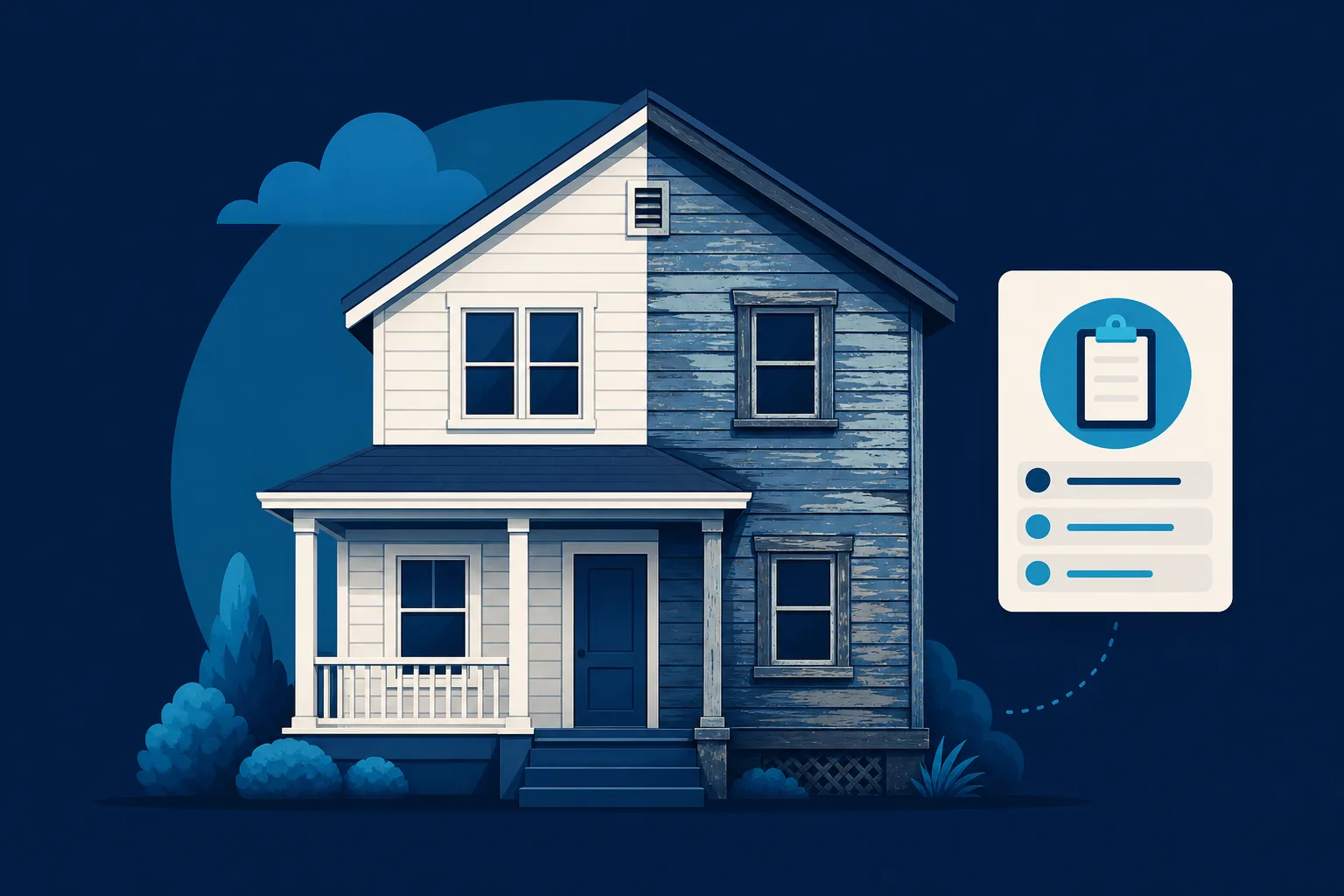
Siding is a big-ticket, once-in-twenty-years decision for a homeowner. Nobody buys new siding on a whim. By the time someone lands on your website, they have usually noticed a real problem: cracked panels, peeling paint, a woodpecker hole, warped boards after a windstorm, or a house that just looks tired next to the neighbors. They are nervous about the cost, unsure which material to pick, and quietly worried you will be hard to reach or hard to trust.
That is the whole job of a website for a siding contractor: take a worried homeowner who is comparing three companies and give them enough proof, enough plain explanation, and an easy enough next step that they hand you their address and ask for an estimate. This guide walks through exactly what to put on the site and how to build one even if you have never had a website before.
Start with the one goal: a booked estimate
Every siding job starts with a measurement. You cannot quote a house without seeing it, so the entire website should point at one action: getting the homeowner to request an estimate or a free measure. Not "learn more." Not "browse." A booked estimate.
That means the button that says Request Your Free Estimate should follow the visitor down the page. On a phone it should sit as a bar at the bottom of the screen that never leaves. Your phone number should be tap-to-call in the header so an older homeowner who hates forms can just call. Pick one primary action and repeat it after every section, because a homeowner reading about fiber cement at 9pm should never have to scroll back up to hunt for how to reach you.
Keep the promise honest and specific. "Free estimate, usually scheduled within 48 hours" beats a vague "contact us" because it tells them what happens next and removes the fear that they are signing up for a pushy sales visit.
Give every siding material its own page
This is the part most siding websites get wrong, and the part that will win you both Google traffic and trust. Homeowners searching are not typing "siding contractor near me" only. They are typing things like "fiber cement vs vinyl siding" and "James Hardie installer" and "LP SmartSide near me." If you have a real page for each material you install, you catch those searches and you look like the expert.
Build a short, clear page for each option you actually offer:
- Vinyl siding - the budget-friendly workhorse. Explain that it is low-maintenance and comes in many colors, and be honest about where it fits.
- Fiber cement (James Hardie and similar) - the premium, fire-resistant, long-warranty choice. This is often your highest-value job, so give it your best photos.
- Engineered wood (LP SmartSide) - the real-wood look that holds up better than natural wood, popular in certain regions.
- Insulated siding - explain the energy angle in plain terms, since this is a common upgrade question.
- Repair and single-side replacement - many homeowners just want one storm-damaged wall fixed. Say that you do it. It is an easy first job that turns into a full re-side later.
On each page, answer the three questions a homeowner is actually asking: what does it look like, how long does it last, and roughly what should I expect to pay. You do not have to publish a price. A simple range or a "most homes in our area run between X and Y" line does more to build trust than silence, and it stops price-shoppers from wasting your time on the estimate visit.
Make the before-and-after photos the star
Siding is curb appeal. It is the single most visible change a homeowner can make to their house, and the emotional sell is entirely in the transformation. A grid of stock catalog photos does nothing. A wall of your own before-and-after shots from houses in your area does almost all the selling for you.
For the gallery, get the details right:
- Shoot the before from the same angle and distance as the after. The matching angle is what makes the change land.
- Include the ugly ones - the faded, patched, storm-torn "before" is what a nervous homeowner recognizes in their own house.
- Add a one-line caption to each: the town, the material, and the problem you solved. "Chalking vinyl replaced with James Hardie in Maple Grove" is worth more than any headline you could write.
- Group them by material so someone deciding between vinyl and fiber cement can see real examples of each.
You do not need a professional photographer. A clean phone photo in good daylight, shot from the curb, is exactly right. Take the before picture on every job before you touch it, and the after picture before you drive away. Do that for a season and you will have the best siding gallery in your market.
Address storm damage and insurance head-on
A large share of siding leads come right after weather: hail, straight-line wind, a fallen limb. Those homeowners are in a different, more urgent mindset than someone doing a planned upgrade, and they are often dealing with an insurance claim for the first time in their life. If your site speaks to them directly, you catch a whole category of high-value work that planned-upgrade sites miss.
Add a short section or its own page on storm and insurance work that covers, in plain language:
- That you inspect for hail and wind damage and can tell them whether it is worth filing a claim.
- That you can work with their insurance adjuster and document the damage properly.
- What to do first: photograph it, do not throw anything away, and call before the deadline on their policy.
- That an insurance re-side may cost them only their deductible, which many homeowners do not realize.
This content does two jobs. It ranks for "storm damage siding" searches, and it positions you as the calm expert who has done this a hundred times, which is exactly who a rattled homeowner wants to call.
Explain financing so the price stops being a wall
A full re-side is a five-figure decision, and for a lot of families that number alone kills the estimate before it is booked. If you offer financing through a partner, saying so on the site turns "we cannot afford that" into "we can do this with a monthly payment." That single change unsticks a large number of leads.
Keep the financing section simple and non-scary:
- Lead with the monthly-payment idea, not the loan paperwork. "Many homeowners do their whole project for a manageable monthly payment" is the message.
- Mention that quick approvals and options for a range of credit situations exist, if your lending partner offers them.
- Do not try to be a bank on your website. Explain the concept, then let the estimate conversation handle the real numbers.
Even homeowners who end up paying cash relax when they see financing offered, because it signals you are a real, established company that does large projects routinely.
The estimate form: capture the house, not a novel
Here is the balance that makes or breaks a siding site. You want enough detail to walk into the estimate prepared, but every extra field you add loses you leads. The fix for siding specifically is to ask for the things that describe the house, and skip everything else.
A strong siding estimate request asks for:
- Name, phone, and email - the basics, and make phone the priority since these jobs close on a call.
- Property address - critical, because you can pull up the home on satellite and size it before you even visit.
- What is going on - a few tap-to-choose options: full re-side, storm or repair, or "not sure yet." This alone tells you which type of lead you have.
- Current siding, if they know it - vinyl, wood, stucco, or not sure. Optional.
- A photo upload - one snapshot of the problem wall. This is gold. It lets you triage urgent jobs and prep an accurate quote.
That is it. Five quick fields and an optional photo. Do not ask for the year the house was built or their preferred appointment window on the first form. Every extra question is a homeowner who closes the tab. Get the address and the phone, and win the rest on the call.
Prove you are legitimate above the fold
Siding contractors carry a trust problem that is not their fault: storm-chasers and fly-by-night crews have burned homeowners in every market. So the top of your homepage has to answer "are you real and are you local" in about three seconds. Put these where a visitor sees them without scrolling:
- A real photo of you and your crew or your truck, not a stock construction image.
- Your Google star rating and review count.
- Years in business and your service area named plainly ("Serving the Twin Cities and western suburbs since 2009").
- License and insurance status, and any manufacturer certification like a Hardie or preferred-installer badge, which homeowners specifically look for.
Underneath, a few real reviews that mention siding by name ("they replaced our whole exterior in three days and cleaned up every nail") do more than a paragraph about your company values ever could.
How to actually get this built
You have three honest routes, and the right one depends on how much of this you want to touch yourself.
Do it yourself with a builder like Wix or Squarespace if you enjoy that kind of thing and have the evenings to spend. You will get a decent site, but you are the one wiring up the estimate form, building each material page, and keeping the gallery current. WordPress gives you more room but more upkeep.
Have it done for you if you would rather be measuring houses than fighting with a page editor. This is where a tool like Saynovo fits a siding contractor well: it generates the whole site around your existing Google Business Profile, and because your material pages, your financing, and your storm-damage process were never on that profile, you say those instead of learning software. Say "add a fiber cement page," "put the storm damage section above the reviews," or "make the free estimate button follow people down the page," and it changes. For a busy owner who wants material pages, a real gallery, and a working estimate form without becoming a web designer, that talk-to-edit approach removes the part most contractors get stuck on.
If you would rather hand off marketing entirely and never think about the website again, a full-service agency like SyntroAI, the company behind Saynovo, can run the whole thing for you.
Your next step
Do not try to build all of it tonight. Start with the one thing that captures leads: this week, take a clean before-and-after photo on your next job and write down the five estimate-form fields above on a sticky note. That is the core of a siding website that books estimates. Everything else - the material pages, the storm section, the financing note - you can add one piece at a time.
Get the address and the photo in the door, be the calm local expert who explains the choices, and let your own before-and-afters close the job. That is a siding website that earns its keep.