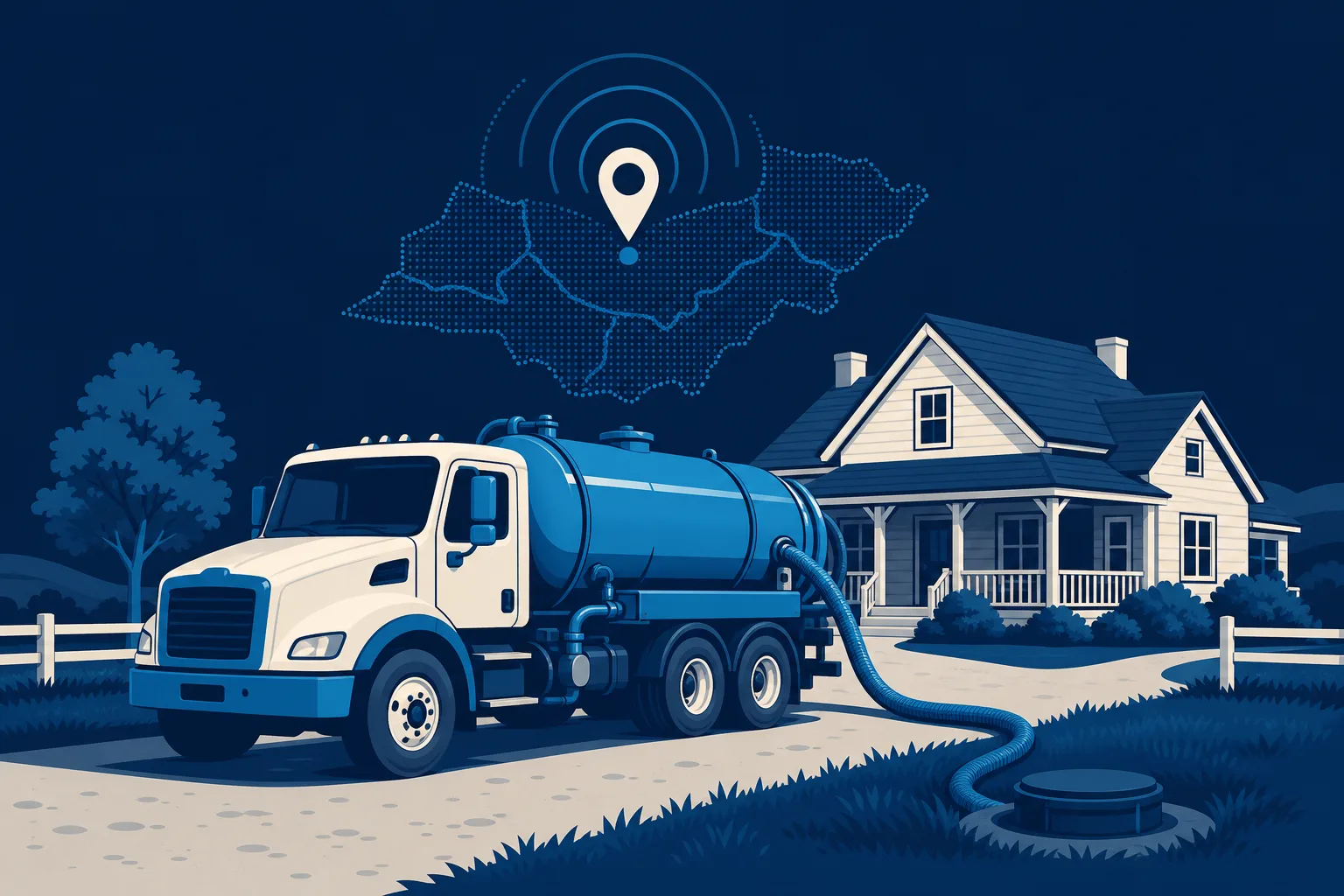
Most people never think about their septic system until something goes wrong. That single fact shapes everything about how you should build a website for a septic service that books pump-outs. Your visitors are not browsing. They are either standing in a yard that smells wrong, watching a toilet that will not drain, or finally remembering that it has been about three years since the last pump-out. Two completely different moods, one website, and both need to end with a booked truck.
If you do not have a website yet, this is not a lecture about falling behind. It is a practical walkthrough of what a septic site actually needs to do, section by section, so that when a homeowner three towns over types your county name plus "septic pumping" at nine at night, your name is the one that answers. You run a real, physical, hard-to-fake service. Your website just has to prove that and make the next step obvious.
Know the three people who land on your site
Every good septic website is built around who is actually reading it. You have three, and they want opposite things.
- The emergency homeowner. Their tank is backing up or the drain field is soggy and they need a truck today. They will not read your About page. They want a phone number they can tap, a promise you serve their area, and a sign that you answer fast.
- The routine customer. No crisis. They know a healthy tank gets pumped every three to five years and theirs is due. They want to confirm you cover their address, get a rough idea of cost, and schedule without a phone tag marathon.
- The realtor, buyer, or seller. A house is changing hands and the sale needs a septic inspection, often on a deadline. This is repeat referral work that most septic companies underserve online. A clear page for point-of-sale inspections wins agents who will send you deal after deal.
Write down which of these matters most to your revenue. For most pumping-focused companies it is the routine customer for volume and the emergency caller for margin, with realtor inspections as the quiet, sticky third leg. Your homepage should serve all three within the first screen.
Put the emergency path first, because that visitor will not scroll
The single most valuable thing on a septic site is a phone number that works in one tap on a phone. Not buried in a header. Not hidden behind a menu. A big, obvious click-to-call button that a stressed person can hit with a thumb while they are still standing outside.
Right next to it, answer the two silent questions that emergency caller has:
- Do you come out fast? Say it plainly. "Same-day emergency pump-outs" or "We answer the phone 24/7" beats any clever slogan. If you truly offer after-hours response, that line alone will win calls your competitors lose to voicemail.
- Do you even cover me? A septic emergency in a rural county is useless to solve for a customer sixty miles outside your range. Name your area high on the page so nobody wastes a call, and so the right people feel instantly reassured.
A backed-up septic system is a genuinely upsetting moment. Calm, confident wording does a lot of quiet work here. Skip the hard sell. A homeowner watching sewage back up wants competence, not enthusiasm.
Give each service its own page and its own answers
A common mistake is cramming pumping, repair, and installation onto one long homepage. Splitting them into clear service pages helps you rank for what people actually search, and it lets you speak to very different buyers. At minimum, build these four.
Pumping and cleaning
This is your bread and butter, so make it the strongest page. Explain what a routine pump-out includes, roughly how long it takes, and what you check while you are there. Address the fears people do not say out loud: Will your truck tear up my yard? Do I need to find the lid myself? What if the tank is worse than expected? Answering those turns a hesitant reader into a scheduled job.
Inspections
Split this into two audiences if you can. Homeowners want peace-of-mind inspections. Realtors and home sellers need point-of-sale or real-estate inspections, often fast. State your typical turnaround in writing, because "we can usually get out within two business days" is exactly what an agent on a closing clock needs to read before they call.
Repairs
Drain field problems, baffle failures, pump replacements, line clogs. People searching here are worried about a big bill, so explain how you diagnose before you quote, and reassure them that not every problem means a full system replacement. Honesty here builds the trust that wins the job.
Installation and replacement
This is your highest-ticket work and a longer decision. Cover conventional and aerobic systems if you install them, permitting, and the fact that you handle the health-department side. Because installs are expensive, mention financing if you offer it. A homeowner facing a five-figure system is far more likely to call the company that shows a path to affording it.
Make the service area impossible to miss
Septic customers are rural and semi-rural, and they search with their town name attached. Someone types their small town plus "septic pumping," not just "septic pumping." If your site only names your headquarters town, you are invisible to the next town over, which in a rural county might be most of your market.
Two things fix this.
- A plain service-area map or list. Show the counties and towns you cover. A simple map graphic plus a written list of town names does double duty: it reassures the human reader and it gives search engines the local words they need to show you in those towns.
- A page for each town you seriously serve. A short, honest page for each community, written about that place and not copy-pasted, helps you show up when someone in that town searches. Do not fake this with a hundred thin pages. Cover the towns you actually drive to and write real sentences about each.
This is where a lot of septic sites quietly leak money. Getting the geography right is often worth more than any design choice on the page.
Turn the three-year cycle into repeat business
Here is the advantage septic has that most trades envy: your service is genuinely recurring on a predictable clock. A tank that gets pumped every three to five years is a customer who should come back like clockwork, but only if you make it easy and if they remember. Your website should quietly set that up.
- Capture the appointment, not just the phone call. A simple scheduling or request form that takes their address, tank details, and preferred timing means a routine customer can book at night without waiting for your office to open. Fewer lost jobs, less phone tag.
- Collect the email or cell at booking. That is the seed of your reminder system. When you can send a friendly text or email the season a customer is due again, you stop competing for their business every cycle. You just show up in their inbox as the company that already knows their tank.
- Say the cycle out loud on the site. A short note that most tanks need pumping every three to five years, and an offer to remind them, educates first-time septic owners who genuinely do not know. New rural homeowners especially will thank you for it.
That reminder loop is the difference between chasing new customers forever and building a route of regulars who barely think about calling anyone else.
Prove you are licensed, insured, and not going to make a mess
Septic work is intimate and a little unpleasant, and you are sending a truck and a crew onto someone's property to handle their waste. Trust does heavy lifting here. Put the proof where people can see it without hunting.
- Credentials. Licensed, insured, permitted, and in good standing with the county health department. Say all of it. For septic specifically, health-department compliance is a real reassurance, not boilerplate.
- Real photos. Your actual trucks, your crew, a clean job site after the work. Skip the stock images of gleaming toilets. A photo of your real pump truck in a real rural driveway tells a homeowner exactly who is coming.
- Reviews in their own words. A few honest reviews that mention showing up on time, being tidy, and explaining the problem clearly will outweigh anything you say about yourself. If most of your reviews live on Google, pull a handful onto the site where every visitor sees them.
- Years and roots. "Family-owned and serving this county since 2009" signals you are not a fly-by-night truck that vanishes after cashing the check.
Keep it fast and thumb-friendly
Your visitors are on phones, often standing outside near the tank with one or two bars of rural signal. A slow, cluttered site loses them before it ever loads. Keep pages light, keep the phone number and the town name near the top, and make every button big enough to hit with a thumb. A person dealing with a septic backup has zero patience for a menu that will not open or a form that fights them. Simple and quick beats fancy every time.
Where a done-for-you option fits
You are a septic operator, not a web designer, and the last thing you want after a long day of pump-outs is to wrestle with a website builder. You have honest choices. A hands-on builder like Wix or Squarespace works if you enjoy the tinkering and have the evenings to spend. WordPress gives more power if you or someone you trust will maintain it. And if you would rather it just be handled, a fully-managed agency like SyntroAI can run the whole thing for you.
There is also a middle path built for exactly this. If you already have a Google Business Profile, Saynovo can import it and generate a full, professional septic site around it, free for the first build. Your license, your pumping guidance, and the towns you cover were never on Google, so you shape those by talking to it. You say "add an emergency pump-out page for the three counties I cover" or "make the phone number bigger on mobile," and it changes. For an owner who wants a real site without learning software or babysitting a designer, saying what you want and watching it happen is about as close to done-for-you as a self-serve tool gets.
Whatever route you pick, the point is the same: get something live that answers the phone-in-your-pocket moment, because right now those calls are going to whoever shows up first in the search.
Your next step
You do not need a perfect website. You need one that does three things: lets a panicking homeowner call you in one tap, tells a routine customer you cover their town and can book them, and gives a realtor a clear inspection page with a turnaround they can trust. Start there.
Pick your single highest-value visitor from the three above, and build the homepage to serve them first without ignoring the other two. Get your service pages, your service-area map, and your click-to-call button in place, then add the reminder habit that turns a three-year cycle into a lifetime customer. Do that, and the next time a tank backs up somewhere in your county, you will be the name that answers.