The short answer
Build a mobile mechanic website around one message stated at the top: you come to them. Name your service area, list upfront prices, and put your phone number on every page so calling takes one tap.
Most drivers have never had a mechanic work in their driveway, so their default plan is a tow and a three day wait. If your homepage does not correct that picture in roughly ten seconds, they leave and call a tow truck instead. Lead with the promise, then back it with the towns you cover, typical prices for common jobs like brake pads or a battery swap, and reviews from customers in those same towns.
Because nobody can walk into your shop and size you up, price transparency and proof do the work a physical location normally does. Answer the quiet first timer questions too: where the car needs to be parked, whether you supply parts, how payment works.
This changes if you also run a fixed bay. Then your site needs both options made clear, so nobody arrives at the wrong place.
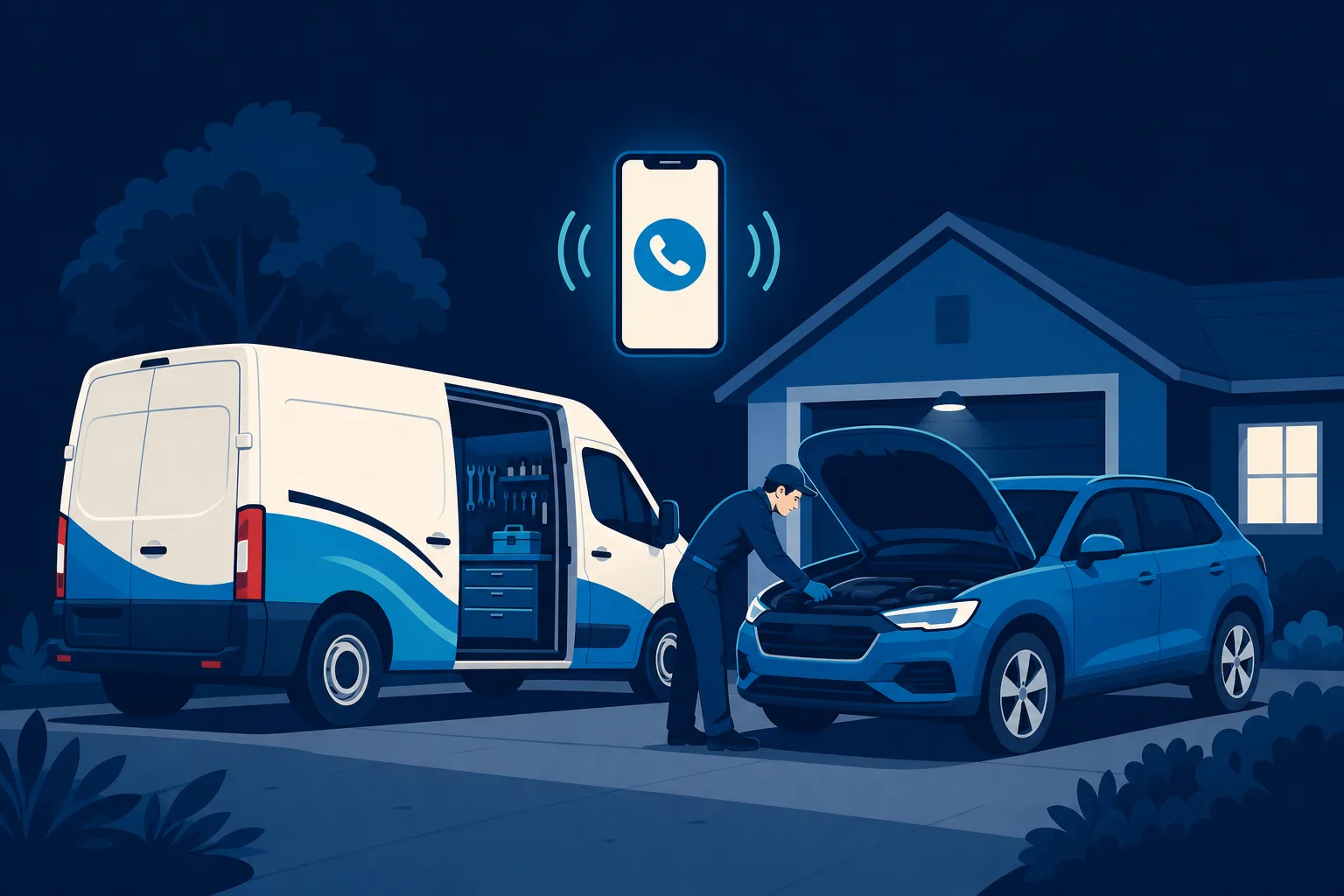
Here is the strange thing about running a mobile mechanic business: half your job is fixing cars, and the other half is convincing people your job exists at all. Plenty of drivers have never had a mechanic show up in their own driveway. When their check-engine light comes on, their brain goes straight to "tow it to a shop and wait three days," because that is the only picture they have.
A website for a mobile mechanic has one job above all others: erase that old picture and replace it with a new one. You come to them. You fix it where the car sits. They pay a fair, clear price and get on with their day. If your site can make that click in someone's head in about ten seconds, the phone rings. If it cannot, they scroll to the next tow truck.
This guide walks through exactly how to build that site, page by page, written for someone who has never had a website before. No jargon. Just the parts that turn a curious visitor into a booked call.
Lead with "we come to you" before anything else
Most contractor websites open with a logo and a slogan. Yours cannot afford that. The single most valuable idea you own is that the customer does not have to go anywhere, and it belongs in the biggest text on the page, above the fold, before a visitor scrolls even once.
Think about the two moments a person lands on your site:
- Their car will not start in the garage, so it physically cannot be driven to a shop.
- They are slammed at work and the thought of losing half a day at a repair shop makes them put off the fix entirely.
For both of them, "we come to you" is not a nice extra. It is the whole reason to call. So your headline should say something a stranger understands instantly, like "Mobile mechanic that comes to your home or work across [your metro area]." Underneath it, one line that names the payoff: no tow, no waiting room, no rearranging your day.
Do not bury this under a stock photo of a generic garage. A shop photo tells the wrong story. A photo of you working on a car in a normal driveway, tools laid out on the ground, tells the right one in an instant.
Make your service area impossible to miss
The number one question in a visitor's head after "you come to me?" is "do you come to where I am?" If they cannot answer that in a few seconds, they leave to protect their own time. A clear service area is not a technical detail. It is a trust signal that says you are a real local operator, not a lead-reselling middleman who will pass their call to whoever pays the most.
Spell it out in plain language, not just a map:
- Name your home base city and then list the surrounding towns and suburbs you cover by name. People search for their own town, and seeing it in writing feels like a personal yes.
- State your radius in a way a normal person pictures, like "anywhere within about 30 minutes of downtown [City]."
- Be honest about the edges. If you charge a small travel fee past a certain distance, say so here. Surprise fees at booking are how you lose a customer and earn a bad review.
If you cover a wide area, individual pages for your bigger towns can help you show up when someone in that town searches. But do not fake it. One clear, honest service area beats ten thin pages that all say the same thing with the town name swapped in.
Build trust with upfront pricing, because they cannot see your shop
A traditional repair shop earns a sliver of trust just by existing. It has a building, a sign, a waiting room with old magazines. You show up in a van. That is more convenient, but it also means a first-time customer has less to reassure them, so your website has to carry that weight instead.
The strongest reassurance you can give is honesty about money. Drivers are conditioned to expect the runaround from car repair. Being the mechanic who is upfront is a genuine advantage, and your site is where you prove it.
You do not need a full price list for every possible job, and you should not promise exact numbers on repairs that depend on the car. But you can:
- Publish clear pricing for the predictable stuff: oil changes, brake pad replacement, battery swaps, diagnostics, starters and alternators on common vehicles.
- Explain how your diagnostic fee works and whether it gets applied to the repair if they hire you. This one line removes a huge amount of hesitation.
- State plainly that they get a price before you turn a wrench, and that the price does not change unless something new is found and they approve it first.
A short "How our pricing works" section does more to book calls than any amount of "quality you can trust" filler. It answers the fear that a mechanic they cannot see will pad the bill.
Design every page to end in a phone call
For a mobile mechanic, the phone is the finish line. Someone whose car is dead in the driveway is not going to fill out a long form and wait for an email. They want to talk to a person, describe the noise, and hear "I can be there this afternoon."
So the whole site should funnel toward one tap:
- Put your phone number in the top corner of every page, and make it a tap-to-call link so a phone user just presses it and the call starts. Most of your visitors are on a phone, often standing next to a car that will not move.
- Add a bold call button that follows them as they scroll, so the option to call is always one thumb away.
- Use button text that says what happens next. "Call for a same-day quote" beats a plain "Contact us." It tells them the call is quick and gets them a number.
- Offer text messaging as a second option for the folks who hate calling. A simple "Call or text [number]" covers both kinds of people.
If you want a booking form as well, keep it to the essentials: name, phone, what car, what is wrong, and where it is parked. Every extra field is a reason to give up. And still keep the phone number louder than the form, because for your service, a live call almost always books better than a message that sits in an inbox.
Answer the questions a first-timer is quietly worried about
Because a lot of your visitors have never used a mobile mechanic, they carry a pile of unspoken doubts. A short, honest FAQ section clears them out before they become a reason not to call. Write it in the voice of a real person answering a real question.
Cover the ones that actually stop people from booking:
- Do you have the tools and parts to fix it here, or will you just look and leave? Reassure them you carry common parts and can source others fast.
- What if it turns out my car needs a shop with a lift? Tell them you are honest about that and will point them the right way rather than waste their money.
- Are you insured and licensed? Say it plainly. Someone letting a stranger work on their car in their driveway wants to know.
- Do you take card, or only cash? List how they pay, right there.
- Can you work in an apartment lot or a workplace parking spot? Many customers assume the answer is no and never ask.
Every honest answer here is one less reason to hesitate. You are not writing a legal document. You are having the conversation you would have on the phone, just earlier.
Show proof that real neighbors trusted you
Trust is your whole battle, so proof matters more for you than for a business with a storefront. Reviews are the closest thing you have to a customer walking past your shop and seeing it busy.
- Put a few of your best reviews right on the homepage, with the person's first name and their town if they are comfortable. "Fixed my starter in the office lot in an hour" from someone in a nearby suburb is worth more than any claim you make about yourself.
- Show before-and-after photos of real jobs, and photos of you actually working in driveways and parking lots. This quietly proves you are a genuine local person who shows up, not a call center.
- If you have a certification, years of experience, or a background at a dealership, say so in one plain sentence. It answers "is this person actually a mechanic" without bragging.
Ask for a review by text right after every job while the relief of a fixed car is fresh. That habit, more than anything, is what fills this section over time.
Make it fast and make it work on a phone
Almost everyone who needs you right now is holding a phone, sometimes with one bar of signal, standing next to a car that will not start. If your site is slow or fiddly on a small screen, they are gone before it loads.
The rules are simple:
- The page has to load fast, even on a weak connection. Heavy background videos and giant images are the usual culprits.
- The phone number and call button must be big enough to tap without zooming.
- Text should be readable without pinching, and buttons should be far enough apart that a thumb does not miss.
You do not need to understand the technical side of this. You just need whatever builds your site to handle it for you, so that a stressed driver on a phone gets a clean, fast, tappable page every time.
The easiest way to get this built
You can absolutely build this yourself. Tools like Wix or Squarespace let you drag pieces around, and if you enjoy that kind of thing, they work. WordPress gives you more control if you are technical or hire someone who is. Those are honest options, and for some owners they are the right call.
But most mobile mechanics did not get into this to spend their evenings fighting a page builder. Your billable time is under a hood, not in a website dashboard. If that is you, a done-for-you approach makes more sense.
Saynovo is built for exactly this situation. It pulls in your existing Google Business Profile, your name, hours, phone, photos, and reviews, and generates a complete website for your mobile mechanic business around it, and that first generation is free, so you can see your own site before deciding anything. Your service radius and your upfront prices were never on Google, so you say those and the page updates. From there, the part that fits a busy mechanic best is how you edit it: you just say what you want changed. "Add same-day brake service to my list." "Put my travel fee on the pricing section." "Move the phone number to the top." You talk, it updates, and you get back to the job. If you would rather hand off the whole marketing side and never think about it, SyntroAI, the parent company, runs it as a fully managed service.
Your next step
You do not need a big, complicated site. You need a fast one that says four things clearly: I come to you, here is exactly where, here is what things cost, and here is the number to call right now.
Start with this today. Write your one-line headline that makes "we come to you" impossible to miss. Write down the towns you cover, by name. List the five jobs you do most and a fair price for each. That is the backbone of a mobile mechanic website that books calls, whether you build it yourself this weekend or let it get built for you. The sooner it is live, the sooner the next driver with a dead battery finds you instead of a tow truck.