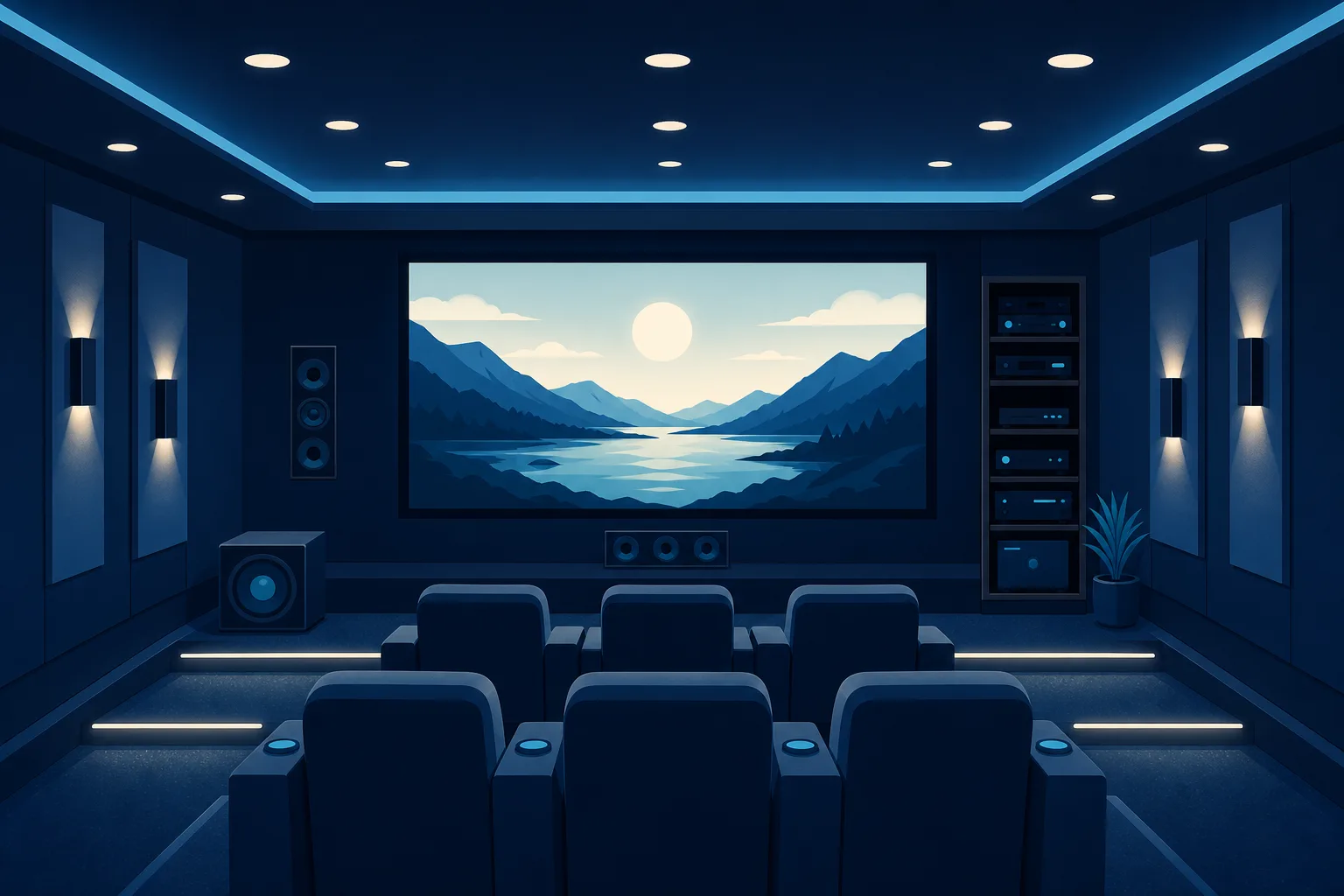
If you install home theaters, media rooms, and whole-home audio, your work is stunning in person and almost invisible online. A homeowner who just spent forty grand on a great room does not want to guess whether you are the pro who can hide every wire and calibrate a 7.2.4 Atmos setup, or the guy who mounts a TV and leaves a power strip dangling. Your website is where that decision gets made, usually before you ever pick up the phone.
The good news: home theater is a high-ticket, high-consideration purchase. That means you do not need a thousand visitors a month. You need the right dozen homeowners, builders, and designers to land on your site and immediately think "these are the people." This guide walks through exactly how to build a website for a home theater installer that books installs, not just clicks, and what to put on every page so serious buyers reach out.
Know who is actually looking (and what they are afraid of)
Before you write a single word, picture the three people who find you.
- The dream-room homeowner. They are finishing a basement or building new and want a real cinema: tiered seating, a projector, acoustic treatment, blackout. Budget is real, but so is the fear of hiring someone who overpromises and underdelivers.
- The upgrade buyer. They have a nice living room and want a clean, big-screen setup with great sound and no visible cables. They are comparing you to the big-box install desk and a handful of local pros.
- The referral partner. A custom builder, interior designer, or electrician who needs a reliable AV integrator on their roster. When they send you a client, their reputation is on the line too.
Every one of these buyers is quietly asking the same question: can I trust this person inside my home and around my expensive gear? Your entire site is the answer to that question. It is not about listing brands. It is about showing calm competence and finished, wire-free rooms.
Lead with a gallery that sells the finished room
For a home theater installer, the project gallery is not a nice-to-have. It is the whole pitch. Homeowners buy the feeling of that dark room with the glowing screen and the perfect seating. Designers and builders buy the proof that you finish clean.
Make the gallery the centerpiece of your homepage and give it its own page too. Here is what actually converts:
- Full-room hero shots. Wide, well-lit photos of the finished space. A dedicated cinema with tiered recliners. A modern great room with a fireplace, a huge screen, and no visible speakers. This is what people screenshot and send to their spouse.
- The "no wires" proof. A close-up of a clean equipment rack, a flush in-wall speaker, a motorized screen dropping from a ceiling recess. AV buyers are obsessed with hidden cabling because that is what separates a pro from an amateur. Show it on purpose.
- Before-and-after pairs. An empty basement or a cluttered TV wall next to the finished result. The transformation does more selling than any paragraph.
- A range of budgets. Include a simple, beautiful media wall alongside a six-figure theater. The upgrade buyer needs to see themselves, not just the dream client.
Caption each project with the room type, the town or area, and one line about the challenge you solved: "Concealed all wiring in a finished basement with no attic access." That single sentence tells a homeowner you handle the hard parts.
Do not hide these photos behind a slow slideshow or a login. Big, fast-loading images, arranged in a clean grid, that a visitor can scroll in five seconds.
Turn your services into clear packages
Home theater shopping is confusing for homeowners. They do not know the difference between a soundbar upgrade and a distributed audio system, and a wall of technical terms makes them freeze. The fix is to group your work into a few named packages so people can find themselves fast.
You know your business better than anyone, but a structure like this works well:
Media room and TV upgrades
The living-room and bonus-room buyer. A large display or short-throw projector, a real surround system, hidden wiring, and everything programmed to one remote or app. This is your volume work and often the front door to bigger projects later.
Dedicated home theaters
The purpose-built cinema. Projector and screen, tiered seating, acoustic treatment, lighting control, and calibration. This is where you show off. Lean on the gallery here.
Whole-home audio and control
Distributed music, outdoor speakers, and a control system like Control4, Savant, or Lutron that ties lights, shades, and AV together. Great for buyers who start with one room and expand.
Design and pre-wire for new builds
The service your builder and designer partners care about most: getting the wiring, backing, and infrastructure right before the drywall goes up. Call this out clearly so pros know you speak their language.
For each package, write three or four plain-English sentences about what it includes and who it is for. Do not publish fixed prices for custom work, but do help people self-qualify with an honest range or a "projects in this category typically start in the range of a serious kitchen remodel" style anchor. Vague pricing scares off good clients and attracts price shoppers who waste your time. A little honesty up front filters for the right people.
Make the consultation the obvious next step
Nobody buys a home theater from a shopping cart. The sale happens at a consultation, whether that is a phone call, a video walkthrough, or a visit to the home. So the single most important job of your website is to book that consultation. Everything points there.
- One primary button, everywhere. "Book a Free Design Consultation" in the header, at the end of every section, and at the bottom of every project. Not "contact us." Name the actual next step.
- Set expectations for the call. A short line like "We will talk through your room, your goals, and a rough budget, then map out what is possible." This lowers the fear of a high-pressure sales pitch.
- A short, smart form. Ask for name, phone, email, town, room type (media room, dedicated theater, whole-home, new build), and rough timeline. Skip the twenty-field questionnaire. Every extra field costs you leads.
- Make the phone number tappable and put it in the header. Some of your best clients, and most of your builder partners, will just call.
If you offer virtual consultations where a homeowner walks their room on a video call, feature that prominently. It removes friction and lets you qualify before you drive across town.
Build trust for a stranger you are letting into their home
Home theater is an in-home, high-dollar service. The trust bar is high. A few sections quietly do the heavy lifting:
- Real reviews with context. Not just stars. Pull quotes that mention neatness, communication, and how the finished room feels. "They ran every cable through the wall and cleaned up better than they found it" is worth more than any ad.
- The brands and platforms you work with. Homeowners researching Control4, Sonos, Sony, Klipsch, Lutron, or Josh AI feel reassured seeing names they recognize. It also helps you show up when people search for an installer for a specific system.
- Your service area, spelled out. List the towns and counties you cover. AV buyers want a local pro who will come back to tune things later, not a company two hours away.
- A short, human "about" section. One paragraph and a real photo. Who you are, how long you have done this, and why you sweat the details. People are inviting you into their home. Let them meet you first.
You do not need a huge site. Five or six well-built pages do the job: home, gallery, services and packages, about, reviews, and a consultation page.
Get found when homeowners search
A beautiful site nobody finds does not book installs. Most of your search traffic will be local and specific. Homeowners type things like "home theater installer near me," "media room wiring [your town]," "Control4 dealer [your county]," or "hide TV wires professionally." Write pages and captions that use the real words your customers use.
Two moves matter most:
- Claim and fill out your Google Business Profile completely. For local trades, this is often the biggest source of calls. Add your service area, categories, and a steady stream of project photos. When someone searches "home theater installation near me," a complete, photo-rich profile with recent reviews is what shows up in the map.
- Give each main service and each town a real page or a substantial section. A page that genuinely explains dedicated home theater design in your area will out-rank a thin homepage that mentions everything once.
If getting a modern site built has felt like a project you never have time for, this is exactly the gap Saynovo was built to close: it can import the basics your existing Google Business Profile already holds, your name, hours, photos, and reviews, and generate a real, agency-quality installer site around them, so your first version exists before you have finished your coffee. Your packages and your consultation offer were never on Google, so you speak those into place.
Keep it current without it becoming a second job
The reason most installer websites look dated is simple: updating them is a pain, so nobody does it. You finish a jaw-dropping theater, you have the photos on your phone, and they never make it to the site. Six months later your best work is invisible.
Pick a setup you can actually keep fresh. With Saynovo, you update the site by talking to it: say "add this basement theater to the gallery" or "change the consultation button to say Book a Free In-Home Design Visit," and it changes. No dashboard to relearn, no waiting on a developer for a one-line edit. It is done-for-you and stays that way. If you would rather have a hands-on local shop manage everything, that is a fair path too, and platforms like Squarespace or Wix can work if you enjoy building it yourself and have the time.
Whatever you choose, the standard is the same: fresh finished-room photos every month, current reviews, and a consultation button that is impossible to miss.
Your next step
You do not need a bigger website. You need a sharper one: a gallery that shows clean, finished rooms, a few clear packages so buyers find themselves, and one obvious path to a consultation. Get those three right and the right homeowners, builders, and designers will reach out already half-sold.
Start with the gallery. Go pull ten of your best finished-room photos and the clean-rack close-ups today. That single folder is the heart of a website for a home theater installer that books installs, and everything else is built around it. Then get a real site live, point your Google Business Profile at it, and let the work speak.