Your whole year happens in about ten weeks. From late September to mid-December, the phone either rings or it does not, and by the time your neighbors are stringing their own lights it is too late to fix it. That squeeze is exactly why building a website for a holiday lighting installer is different from building one for a plumber or a painter. You are not selling year-round convenience. You are selling a limited number of install slots before a hard deadline, and your website has to make that scarcity feel real without making it feel pushy.
This guide walks through what actually belongs on a holiday lighting website, in the order a homeowner reads it, so the site does the one job that matters: turning a curious visitor in October into a booked, deposit-paid install before your route fills up.
What a homeowner is really thinking when they land on your site
The person searching for you is not shopping the way they shop for a roof. They have usually just decided, sometimes that very week, that they are done climbing a ladder in the cold, done untangling last year's lights, done with the one strand that never works. They want their house to look like the nice ones on the block, and they want someone else to deal with all of it.
So they arrive with three quiet questions:
- Do these people do houses like mine, in a style I would actually want?
- Do they handle everything, or am I still on the hook for something?
- Are they going to have room for me, and how fast do I need to move?
Notice that price is not the first question. For most holiday lighting buyers, looking good and zero hassle come before the number. Your website should answer those three questions on the first screen, in that order, before it asks anyone to fill out a form.
Lead with the gallery, because you sell a look
Roofers can get away with a photo of a truck. You cannot. Your product is a feeling on a December evening, and the only way to sell it is to show it. Your gallery is not a nice-to-have buried in the menu. It is the beating heart of the site, and it should be one of the very first things a visitor sees.
Make the gallery specific instead of generic:
- Sort by home style, not just "residential." A row of two-story colonials with clean roofline lighting, a section of ranches with wrapped trees and a lit walkway, a few sprawling estates, a couple of storefronts and HOA entrances.
- Show the range of the look. Warm white classic for the traditional crowd, multicolor for families with kids, and the big architectural displays for the person who wants to win the street.
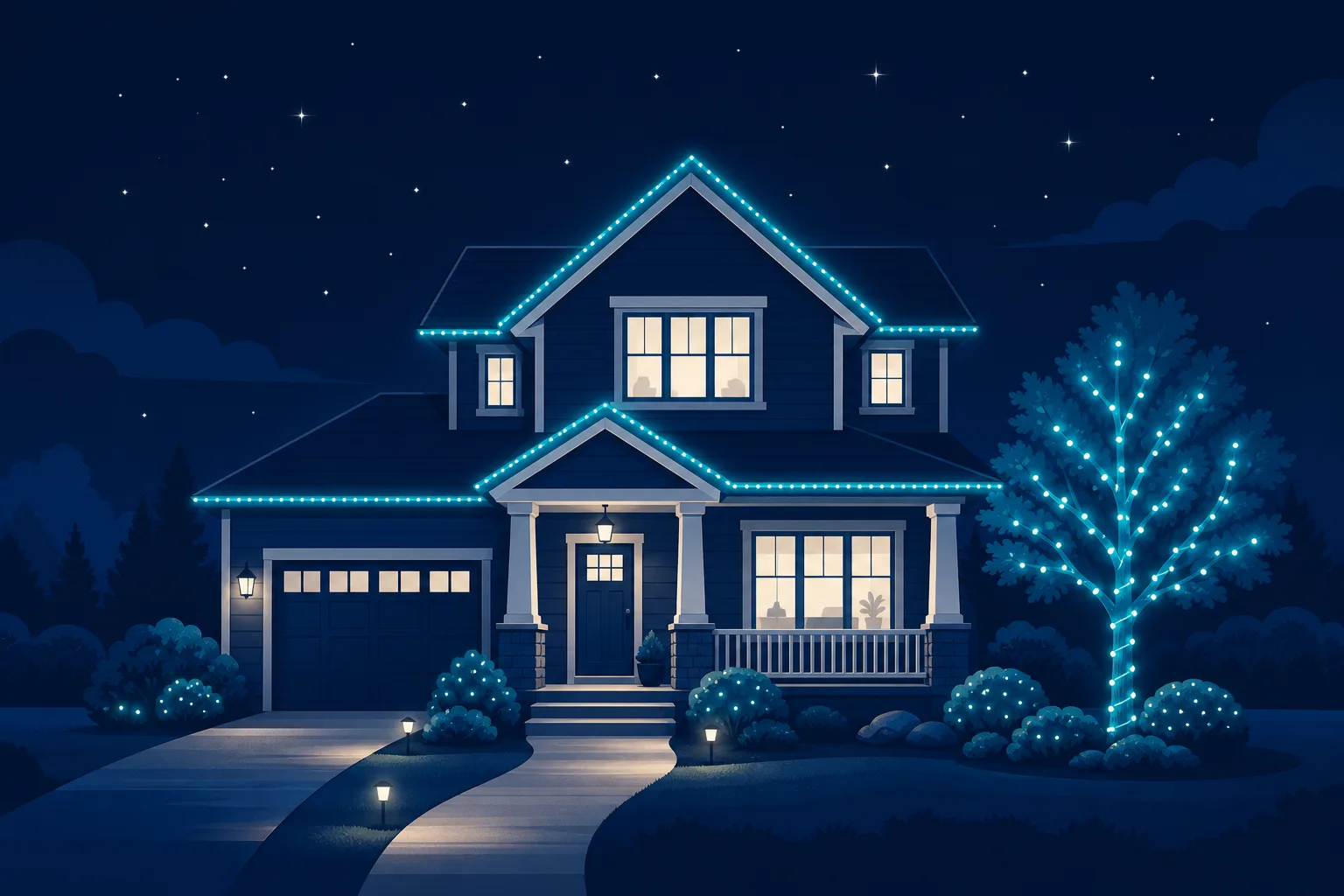
- Shoot at dusk, not pitch black. That blue-hour glow where you can still see the house and the lights are lit is the shot that sells. Full-dark photos hide the home and look like everyone else's.
- Include a few daytime shots too. Buyers quietly worry the lights look messy or the clips are ugly during the day. Showing a clean daytime roofline removes an objection they will never say out loud.
If you have before-and-after pairs, use them. The bare gray roofline next to the lit one does more selling than any paragraph you could write.
Sell the package, not the light strand
The single biggest mistake on holiday lighting websites is talking about lights when you should be talking about relief. Homeowners are not buying bulbs. They are buying the fact that a crew shows up, makes it beautiful, keeps it working, and takes it all down in January so it is not their problem.
Spell out your design-install-takedown package as one clean promise. A page that walks through it plainly works better than a wall of features:
- Design. You come out or review photos, plan the layout, and recommend a look for their specific home. They approve it before anything is ordered.
- Materials. You supply commercial-grade lights cut to fit their roofline, and you store them in the off-season so their garage stays empty.
- Install. Your insured crew hangs everything on a scheduled day, with timers set so it all comes on by itself.
- Season-long service. If a section goes dark in the middle of December, you come fix it. This is the line that closes the sale for people who got burned by a cheaper crew last year.
- Takedown and storage. After the holidays you pull it all down, and it is waiting, labeled and ready, for next year.
When a homeowner sees the whole arc laid out like that, the price stops feeling like "lights cost how much?" and starts feeling like "someone else handles the entire headache for one flat number." That reframe is most of the battle.
Be clear about whether you rent or the homeowner buys the materials, and whether returning customers get a faster, cheaper re-hang the second year. Repeat business is the quiet engine of this trade, and your website should make year two feel obvious and easy.
Make early booking the whole point of the site
Your calendar is your inventory, and it is genuinely limited. Weather, daylight, and crew size cap how many homes you can reach before the holidays, and the good weekends in November go first. A website for a holiday lighting installer should make that reality visible in an honest, useful way.
Put the season front and center:
- State the year plainly. "Now booking for the 2026 season" tells a summer visitor you are open and a December visitor that you may be full.
- Reward the early birds. An early-hang window in September and October, where you install now and simply flip the timers on later, spreads out your crew and locks in customers before your competitors even start. Say so on the site.
- Be honest when you are filling up. "Weekends in early December are limited" is not a gimmick if it is true. It is you doing the buyer a favor by telling them to move.
- Ask for a deposit to hold the date. A slot that is not paid for is not really booked. A simple deposit turns a maybe into a commitment and protects your route.
The goal is a site that quietly pushes every visitor toward booking sooner rather than later, because for you and for them, sooner is genuinely better.
The handful of pages that actually matter
You do not need fifteen pages. A holiday lighting site works with a tight set that maps to how people decide:
- Home. The dusk hero shot, your three-question answers, the season status, and one clear button to request a quote. Everything above the fold should say "beautiful, done-for-you, booking now."
- Gallery. Sorted by home style and look, the way described above. This page does more selling than any other.
- Packages and how it works. The design-install-takedown promise, the season-long service line, and the difference between residential and commercial.
- Service area. List the towns and neighborhoods you cover by name. A homeowner needs to see their own town in writing before they trust you will actually show up, and it helps you get found in local searches.
- Reviews. A few real quotes that mention the two things buyers fear most: reliability and cleanup. "They fixed a dark section the next day" and "you would never know they were here in January" are worth more than five stars alone.
- Book or get a quote. A short form that asks for address, home type, the look they want, and their timeline. Every other page should point here.
Skip the blog, the mission statement, and the ten-tab mega-menu. In a ten-week season nobody reads them, and they only get between the visitor and the quote form.
Make it effortless on a phone at night
Picture your actual customer. It is 9pm, they just drove past a beautifully lit house two streets over, and they are searching on their phone from the couch. If your site is slow, if the photos are tiny, or if the quote form wants twelve fields, they close the tab and the moment is gone.
A few things that matter more than they sound:
- The gallery has to look great on a small screen, because that is where most people will see it.
- A tap-to-call button should sit at the top on mobile. Some buyers want to talk, especially the older homeowners who are your best repeat clients.
- The quote form should be short. Address, phone, home type, and a note is plenty. You can gather the rest when you follow up.
- Pages need to load fast. A heavy, sluggish site during the two-month window when everyone is searching at once will cost you booked jobs you never even hear about.
Where Saynovo fits, and where it might not
You could build this yourself. Wix and Squarespace both have templates, and if you enjoy that kind of work and have time in the off-season, they can get you a decent gallery site. WordPress gives you the most control if you are technical or willing to hire someone. And if you want a hands-on marketing partner to run everything year after year, a local agency is a fair choice. Be honest with yourself about which of those you will actually finish before September.
The problem specific to this trade is timing. Your season is short, and the weeks when your website matters most are the exact weeks you are on ladders from dawn to dark. That is the gap Saynovo is built for. It imports what your existing Google Business Profile holds, your name, hours, photos, and reviews, and generates a full holiday lighting site around it, so you are not starting from a blank page in your busiest month. Your package tiers and your early-booking deadline are not on Google, so you say those and they land on the page. Because your first generation is free, you can see your actual photos and reviews arranged into a real site before you decide anything.
The part that fits this trade best is what happens after launch. When you get a fresh batch of dusk photos from last weekend's installs, or you need to flip "now booking" to "December is full," or you want to add a wrapped-trees package, you just say it to the site and it changes. No logging into a builder at midnight, no waiting on a developer during your ten-week sprint. For a business that lives or dies by how current the site feels during a short window, being able to talk to it and have it update is the difference between a site you maintain and a site you forget. Saynovo is run by SyntroAI, a fully-managed agency, so the technical side stays handled while you stay on the roof.
Your next step before the season sneaks up
The mistake most installers make is thinking about their website in November, when the calendar is already tight and there is no time to fix anything. The move is to have it live and sharp by late summer, so that when homeowners start searching in September and October, you are the one who looks established, handles everything, and clearly has slots to give.
Start with the gallery. Pull your best dusk shots, sort them by the kind of home, and write down the design-install-takedown package as one plain promise. Get those two things right and you are most of the way to a site that books the season. Then put "now booking 2026" at the top, add a deposit to hold the date, and let the calendar fill while you get your ladders and lights ready. The houses you light this year are the referrals that fill next year, and it all starts with a site that was ready before the first cold night.