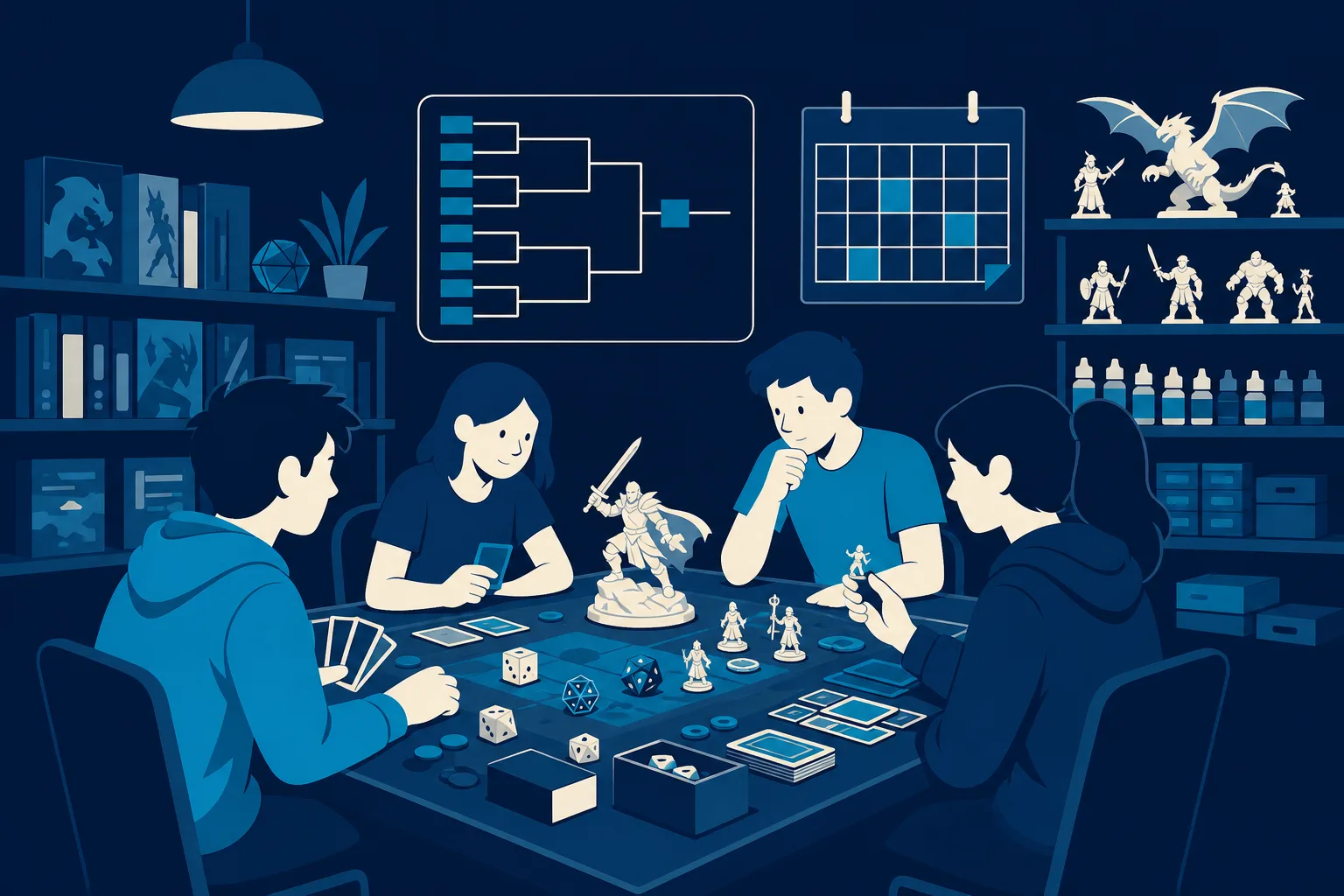
Your hobby shop is not really a store. It is a room where people show up on a Thursday, sit at the same table they sat at last week, and stay three hours longer than they meant to. The board games and the miniatures and the card singles are the reason they walk in the first time. The community is the reason they keep coming back.
So when you build a website for a hobby shop, the goal is not just "sell products online." Plenty of people can buy a booster box cheaper on a giant marketplace, and you will never win that fight on price. What you can win on is the thing the marketplace does not have: a table, a calendar, a league, and a group of people who know each other's names. This guide walks through how to build a hobby shop website that fills those tables and turns a curious first-timer into a Friday-night regular.
What people actually want from your site
Before you pick a single color or font, get clear on who is landing on your website and what they are trying to do. For a hobby shop it is usually one of four people.
- The newcomer who just got into a game and searched "board game store near me" or "Warhammer store [your town]." They want to know you exist, that you are welcoming, and that there is somewhere to play.
- The regular who already loves you and is checking one thing: what is happening this week and what time does it start.
- The event hunter who plays competitively and wants to know your tournament schedule, format, and entry details before they commit a Saturday.
- The gift buyer, often a parent or partner, who has no idea what to buy and needs a friendly human to point them at the right thing.
Notice that only one of those four is primarily there to shop. The other three are there for information and belonging. A hobby shop website that treats itself like a plain online store ignores three quarters of its visitors. Build for all four.
Lead with your event calendar, not your product grid
The single most valuable page on a hobby shop website is a clear, current calendar of what is happening and when. This is what separates you from every online retailer, and it is the reason someone drives to your shop instead of clicking "buy now" at midnight.
Put your recurring events where nobody can miss them:
- Weekly game nights, with the day, the start time, and whether newcomers can just show up.
- League nights and their formats, so a competitive player knows exactly what to expect.
- Learn-to-play sessions, painting nights, model-building workshops, and demo days.
- Kid-friendly or family afternoons, which parents search for specifically.
The detail that matters most is the one shops forget: say clearly whether you have to sign up or can just walk in, and whether beginners are welcome. A nervous first-timer will not come to "Commander Night" if they cannot tell whether everyone there has played for ten years. One friendly sentence such as "New players welcome, we will teach you, loaner decks available" removes the fear that keeps people home.
Keep it current. A calendar that still shows last month's tournament tells visitors your shop might be closed. A calendar updated this morning tells them you are alive and busy, which is exactly the feeling you want.
Make tournaments and leagues easy to find and easy to join
Your competitive players are your loudest advocates and your most reliable weekly revenue, so give them a real home on the site. A good tournament section answers the questions they always ask before they show up:
- What game and format is it (Standard, Modern, a specific points level, a particular ruleset).
- Date, start time, and how long it usually runs.
- Entry cost and what the prize support looks like.
- How many seats there are and how to reserve one.
- Whether it is beginner-friendly or clearly for veterans.
For ongoing leagues, a simple standings or results page is community gold. When people can see their name on a page, they come back to defend it. A short recap after a big event, even two sentences and a photo of the winner holding their prize, tells everyone who missed it what they missed and makes them plan to be there next time. This is the quiet engine of a hobby shop: people do not want to be left out of the story, so they keep showing up to stay in it.
Show the room, not just the products
Photos decide whether a first-timer trusts you, and for a hobby shop the photos that matter are not clean product shots on a white background. They are photos of your actual space with actual people in it.
Get pictures of:
- Your play tables mid-game, with people leaning in and laughing.
- A packed tournament, so the room looks alive.
- Your shelves and wall of product, so browsers can see your range.
- Painted minis, built models, or a nicely staged board, so the craft comes through.
- A friendly shot of you or your staff behind the counter, so a stranger knows who they are walking up to.
A phone camera is fine. What you are selling is the feeling of belonging, and you cannot fake that with stock images of dice. Real photos of your real room do more work than any paragraph of copy. If you run a painting night or a big release event, take five minutes to shoot it. Those images will fill your site for months.
Give products a place without pretending to be a warehouse
You do sell things, and your site should show that, but be honest with yourself about what your website is for. You are almost never going to out-ship a national retailer on new-in-box product. Where you win is on the stuff that is local, curated, or hard to get.
Feature the things that pull people through the door:
- New arrivals and preorders for upcoming releases, so fans check your site to see if you have it.
- Card singles, used games, or trade-in stock, which people cannot get from a big box shipment.
- Starter recommendations for newcomers, so the overwhelmed beginner has an obvious first purchase.
- Gift ideas grouped by age or interest, aimed straight at the confused parent.
You do not need a giant online checkout on day one. Many thriving hobby shops run a simple "reserve it and pick it up" or "message us to hold this" flow, which drives a real visit and a real conversation. That visit is where the community starts. A full online store can come later once you know which products actually sell through the site.
Answer the questions that keep first-timers away
Most people who want to visit a hobby shop for the first time are a little intimidated. Your website's job is to remove every excuse not to come. Put the practical stuff where it is obvious:
- Your address, hours, and a map, on every page, not buried.
- Whether there is table space to play and whether you have to book it.
- Whether outside food is fine, whether you sell snacks and drinks, and how long people can stay.
- Whether there is parking and whether the space is welcoming to kids, teens, and total beginners.
A short, warm FAQ answers the fears people are too shy to ask out loud: "I have never played, can I still come?" "Do I need my own stuff or can I borrow?" "Is it okay to just watch the first time?" Answering these in plain, friendly language is the difference between someone bookmarking your site and someone actually walking in on Thursday.
Keep it fresh without it becoming a second job
Here is the honest problem with a hobby shop website: it only works if it stays current, and you are already running events, ordering stock, and standing behind a counter. A calendar you never update is worse than no calendar. So the real question is not "what should the site say" but "how do I keep it saying the right thing every week without losing an evening to it."
This is exactly where a done-for-you approach earns its keep. With Saynovo, you get an agency-quality hobby shop website built for you, and then you change it by talking to it. After a tournament you can say "add Saturday's Modern results and put the top three players on the events page," and it updates. When a new set drops you can say "feature the new release as a preorder on the homepage," and it is done. No wrestling with a page builder at eleven at night.
If you would rather build and maintain everything yourself and you enjoy that side of it, tools like Wix, Squarespace, or WordPress can absolutely get you there with enough evenings. The trade is time and upkeep. If your evenings are already spoken for by the actual community you are trying to grow, having the site handled for you is usually the smarter trade.
Getting started
You do not need a perfect website to start filling tables. You need a clear one: the events front and center, the tournaments easy to join, real photos of your room, and the practical details a nervous first-timer needs to feel safe walking in.
If you already have a Google Business Profile with your hours, photos, and reviews, Saynovo can import it and generate a first version of your hobby shop website around it for free, so you can see your shop online before you decide anything. Your event calendar and your league nights were never in that profile, so you add those by saying them. From there the next step is small and concrete: put this week's game night and your next tournament where nobody can miss them. That one change is what turns a search result into a stranger at your table, and a stranger at your table is how every regular you have ever had got started.