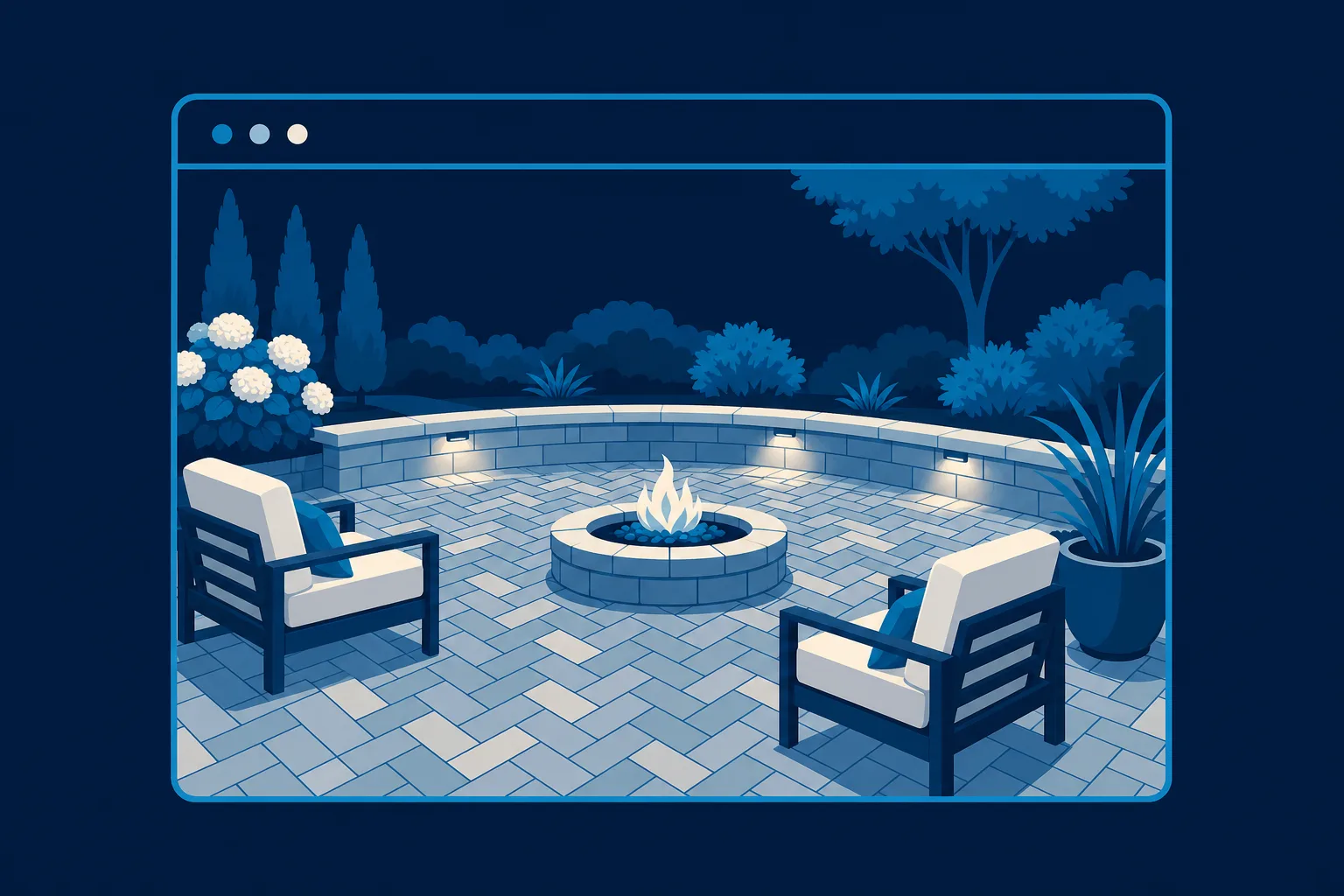
You build things that last twenty years. A paver patio laid on a proper base, a retaining wall with real drainage behind it, a walkway that still sits flat after ten winters. Then a homeowner searches for someone to do that work, finds a slapped-together Facebook page or nothing at all, and calls the loud company with the truck wrap instead. If you have ever lost a job you were more qualified for to a business that just showed up better online, this guide is for you.
Learning how to build a website for a hardscaping company is not about becoming a tech person. It is about turning the photos already on your phone into a machine that fills your schedule with the patio, paver, and retaining wall jobs you actually want. Let me walk you through exactly what that machine looks like.
Who is actually on your website, and what they are afraid of
Before a single page, picture the person clicking. A hardscape buyer is rarely an emergency. Nobody wakes up needing a patio the way they need a plumber at 2am. They are dreaming. They have been staring at a muddy, sloped, useless part of their yard for two summers and finally decided this is the year.
That changes everything about your site. They are not price-shopping a commodity. They are trying to answer three quiet fears:
- Will this look like the picture in my head, or will I regret it? A patio is permanent and expensive. They are terrified of a result that looks cheap or wrong.
- Is this crew going to disappear on me? They have heard the horror stories. Half-finished walls, deposits gone, weeds already growing through the joints by fall.
- Am I even in their world? A $40,000 outdoor living space and a $6,000 walkway are different conversations. They want to know they are talking to the right size company.
Your website's whole job is to answer those three fears before the phone ever rings. When it does, you get a warmer, more qualified call. Do it well and you stop quoting tire-kickers and start quoting people who already trust you.
The design gallery is your entire business, so build around it
For most trades, photos are nice to have. For hardscaping, the gallery IS the pitch. Homeowners buy with their eyes. They cannot read a paver spec sheet, but they can fall in love with a curved flagstone patio wrapped around a fire pit at dusk.
So do not bury your work in a tiny thumbnail strip. Make the gallery a real, browsable centerpiece. A few things that separate a gallery that sells from a phone dump:
- Group by project type, not by date. A visitor who wants a retaining wall does not want to scroll past twelve driveways to find one. Sort into patios, walkways, retaining walls, fire features, and full outdoor living spaces.
- Show the before. The muddy slope next to the finished terraced wall is more persuasive than the finished wall alone. It proves you solve problems, not just lay stone.
- Shoot the details. A tight shot of a clean soldier-course border, a crisp step edge, a wall cap that lines up perfectly. Detail shots quietly tell a serious buyer you are a craftsman, not a guy with a plate compactor.
- Caption with the useful stuff. The paver line, the color blend, the town it is in. "Techo-Bloc Blu 60mm, Chestnut Brown, Maple Grove" tells a ready buyer more than any paragraph.
You do not need a professional photographer. A clean phone photo shot in soft evening light, held level, with the hose and tools moved out of frame, beats a blurry midday snapshot every time. Take the after photo before you pack up and drive away, because you will never go back for it.
Give each material its own page, because that is what people search
Here is a trick most hardscapers miss. Homeowners do not just search for a company. They search for the thing they want. "Paver patio cost near me." "Segmental retaining wall installer." "Travertine vs pavers for a pool deck." "Do I need a permit for a retaining wall over 4 feet."
Every one of those is a page you could own. When you give concrete pavers, natural stone, and retaining walls their own dedicated pages, you do two things at once. You show up in more searches, and you educate the buyer so the sales call is shorter.
A strong material page is not a brochure. It answers the real question the homeowner is chewing on:
- Paver patios: what a proper base actually involves (excavation, gravel, compaction, edge restraint), why the base is where cheap installers cut corners, and how long a real one lasts.
- Retaining walls: the difference between a decorative sitting wall and a structural wall holding back a hillside, when drainage and geogrid matter, and why the wrong wall bulges and fails in a few years.
- Natural stone and specialty work: flagstone, travertine, porcelain pavers, and what each costs to live with over time.
You are not giving away trade secrets. You are proving you know things the low-bid crew does not, which is exactly why you are worth more. A homeowner who reads your retaining wall page and understands why drainage matters will happily pay you more than the guy who never mentioned it.
Say something honest about price without printing a number
Hardscaping buyers are anxious about cost because the range is enormous and they have no reference point. A hidden price feels like a trap. A flat price feels dishonest, because you both know it depends on grade, access, materials, and square footage.
The move is to give ranges and drivers, not a fixed number. Something like: a basic paver walkway starts around one figure, a mid-size patio with a seating wall lands in another, and a full outdoor living space with a kitchen and fire feature is another tier entirely. Then explain what pushes a project up or down: a steep or wet site, poor access for machinery, premium pavers, or add-ons like lighting and drainage.
This does two things. It filters out the person expecting a patio for pocket change, so you stop wasting quote visits. And it builds trust with the serious buyer, who now feels like you are being straight with them. You will get fewer calls and close more of them.
Turn the busy season into booked jobs, not just leads
Hardscaping lives and dies by the calendar. Spring hits and every homeowner in your county decides at once that this is the summer for the patio. By June your good crews are booked out for weeks, and by fall the ground is freezing and the phone goes quiet.
Your website should work the seasons for you instead of ignoring them.
- In late winter and early spring, create urgency. A simple line like "We book the spring build calendar by March and it fills fast. Reserve your consultation now to break ground before summer." That is not a fake countdown. It is the truth, and it moves the dreamer who has been stalling for two years.
- In peak summer, set expectations and keep qualifying. If you are booked six weeks out, say so. "Currently scheduling August installs." A serious buyer will wait for the right crew. It also quietly signals you are in demand, which is its own form of proof.
- In fall, sell the shoulder. Late-season pricing, or booking now for a first-thing-in-spring start so they are first in line next year. A deposit in October beats a cold December.
The point is that a static site treats January and June the same. Your business does not. The best hardscaping websites change their message with the season, and that is exactly the kind of edit that used to mean emailing a web guy and waiting a week.
The pages that actually matter, in order
You do not need twenty pages. You need a handful that each do a job:
- Home: your best three or four project photos above the fold, the towns you serve, and one clear button to request a consultation. A visitor should know in five seconds that you do beautiful hardscaping in their area.
- Gallery: the browsable, grouped portfolio described above. This is where people spend their time.
- Service and material pages: patios, pavers, retaining walls, walkways, and outdoor living. One page each.
- About: the real story. Who runs the crew, how long you have been laying stone in this area, whether you are licensed and insured. This kills the "will they disappear on me" fear.
- Reviews: real words from real neighbors, ideally with the town named. "Our patio in Westfield still looks brand new three years later." Local proof outperforms a five-star average with no context.
- Contact and quote request: dead simple. Name, address or town, what they are dreaming about, and a photo upload if you can manage it. A homeowner sending you a picture of their sloped backyard is a hot lead.
How to actually get this built without losing a season to it
You have three honest paths, and the right one depends on your time and temperament.
Build it yourself on Wix or Squarespace. The tools are genuinely good now, and if you have a slow winter week and enjoy fiddling, you can get a clean site up. The catch is that it is real work, and the site is only as good as the photos and words you feed it. Many hardscapers start this way and stall out with a half-finished site for two years.
Hire a web designer or a marketing agency. You get a professional result and hand off the headache. The tradeoff is cost and speed, and every future change, like flipping your spring urgency message or swapping in this week's finished patio, means an email and a wait. If you want a fully managed partner and budget is not the blocker, an agency like SyntroAI can run the whole thing for you.
Use a done-for-you service built for exactly this. This is where Saynovo fits. If you already have a Google Business Profile with photos and reviews, Saynovo can import it and generate a complete hardscaping website around it, free for your first build, so you can see your own work laid out as a real site before deciding anything. Your paver and wall material pages and your honest price range come from you, said out loud, because Google never stored them.
The part that matters most for a business as seasonal and visual as yours is what comes after launch. With Saynovo you edit the site by talking to it. You finished a stunning fire pit patio in Maple Grove this afternoon, so you say "add these four photos to the gallery under patios," and it does it. Spring is coming, so you say "put a note on the home page that we are booking the spring build calendar now," and it changes. No email, no waiting on a developer, no losing a warm week of demand because your website still says you are booked through last August.
Your next step
Do not wait for a slow month to figure out the perfect website. Start with what you already have. Go find your ten best finished projects, the ones that still make you a little proud, and get them somewhere a searching homeowner can see them.
If you want to see what your work looks like as a real, bookable website without paying to find out, import your Google Business Profile, let the first version get generated around it, then say the rest. Then get it saying exactly what your season needs it to say, and let it start booking the patios you were built to build.