Someone is standing in their garage right now, staring at a pile of old drywall, a busted couch, and three years of stuff from the basement. They pull out their phone and type "dumpster rental near me." In the next ninety seconds they will decide who gets a hundred-plus dollars of their money. If your website answers three questions fast - what size, what price, and can you deliver to my street - you win that job. If it does not, they call the next number.
This is a guide to building a website for a dumpster rental business that actually books drop-offs, not one that just sits there looking nice. It is written for the owner who might not have a website yet, or has a one-page placeholder that does nothing. No jargon. Just the pages, the details, and the choices that get a roll-off in someone's driveway by Monday.
What a dumpster rental customer is really asking
Your customers are not shopping the way a restaurant or a gym customer shops. They are mid-project, a little stressed, and they want the whole thing handled without a phone tag marathon. There are really only two kinds of them:
- The homeowner. Cleaning out a house, doing a garage teardown, ripping out an old deck, or handling an estate. They have never rented a dumpster before and do not know what "10 yard" means. They are nervous about the price and about a truck cracking their driveway.
- The contractor or crew. Roofers, remodelers, landscapers. They know exactly what they need, they rent often, and they care most about whether you can deliver tomorrow and swap it out fast. They want to book in thirty seconds and get back to work.
Your website has to serve both without slowing either one down. The homeowner needs hand-holding. The contractor needs speed. The good news is the same four things do both jobs: clear sizes, honest pricing, real online booking with dates, and a service area they can trust.
Show your dumpster sizes like a human, not a spec sheet
The single biggest source of anxiety for a first-time renter is picking the wrong size. Too small and they have to rent twice. Too big and they feel ripped off. A spec sheet full of cubic yards does not help them. Translate every size into something they can picture.
For each size you carry, put these on the page in plain terms:
- The name and the yardage. For example, a 10-yard, a 20-yard, a 30-yard.
- What it looks like in real life. "About the length of a pickup bed and chest-high" beats "10 cubic yards" every time.
- What it holds in pickup-truck loads. "Roughly three to four pickup loads" is a measuring stick everyone owns.
- The job it is made for. A single-room cleanout, a small bathroom remodel, a roof tear-off, a whole-house purge.
- The footprint on the ground. How many feet long and wide, so they know it fits in the driveway and not on the neighbor's grass.
A short honest line does more than a big photo: "Not sure? Most single-room cleanouts fit a 10-yard. When people guess wrong, they guess too small - if you are between sizes, go up one." That sentence prevents a re-delivery and earns trust.
Put a real photo of each dumpster next to a house or a car for scale. Stock renders make you look like a broker, not a local company with real trucks.
Put your pricing where they can see it
Here is the thing most dumpster rental sites get wrong: they hide the price behind a "call for a quote." First-time renters read that as "this is going to be expensive and awkward." They bounce.
You do not have to publish a rigid price for every scenario. You have to remove the fear. Show a clear starting price for each size and spell out exactly what is included so there are no surprise fees on drop-off day. Cover the four things every renter secretly worries about:
- The rental period. How many days is the flat price good for, and what a longer stay costs per day.
- The weight allowance. How many tons are included, and the per-ton charge if they go over. Homeowners have no idea a dumpster has a weight limit, so a one-line explanation ("heavy stuff like concrete, dirt, and shingles hits the limit fast") saves you an angry phone call later.
- What is not allowed. Tires, paint, mattresses, appliances with freon, hazardous stuff. List it plainly. This protects your load and your dump fees.
- Delivery and pickup. Whether it is baked into the price or added, so the number they see is close to the number they pay.
Transparent pricing is not just kindness, it is a filter. It scares off the price-shopper who was going to waste your time and reassures the ready-to-book customer that you are straight with them. If you genuinely cannot post prices because your market swings on dump fees, at least post a range and the exact list of what changes it.
Make online booking with real dates the main event
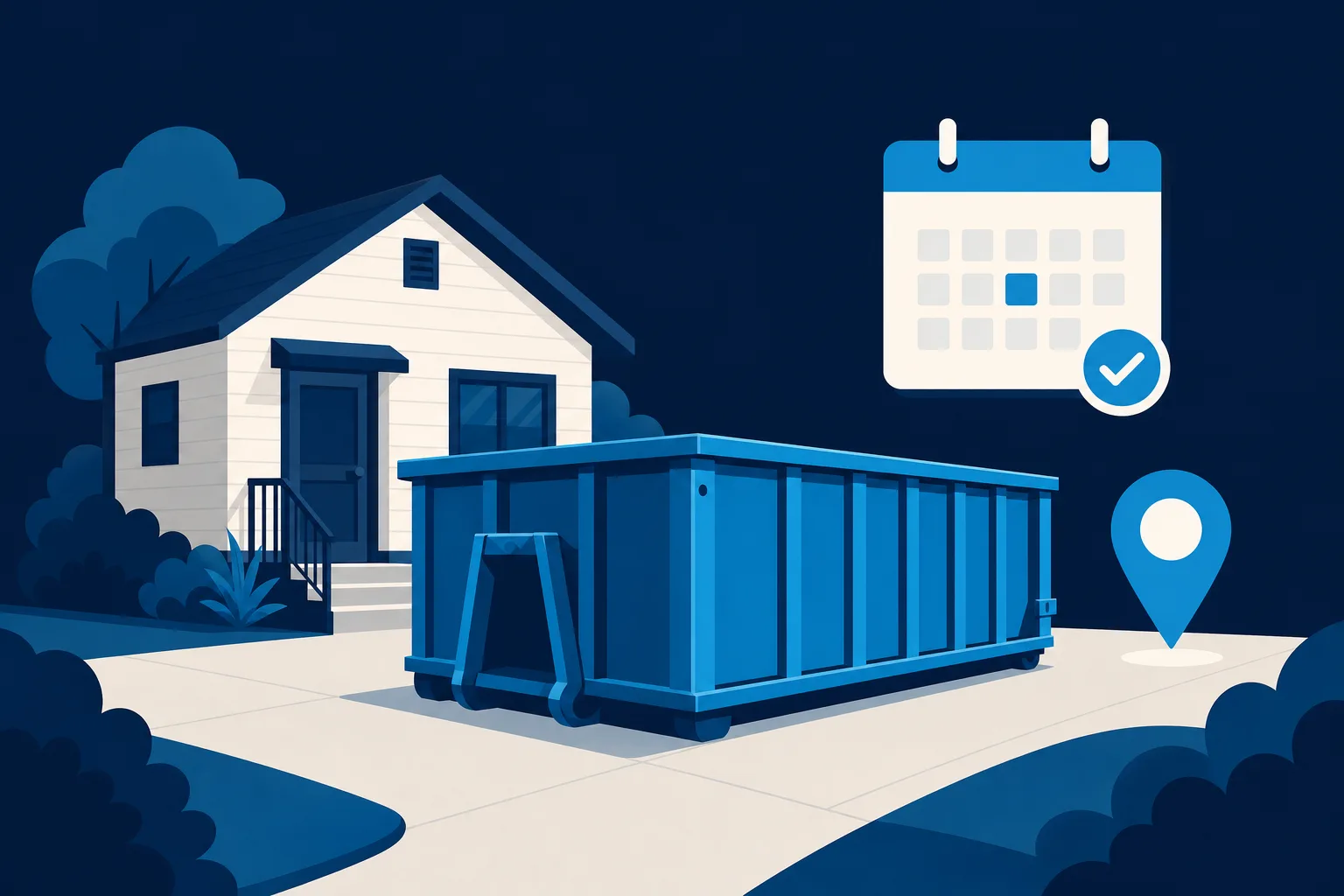
A phone number alone is a leak. Plenty of your customers are searching at 9pm or during a lunch break and will not call. Some of your best contractor accounts want to book without talking to anyone. The website should let them pick a size, pick a delivery date, and lock it in.
A booking flow that actually converts asks for only what you need:
- Size (already chosen from the sizes section).
- Delivery date and a pickup or "call when full" option. Let them see which dates are open. Nothing kills a booking like submitting a request and waiting a day to hear if you even have a bin free.
- The drop address - which also confirms they are in your service area.
- Where to place it - driveway, street, side yard - and a checkbox for "I understand a permit may be needed if it goes on the street."
- Name, phone, and how to pay.
Keep it to one screen if you can. Every extra field is a place people quit. And whatever your booking form does, make sure a confirmation lands in their inbox and texts their phone, because a dumpster showing up is a big deal and people want proof it is really coming.
If online booking with live dates feels like a mountain to build, this is exactly the kind of thing a done-for-you website should handle for you. With Saynovo, you connect your Google Business Profile, get an agency-quality site built for you, and when you want to change a size, a price, or a booking rule you just say it out loud - "add a 15-yard and set the flat rate for seven days" - and the site updates. No dashboard to wrestle, no developer to email.
Nail your delivery service area so nobody wastes a click
A dumpster rental business lives and dies by drive time. A drop-off forty minutes away can eat your whole margin in fuel and hours. Your website should make your service area obvious so you only get bookings you actually want.
Do this in two layers:
- Say it in words. List the towns, cities, and counties you cover, by name. "We deliver across the north metro: Springfield, Fairview, Oak Hills, and everything inside the county line." Those town names are also what people type into Google, so this doubles as local SEO.
- Show it on the address step. When someone enters a drop address outside your zone, tell them right away instead of taking a booking you have to cancel. If you charge a mileage fee past a certain radius, say so up front.
If you serve a wide area, build a short page for each main town you cover with a sentence or two about that specific place. It helps you show up when someone searches "dumpster rental in Fairview" instead of only the generic term everyone else fights over.
The other pages that close the deal
Sizes, pricing, booking, and service area do the heavy lifting. A few supporting pieces turn a maybe into a yes.
An honest FAQ
This page kills objections before they become phone calls. Answer the questions people are actually afraid to ask:
- Will the truck damage my driveway? (Explain the boards or plywood you put down.)
- How much notice do you need for delivery?
- What if I fill it faster than expected or need it longer?
- Can it go on the street, and who handles the permit?
- What happens if I put something in there I was not supposed to?
Reviews from real neighbors
A dumpster in a driveway is a visible, public thing. People want to know a stranger's truck showing up at their house is going to be professional. Pull in your Google reviews and feature the ones that mention on-time delivery, clean pickup, and no surprise fees. If you are brand new and have none yet, ask your first five customers the day of pickup, when they are happiest.
A dead-simple contact and a giant phone number
Even with great online booking, some people - especially older homeowners and busy contractors - just want to call. Put a tappable phone number in the top corner of every page and near every price. On a phone it should dial with one tap. Do not make anyone hunt for how to reach you.
Make sure it works on a phone, because that is where the job starts
Almost every dumpster search happens on a phone, often standing in the mess that needs hauling. If your site is slow, pinch-to-zoom tiny, or the booking form is a nightmare with a thumb, you lose the job to whoever is easier. Test the whole thing on your own phone: can you find a size, see a price, pick a date, and book in under a minute without squinting? If not, fix that before anything else.
Speed matters too. A page that takes five seconds to load loses a chunk of visitors before they see a word. Keep photos sharp but light, and skip the auto-playing video of a truck that nobody waits for.
Get found before you get booked
A perfect website nobody sees books nothing. Two moves matter most for a local dumpster business:
- Claim and fill out your Google Business Profile. For "dumpster rental near me," the map results sit above everything. A complete profile with real photos, your service area, hours, and steady reviews is often what gets you the click in the first place. Your website and your profile should point at each other.
- Name your towns on the site. As covered above, the actual place names you serve are the phrases people search. Use them naturally in your headings and your service-area page.
You do not need a hundred blog posts. You need a fast, clear site that says exactly what you do, where, for how much, and a Google profile that puts it in front of the person with the pile in their garage.
Your next step
You do not need to become a web designer to book more drop-offs. You need four things done right: sizes a homeowner can picture, pricing that does not make people flinch, booking with real dates, and a service area that filters out the jobs you do not want. Get those four working on a phone and you will out-book the competitor who is still hiding behind "call for a quote."
If you would rather have all of that built for you and never touch a dashboard, that is what Saynovo is for - it imports your Google Business Profile for free to build the first version, and from there you shape it by talking to it. When your dump fees change, when you add a size, when you want to pause bookings during a busy week, you just say it and it is done. Spend your time keeping trucks moving, not fighting with a website.
Start with the sizes page. Write each one the way you would explain it to a nervous first-time renter on the phone. If you can do that, you already have the hardest part of the site written.