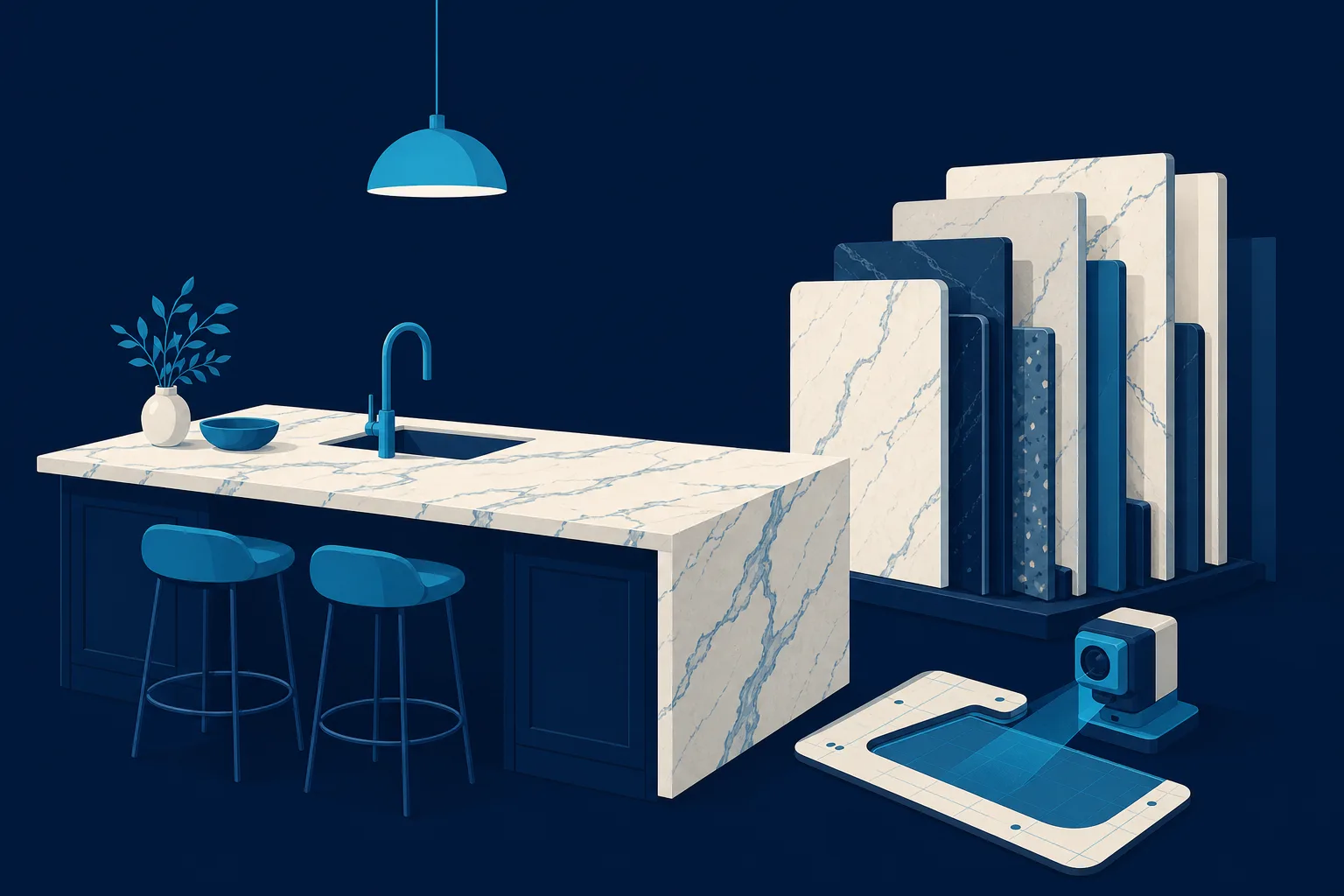
You already know the moment a job becomes real. It is not the phone call. It is the day your tech shows up with the laser, maps the cabinets, and pins down the sink cutout to the eighth of an inch. That template visit is where a curious homeowner turns into a signed kitchen. So the whole point of a website for a countertop installer is not to look pretty. It is to move someone from "I am pricing granite" to "come measure my counters" without you playing phone tag for a week.
Most countertop shops have the opposite. A page with a logo, a phone number, and three blurry slab photos from 2019. Meanwhile the homeowner has ten browser tabs open, half of them big-box estimators, and they cannot tell your shop apart from the next one. This guide walks through the exact pages, photos, and one form that make your site the one that books the template.
Know who is actually reading (and how nervous they are)
The person landing on a countertop website is almost always mid-project and slightly overwhelmed. The cabinets are ordered or already in. A remodeler or a designer may be pushing them. They have heard "granite is dated" and "quartz is bulletproof" and they are not sure what is true. And they are scared of one thing above all: signing off, then getting surprised by a seam in the wrong place, an edge they hate, or a price that jumped after measurement.
Your site is not talking to a builder who knows the trade. It is talking to a homeowner who wants to feel like they will not get burned. Two buyers show up most:
- The kitchen remodeler homeowner. New cabinets, picking counters last, wants it to feel like the Pinterest board. Cares about slab veining, edge profiles, and how the sink sits.
- The one-room upgrade. Tired laminate in a bathroom or a small kitchen. Price-sensitive, wants a fast turnaround, needs to know templating and install will not take a month.
Write and photograph for both, and you stop losing the ones who click away because your site felt like it was built for contractors, not for them.
Lead with the slab gallery, because they are shopping with their eyes
Countertops are the most visual trade in the whole remodel. Nobody falls in love with a paragraph about "premium stone solutions." They fall in love with a photo of a waterfall island in a bright kitchen. Your gallery is the most important page you have, so build it like a showroom, not an afterthought.
Do these things and you will outclass most countertop sites in your zip code:
- Group by material, not by date. Give quartz, granite, quartzite, and marble their own clearly labeled sections. A shopper who has decided on quartz should not have to scroll past twenty granite kitchens.
- Show the whole room, then the close-up. One wide shot of the finished kitchen, then a tight shot of the veining and the edge. The wide shot sells the dream, the close-up proves your seams and polish are clean.
- Name what they are looking at. A short caption like "Calacatta quartz, waterfall island, mitered edge" teaches the homeowner the vocabulary they need and quietly shows you know your craft.
- Include a few bathrooms and small jobs. Not every visitor has a giant kitchen. Seeing a vanity top tells the one-room buyer you want their work too.
Real photos of your own installs beat stock every time. A homeowner can smell a catalog image, and it makes them wonder what your actual work looks like.
Turn the price question into a measure-and-quote request
Here is the trap. Every countertop shopper wants a number, and the big estimator sites train them to expect an instant one. But you cannot honestly quote a kitchen you have not measured. Overhangs, sink type, backsplash, seams, and cutouts all move the price. If your site pretends to give an exact online total, you either lowball and eat it, or you quote high and scare people off.
So do not fight the price question. Redirect it. Your site should say, in plain language, that a real quote comes after a measurement, and that the measurement is easy to book. Frame it as a benefit, not a hurdle.
A few honest lines do more than any calculator:
- Explain that final price depends on the slab you choose, the square footage, the edge profile, and cutouts for sinks and cooktops.
- Give a rough per-square-foot range by material so nobody feels blindsided, but make clear the firm number comes at templating.
- Promise the quote after measurement is the price they pay, with no surprise jumps, if that is how you run your shop.
That last promise is worth more than any coupon. The number one fear in this trade is the price moving after they are committed. Kill that fear on the page and you win jobs your competitors lose.
Make "book a template" the one job the site does
Every good countertop website has a single primary action, and yours is booking the measure-and-quote visit. Not "contact us." Not a generic form buried in a footer. A clear, repeated invitation to have you come out, measure, and lock in a real price.
Keep the request form short. The longer it is, the more people abandon it. Ask only for what you need to show up prepared:
- Name, phone, and email
- Address or at least the city and zip
- Which rooms (kitchen, bathroom, laundry, bar)
- Material they are leaning toward, if they know
- Whether cabinets are already installed
That last question matters more than people realize. Cabinets have to be fully set, with any finished end panels on, before you can template. Asking it on the form saves you a wasted trip and signals to the homeowner that you know exactly what you are doing. Put a button that leads to this form in the header, at the bottom of the gallery, and at the end of every page.
Explain templating so the visit feels safe, not mysterious
Most homeowners have no idea what templating is. To them, "we need to come template your counters" sounds like jargon and maybe another charge. A short, friendly page that walks through the process removes the mystery and makes booking feel low-risk.
Cover the questions running through their head:
- What actually happens. A tech comes out and makes a precise digital or physical map of your counters, down to the eighth of an inch, so the stone is cut to fit perfectly the first time.
- What they need ready. Cabinets installed, sink and faucet on site, cooktop or range on hand, and final decisions made, because changes after templating are the biggest cause of delays.
- How long from template to install. Be honest. A straightforward kitchen might be a week or two after measurement; busy season or a complicated layout can run longer.
- Why the seam and edge choices happen now. This is where you show you plan seams in the least visible spots and confirm the edge profile before anything gets cut.
A homeowner who reads this page shows up to the template visit calm and ready, and calm ready customers sign faster and change their minds less.
Answer the material fight before they ask
Granite versus quartz is the argument in every kitchen. Your site can be the calm expert that settles it, which builds trust before you ever meet. You do not need a textbook. You need a short, straight-talking section that helps them choose without pushing.
Hit the real trade-offs a homeowner cares about:
- Quartz. Consistent look, no sealing, very hard to stain. Great for busy kitchens and people who do not want maintenance.
- Granite. Every slab is one of a kind, handles heat well, needs periodic sealing. For people who want natural stone and no two counters alike.
- Quartzite and marble. For the buyer chasing a specific high-end veined look, with a note on the extra care marble needs.
Then tell them the honest truth: the best way to choose is to see full slabs in person, because a two-inch sample never shows how the veining runs across a whole island. That line does two things. It is true, and it pulls them toward a visit to your yard or showroom, which is one step from booking.
Prove you are local, real, and not going to vanish
Countertops are a several-thousand-dollar decision handed to a stranger who is going to cut permanent holes in a homeowner's kitchen. Trust does a lot of the selling. Sprinkle proof across the site, not just on one buried page:
- Reviews that mention specific things, like clean seams, on-time install, and the quote matching the final bill
- The towns and counties you cover, written out, so a searcher in your area knows they are in your zone
- A real photo of your crew or your shop, because a face beats a stock hero image
- Any manufacturer certifications or fabricator credentials that back up your quality
You do not need dozens of reviews. A handful of detailed, believable ones near the booking button reassures the nervous buyer at the exact moment they are deciding whether to fill out the form.
Getting it built without becoming your own web guy
You fabricate and install stone. You should not have to learn a website builder, wrestle a photo gallery, or pay an agency every time you want to swap in last week's install photos. You have a few honest paths.
If you enjoy the tinkering and have the evenings, a Wix or Squarespace template can get you a decent gallery for a monthly fee, though you will be the one resizing photos and fixing the layout on your phone. If you want something heavier and hire a developer, WordPress is flexible but becomes a project you have to maintain. If you would rather hand the whole thing off, a full-service agency will build and run it, usually for a bigger budget.
There is also a middle path built for shops that do not have a spare person for this. Saynovo builds you an agency-quality countertop site done for you, and then you keep it current just by talking to it. When you finish a stunning quartzite kitchen and want it up top, you say "add this waterfall island to the quartz gallery and feature it on the home page," and it changes. If you already have a Google Business Profile with your reviews and photos, Saynovo can import it and generate a first version for free, so you see your own gallery live before deciding anything.
The point is not the tool. The point is that your slab photos and your template booking should never be stuck waiting on you learning software.
Your next step
Look at your current site on your phone right now, the way a homeowner would. Can they see your actual slab work in the first few seconds? Is it obvious how to have you come measure? Is the granite versus quartz question answered without a phone call? If any of those is a no, that is the one thing to fix this week.
A countertop website has exactly one job: turn a slab photo into a booked template visit. Get the gallery, the honest price answer, and the measure-and-quote form right, and your site stops being a brochure and starts filling your install calendar.