Selling CBD is not like selling coffee mugs. Half the people who walk through your door are a little nervous. They are not sure it is legal. They are not sure it will show up on a drug test. They read a scary headline once, or a relative told them it is "basically marijuana," and now they are standing at your counter asking careful questions with a look on their face that says they might turn around and leave.
Your website has the same job your best budtender has: calm that person down, answer the real question behind the question, and make them feel safe spending money with you instead of the gas station down the road. If you want to build a website for a CBD store that actually builds trust, you have to design the whole thing around doubt. Not hype. Doubt. The store that removes the most doubt wins the sale.
This guide walks through exactly what belongs on that site, what to keep off it so you stay compliant, and how to make sure the anxious first-timer three miles away chooses you.
Why trust is the entire game for a CBD store
Think about who is really shopping. You have the 62-year-old with knee pain her doctor could not fully fix. You have the guy who cannot sleep and is tired of pills. You have the young parent with anxiety who does not want to feel foggy. None of them are experts. All of them are quietly worried about three things: is this legal, is it safe, and will it actually do anything.
A pretty website with stock photos of hemp leaves does nothing for those three fears. In fact, leaf-heavy, neon "420" styling often makes older buyers more nervous, not less. The stores that win look clean, calm, and clinical, closer to a wellness shop than a head shop. Your site should feel like a place a cautious 55-year-old would feel comfortable pulling out her credit card.
Trust is not one page. It is a feeling that builds across every page from the plain way you explain things, the lab results you are not hiding, the real face behind the counter, and the total absence of anything that sounds too good to be true.
Put your lab results where nobody has to ask
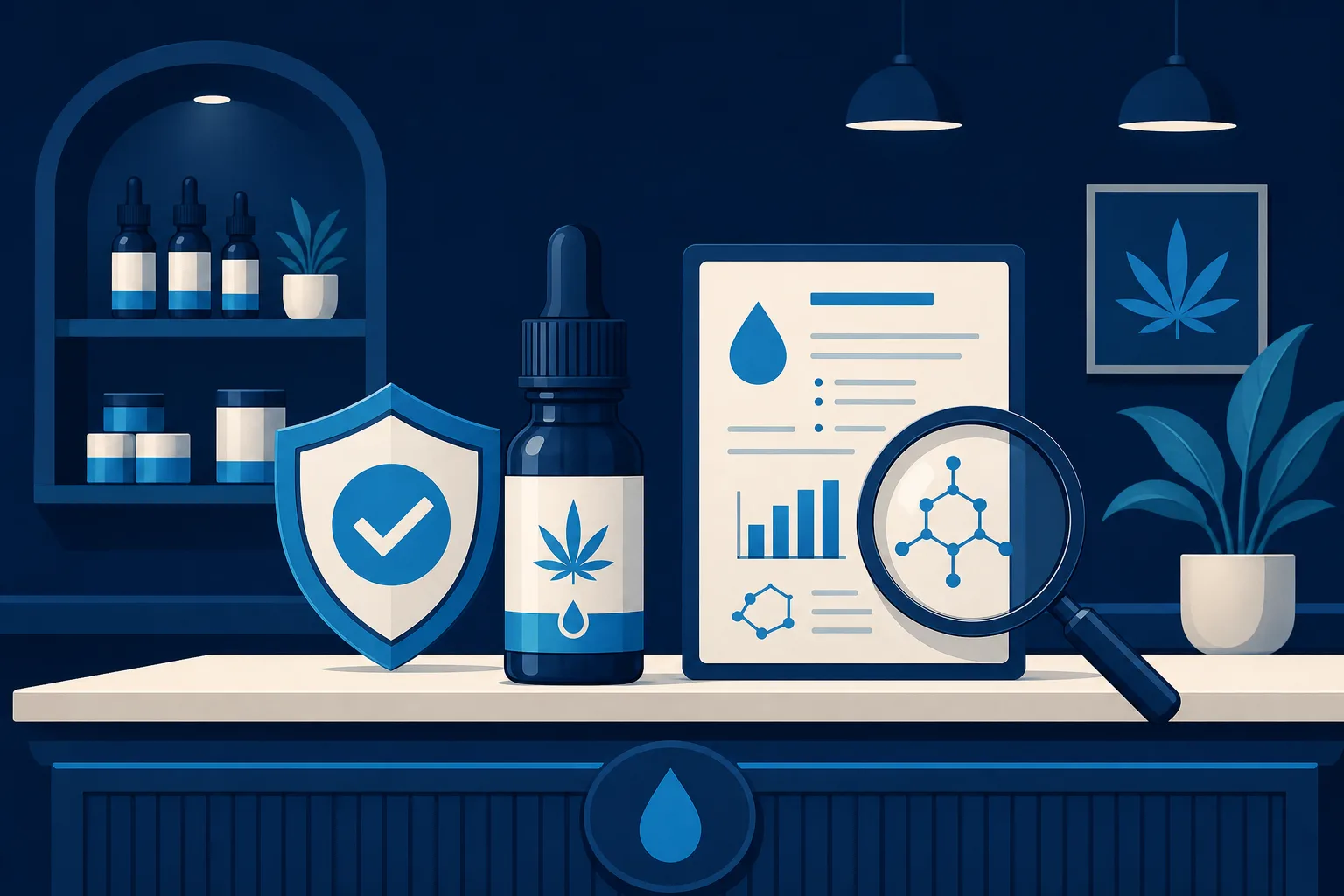
This is the single most important trust signal on a CBD website, and most local stores bury it or skip it. Every reputable product has a Certificate of Analysis, the COA, from a third-party lab. It shows the CBD content, confirms the THC is under the legal 0.3 percent, and screens for pesticides, heavy metals, and solvents.
Do not make people email you for it. Put it right on the product.
- Link the COA directly from each product page, or offer a simple QR code that opens the lab report.
- Add one plain sentence explaining what the report means, because most shoppers have never read one. Something like: this report is from an independent lab, and it confirms what is in the bottle and that the THC is under the legal limit.
- If a batch number matches the report, say so. Matching batch numbers is the detail that separates a real store from a fly-by-night one.
When a nervous shopper sees that you volunteer the proof before they even ask, the doubt drops. You just did the thing the sketchy competitor will not do.
Teach first, sell second
Most of your traffic will be people who do not know the vocabulary yet. Full spectrum, broad spectrum, isolate, CBG, CBN, milligrams per serving. To you it is obvious. To them it is a wall. A confused shopper does not buy, they leave and "think about it," which means they never come back.
So build a genuinely helpful education section written the way you would explain it to a friend at the counter.
- A short "New to CBD? Start here" guide that covers the basics in five minutes of reading.
- The difference between the spectrum types in one honest paragraph each, including the plain truth about trace THC and drug tests, because that question comes up constantly.
- A simple "how much do I take" explainer that talks about starting low and giving it time, without promising any outcome.
This content does double duty. It calms the beginner, and it is exactly what people type into Google when they are curious but not ready to buy. A store that patiently answers "will CBD show up on a drug test" earns the click, the trust, and eventually the visit.
The compliance guardrails you cannot cross
Here is the part that trips up well-meaning owners. You are not allowed to say CBD treats, cures, or prevents anything. The FDA has sent warning letters to CBD sellers for exactly this, and the claims that get flagged are the ones that feel most natural to write, things like "cures anxiety," "treats arthritis," or "relieves pain." Those sentences can also get your payment processor to drop you overnight.
So the rule is simple: describe the product, never promise a medical result.
- Do not say a product treats, cures, heals, or prevents any condition or disease.
- Do not name diseases as things your product handles.
- You can describe the product honestly (its strength, its ingredients, how customers use it) and let your education pages talk in general, non-medical terms.
- Watch your reviews and testimonials too. If a customer writes "this cured my chronic pain" and you feature it on your homepage, regulators can treat that claim as yours. Curate what you publish.
- Add an age gate so visitors confirm they are of legal age, and keep clear terms and a privacy note, because your payment processor will want to see them.
None of this means your site has to be boring. It means you build trust with proof and plain honesty instead of promises. Ironically, that restraint reads as more credible, not less. The store that refuses to overhype sounds like the grown-up in the room.
Make your local presence impossible to miss
A lot of CBD buying is still local and in-person, especially for first-timers who want to ask a human before they commit. That is your edge over the faceless online mega-brands, so lean into it hard.
- Put your address, hours, phone number, and a map on the site, and repeat the address in plain text in the footer so Google can read it.
- Claim and fill out your Google Business Profile completely. When someone searches "CBD store near me," the businesses with photos, hours, and reviews show up first, and that map result is where most local discovery actually happens.
- Ask happy customers to leave a Google review and respond to every one. A steady stream of recent, real reviews does more for a CBD store than almost any ad, because it answers the "is this place legit" fear before the person even visits.
- Show the actual shop. A clean, well-lit photo of your storefront and your shelves tells a cautious shopper this is a real, permanent business, not a website that will vanish next month.
If you serve more than one town, a short page for each area you cover ("CBD in [town name]") helps you show up when neighbors in those specific towns search.
The pages your CBD site actually needs
Keep it focused. A tight, trustworthy site beats a sprawling one every time.
- Home: who you are, that you are local, that everything is third-party tested, and a clear path to shop or visit.
- Shop or product pages: each with strength, ingredients, usage description, and the linked COA. No medical claims.
- Education / CBD 101: the beginner guide and the honest answers to the common fears.
- About: the real story, the owner's face, where your products are sourced, and why you started. People buy wellness products from people they can picture.
- Visit us: address, hours, map, parking notes, and a friendly "come ask us anything" tone.
- Lab results / quality: one page that explains your testing standard in general so shoppers understand the proof they are seeing on each product.
- Contact: an easy way to ask a question before buying, because a lot of CBD sales start with one reassuring reply.
Building it without becoming a full-time webmaster
You run a store. You have inventory to count, a counter to staff, and compliance to stay on top of. You do not have nights free to fight with a website builder or to keep re-uploading COAs every time a new batch comes in.
You have a few honest options. If you enjoy tinkering and have the time, Wix or Squarespace can get a simple informational site up, and if you plan to sell online at scale, Shopify with a CBD-friendly payment gateway or WordPress with WooCommerce gives you the most control (just know CBD payment processing takes extra setup). If you would rather not touch any of it, a hands-on agency will build and run the whole thing for you.
There is also a middle path built for exactly this kind of owner. Saynovo builds you an agency-quality CBD store website and then lets you change it by talking to it. When a new lab report comes in, you say "swap the COA on the 1000mg tincture," and it updates. When you want to soften a line that drifts too close to a health claim, you say "reword this to describe the product without promising anything," and it rewrites it on the spot. It is done for you, and the ongoing edits that normally pile up on a busy owner's to-do list become a sentence instead of a chore. For a store where the copy has to stay careful and the lab results have to stay current, being able to fix things by just saying them keeps you both compliant and calm.
Your next step
You do not need a huge site. You need a trustworthy one. Start with three things this week: get every product's COA linked and visible, write the plain-English beginner guide that answers the drug-test and legality fears, and fully claim your Google Business Profile so "CBD store near me" points to you.
Do those three, keep every word honest and claim-free, and your website starts doing what your best employee does: turning a nervous first-timer into a regular who trusts you enough to come back. That trust, built one honest page at a time, is the whole business.