You build things that last thirty years, and yet the person deciding whether to hire you spends about eight seconds on your website before they decide. That is not fair, but it is how it works. The good news is that a cabinet maker has one of the easiest stories in the trades to tell online, because the work itself is beautiful. The trick is showing it in a way that filters out the price shoppers, attracts the homeowner who actually wants custom, and gets them to book a design consult instead of just clicking away.
This is a practical guide to building a website for a cabinet maker that books custom work. No jargon, no theory. Just what to put on the page, in what order, and why each piece matters to the specific kind of buyer who hires a custom shop.
Know exactly who you are trying to reach
Before you write a single word, get clear on who is standing at the other end of the screen. A custom cabinet buyer is not the same person who buys a flat-pack kitchen from a big-box store. They are usually a homeowner in the middle of a remodel, an interior designer sourcing for a client, or a builder who needs a shop that will not miss a deadline.
What they all have in common is that they have already decided they want something better than stock. They are not looking for the cheapest option. They are looking for proof that you can do the thing in their head, and reassurance that you will not disappear halfway through. Your whole site should speak to that person: someone who values the work and is nervous about picking the wrong shop.
That single idea changes everything. You are not writing to convince people that custom is worth it. You are writing to convince a specific homeowner that YOUR shop is the safe, skilled choice for the piece they already want.
Let the portfolio do the heavy lifting
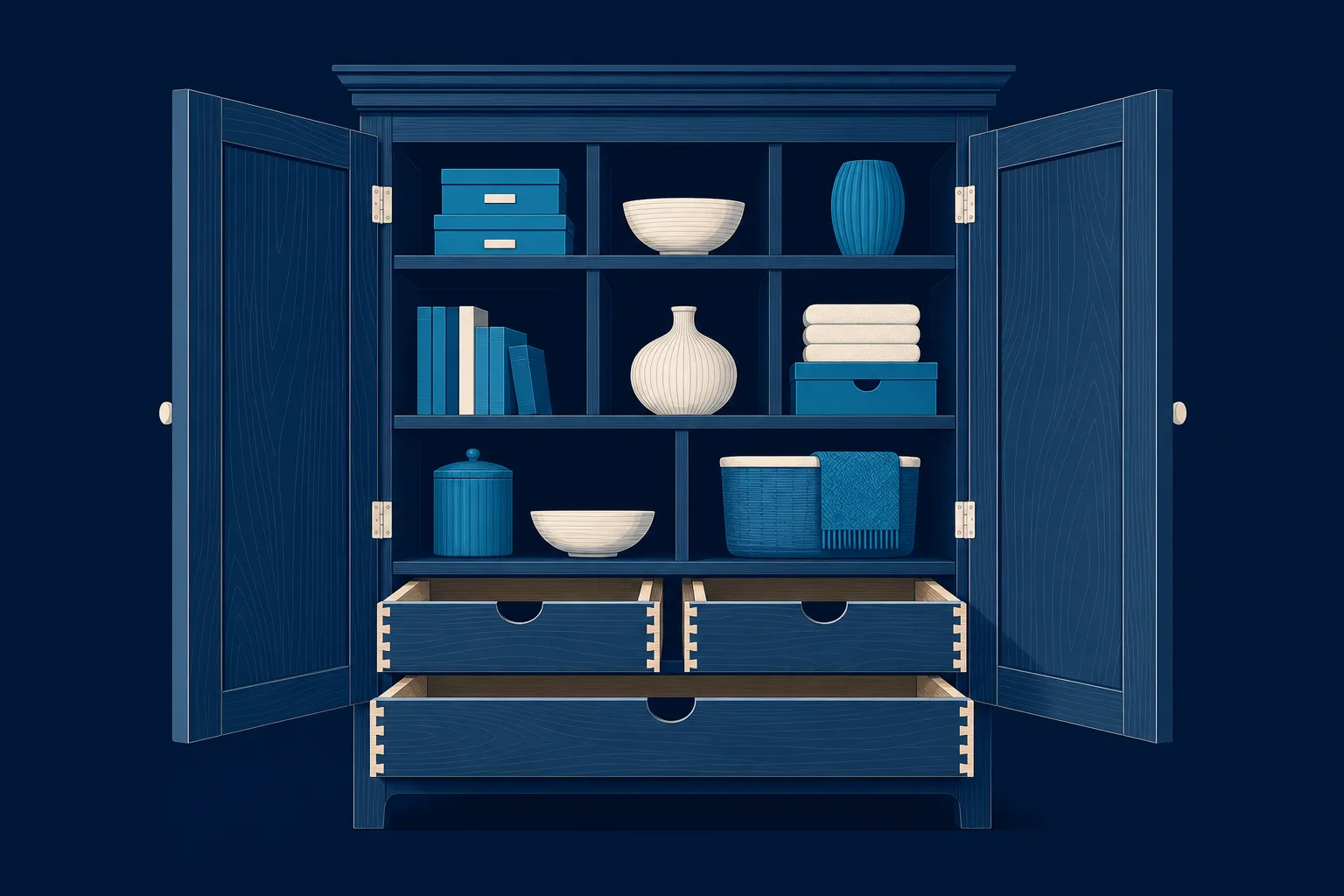
For a cabinet maker, photos are not decoration. They are the product. A homeowner cannot touch your dovetails through a screen, so the pictures have to carry the craftsmanship. This is the single most important part of the site, so spend your energy here.
A few things separate a portfolio that books work from one that just sits there:
- Show the whole range. Kitchens, of course, but also built-in bookcases, a mudroom bench, a floating vanity, a wine wall, a window seat. Buyers need to picture their own project, so give them variety to see themselves in.
- Get close. Wide shots prove you can do a room. Tight shots of a drawer box, an inset door with a nickel reveal, a hand-rubbed finish, or a matched grain across a run of doors prove you can do it well. Custom buyers pay for the details, so show the details.
- Show a few before-and-afters. A dated kitchen turned into something clean and modern tells a story a single glamour shot cannot.
- Name the wood and the door style. A short caption like "rift-sawn white oak, flat-panel Shaker, clear conversion varnish" does two things. It reassures the buyer you know your materials, and it quietly teaches them the vocabulary they will use when they call you.
You do not need a hundred photos. Fifteen to twenty strong, well-lit projects beat a messy dump of everything you have ever built. If your phone shots look flat, it is worth paying a local photographer for one afternoon in a finished kitchen. That set of images will earn its cost back on the first job it books.
Explain custom vs stock without talking down to anyone
Here is a gap almost every cabinet maker website leaves wide open: nobody explains, in plain terms, what "custom" actually buys you. Most homeowners genuinely do not know the difference between stock, semi-custom, and full custom. They just see a big price gap and assume they are being upsold.
A short, honest section that lays this out will set you apart from every competitor who skips it. You do not need charts or jargon. Just walk them through it the way you would at a kitchen table:
- Stock comes in fixed sizes and a handful of finishes, and the filler strips hide wherever the boxes do not line up with the room.
- Semi-custom gives you more sizes and door options, but you are still choosing from a menu.
- Full custom means the cabinets are built for your exact room, your exact ceiling height, your exact appliances, in whatever wood and finish you want, with the storage laid out around how you actually live.
Then say the quiet part out loud: custom is not always the right call, and you will tell them honestly if their project would be served fine by semi-custom. That kind of straight talk builds more trust than any sales pitch. The homeowner who reads it feels informed instead of sold to, and an informed buyer is a much easier buyer to close.
Be honest about lead times
This is where a lot of custom shops lose good jobs, and it is completely avoidable. A homeowner mid-remodel is terrified of two things: paying a lot and then waiting forever, and getting a shrug when they ask how long it will take.
Put your real lead times on the site. If you are booking twelve to sixteen weeks out, say so. If a full kitchen runs eight to ten weeks in the shop once the design is locked, say that too. You might worry this scares people off. It does the opposite. It scares off the wrong people, the ones who needed it done last week, and it earns the trust of the serious buyer who was already expecting to wait for something built by hand.
Explain the "why" behind the wait in one or two lines: design and approval, ordering material, the build itself, finishing and cure time, then installation. When a homeowner understands that a fifteen-week timeline is fifteen weeks of care and not fifteen weeks of you being disorganized, the number stops being scary and starts being reassuring.
Honesty about timing also protects you after the sale. Nobody who read "twelve to sixteen weeks" on your site is going to be angry at week ten. You set the expectation, and the expectation did its job.
Make the design consult the one clear next step
Your website has one job at the end of the day: turn a browser into a booked design consultation. Not a phone call that goes to voicemail, not a vague "contact us." A specific, low-pressure first step.
Frame the consult as what it actually is. Something like: a sit-down where you talk through how they use the space, look at door styles and wood samples, take rough measurements, and give them a realistic ballpark. Tell them what to expect and it stops feeling like a sales trap and starts feeling like the natural first move.
A few things make the consult button actually get clicked:
- Put it everywhere. Top of the page, after the portfolio, after the lead-time section, and at the very bottom. Someone convinced by your dovetails should never have to scroll back up to find the button.
- Keep the form short. Name, phone, email, and a couple of lines about the project. Every extra field you add is another reason to abandon it. You can get the rest of the details during the consult.
- Ask one smart question. A simple "what room are you working on?" or "what is your rough timeline?" helps you walk into the consult already knowing what you are dealing with, and it filters out the tire-kickers.
If you offer a paid design or measure service, say so plainly and explain what it includes. Custom buyers are used to the idea that good design has value, so do not be shy about it.
The pages a cabinet shop actually needs
You do not need a sprawling site. A tight, focused one converts better than a big confusing one. For most custom cabinet makers, this is plenty:
- Home. Your best three or four project photos, one clear sentence about what you build and where, and a consult button above the fold.
- Portfolio or gallery. The heart of the site. Organized loosely by type: kitchens, bathrooms and vanities, built-ins, and specialty pieces.
- Custom process. The custom-vs-stock explainer, your lead times, and a walk-through of how a project goes from consult to installed.
- About. Who you are, how long you have been building, and a real photo of you and your shop. People hiring a craftsman want to know the craftsman.
- Reviews. A handful of real quotes from past clients. For a big-ticket, high-trust purchase, other homeowners saying "they nailed it" is worth more than anything you can say about yourself.
- Contact. The consult form, your service area, and how fast you reply.
Notice what is not on that list: a blog you will never update, a live-chat widget, ten stock photos of generic kitchens. Cut anything that is not helping a serious buyer say yes.
Show up when someone searches for you
A gorgeous website nobody finds does not book work. Most of your customers will find you by searching something like "custom cabinets near me" or "cabinet maker" plus your town. To show up, two things matter more than anything fancy.
First, claim and fill out your Google Business Profile. Add your real photos, your service area, your hours, and ask happy clients to leave a review there. For a local shop, that profile often does more than the website itself, because it is what shows up on the map when someone searches.
Second, make sure your website actually says where you work. Name your town and the surrounding areas in plain text on the page. A shop in Asheville that never mentions Asheville is invisible to everyone searching for a cabinet maker in Asheville.
This is one place where the modern tools genuinely help. Saynovo can take the Google Business Profile you already have and generate a full website around it, free for that first build, so the photos and reviews you have collected become the first draft of your site instead of a blank page you have to build from scratch.
Keep it current without hiring a webmaster
The reason most trade websites go stale is simple: updating them is a pain. You finish a stunning walnut library, you want it on the site, and instead it sits on your phone for six months because touching the website means emailing a developer and waiting a week.
The fix is being able to change your own site the moment you have something to show. With Saynovo you edit by talking to it: say "add these three photos to the kitchen gallery and mention the new maple range hood," and it updates. For a shop owner who would rather be at the bench than fighting a page builder, that is the difference between a site that grows with your best work and one that freezes on the day it launched.
If you would rather hand the whole thing off and never think about it, that works too. A hands-on option like Wix or Squarespace lets you drag things around yourself, and a full agency will build and manage everything for a higher cost. Pick the level of involvement that fits how you like to work. The best website for your cabinet business is the one that actually stays current, not the one that looked perfect for a month.
Your next step
You do not need to overthink this. Start with the part that does the most work: pull together fifteen to twenty of your strongest project photos, get a few close-ups of the details you are proud of, and write down your honest lead times. That single hour of prep is most of what makes a website for a cabinet maker actually book custom work.
From there, get those photos onto a clean site with one clear consult button, make sure your town is named on the page, and point your Google reviews at it. Do that, and the homeowner who wants something built to last will find a shop that looks exactly as skilled as it is, and they will pick up the phone.