The short answer
The real cost of having no website is the work you never hear about: referred customers who search your name, find nothing solid, and call a competitor instead, so the loss never appears on any bill.
That is what makes it dangerous. A missed job leaves no record, no voicemail, no email, so you cannot manage it the way you manage fuel or insurance. Even one job a month lost this way, at your average ticket, is a meaningful annual number, and for most home service businesses that ticket is in the hundreds. The pattern repeats after hours, when someone searching at 9pm has no way to see your services, your area, or your prices, and simply keeps scrolling.
The answer changes if nearly all your work comes from one long-standing commercial contract or a builder who already knows you. Then a website matters less. But if new customers ever look you up before calling, and they do, a simple page with your services, service area, hours and phone number closes the gap.
Most costs in your business show up on a statement. Fuel, insurance, materials, the phone bill. You can see them, so you manage them. The hidden cost of not having a website for your small business is different, and that is exactly why it is dangerous. It never lands on a bill. It shows up as jobs that quietly go to someone else, calls that never come, and estimates that were never requested because the customer picked a competitor before you were ever in the running.
You cannot miss a job you never knew existed. That is the whole problem. This post is not a scare piece with wild numbers. It walks through where the money actually leaks when you have no website, using conservative, real-world math, so you can decide for yourself whether the leak is worth plugging.
The job goes to whoever looks legit first
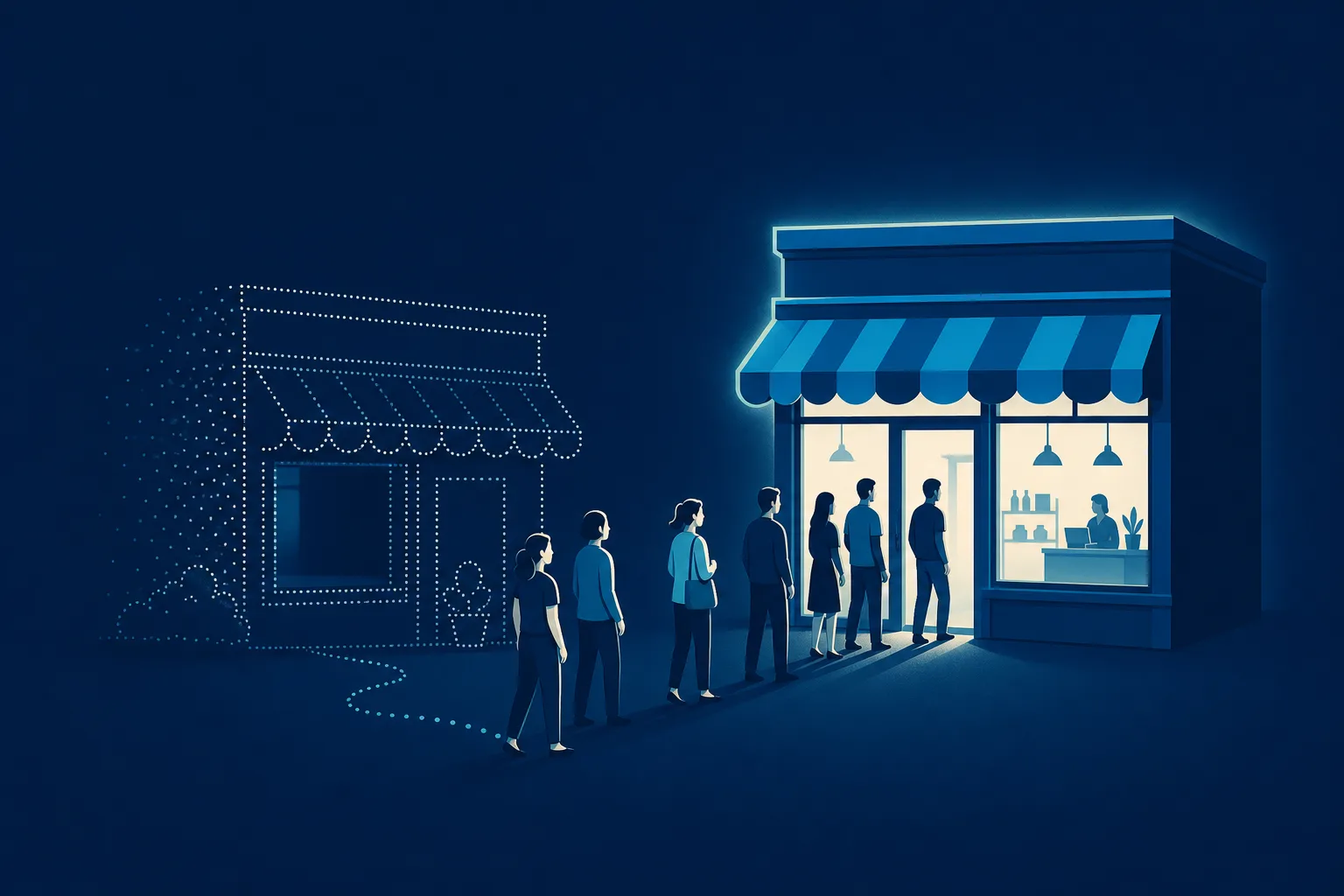
Picture a homeowner whose water heater just started leaking. They ask a neighbor, who says "call these guys, they were fine." The homeowner does what nearly everyone does now. They search that name to check it out before they dial.
If your business has a clean, simple website, they see your service area, a few real photos, your hours, and a phone number. Two minutes later they call. If your business has nothing, or only a bare listing with no site behind it, they hesitate. They go back to the search results, see a competitor with a real website right there, and call that one instead.
You were the referral. You had the inside track. And you still lost the job, because the referral only got the customer to the door and your competitor was the one who looked ready to answer it. This is the quietest loss of all, because the person who referred you never finds out it did not work out. They assume you got the call.
Here is the part that stings. Studies of local buying behavior suggest a meaningful share of referred customers, often estimated around one in four to one in three, drop off during this "let me just look them up" step when there is nothing to find. You did the hard part, earning the referral, and lost it at the last inch.
The trust gap is real and it is not about your work
Nobody doubts your skill because you lack a website. They doubt it because they have no way to check, and in 2026 the absence of a website reads as a small warning sign. Customers have been trained by years of scams and fly-by-night operators to expect that a real, established business has a home online. When there is nothing, a normal, careful person quietly wonders:
- Are they still in business, or is this an old number?
- Are they licensed and insured, or just a guy with a truck?
- Will they show up, or take a deposit and vanish?
- Is this a real local company or someone passing through?
None of those doubts are fair to you. You may be the most reliable operator in your county. But the customer cannot see that, and in the absence of proof, caution wins. A simple website answers every one of those questions before they are even asked. It is not marketing so much as reassurance, and reassurance is what closes a first-time customer who has never met you.
Surveys consistently find that a chunk of consumers, often cited around a quarter to a third, will simply not consider a business that has no website when they have another option that does. You do not have to believe the exact figure. You only have to accept that it is not zero, and that every point of it is a customer who ruled you out silently.
Missed after-hours leads add up faster than you think
Here is a cost that is easy to picture. Think about when people actually decide to hire a local service. It is often at night, on a weekend, or on a lunch break. The furnace quits at 9pm. The pipe bursts on a Sunday. Someone finally deals with the broken fence on a Saturday morning.
Without a website, those moments have nowhere to land. The customer cannot browse what you do, cannot fill out a quick "here is my problem, call me Monday" form, cannot even confirm you cover their town. So they keep looking until they find someone they can act on right then, and the person who captures that late-night decision is the one who gets the job.
Let us put soft numbers on it, deliberately conservative. Say only two people a week try to reach you outside business hours and give up because there is nothing to act on. Say just one of those would have become a real customer. If your average job is a few hundred dollars, that is one lost customer a week you never saw. Over a year, that single quiet leak is a number large enough to matter to any small business, and it never appeared on a single statement. Adjust the inputs to your own business and the shape of the answer does not change. After-hours is when demand is highest and your phone is least available, and a website is the only thing that works while you sleep.
No website means you compete on price, not value
When a customer cannot tell two businesses apart, they fall back on the one thing they can compare: the number. Price becomes the tiebreaker by default. That is a terrible position to be in, because there is always someone willing to go cheaper, and racing them to the bottom is how good operators burn out.
A website is how you stop competing on price alone. It is the place where you get to show why you are worth more:
- The photos of your actual finished work, not stock images.
- The specific problems you solve and the way you solve them.
- Your warranty or guarantee, in plain words.
- The reviews from real neighbors who were happy.
- The small signals of professionalism that say "these people take this seriously."
Give a customer a reason to value you and price stops being the only conversation. Take that reason away and you have handed the decision to whoever quotes lowest. The hidden cost here is not just the jobs you lose. It is the margin you give up on the jobs you win, because you had nothing to justify charging what your work is actually worth.
Why the losses stay invisible
The reason so many owners run for years without a website and feel fine about it is that the meter is completely silent. You still get calls. You still stay busy enough. Nothing is obviously broken. The losses are invisible for three reasons:
- You never meet the customer who ruled you out. They searched, found nothing, and moved on. You have no record they ever existed.
- Your referrers do not report back. When a referral does not convert because the customer could not verify you, the person who referred you rarely hears about it, so neither do you.
- The competitor gets the compounding upside. Every job they win from your lost lead earns them a review, which earns them the next customer's trust, which widens the gap over time. Their site is working for them while yours does not exist.
Add those up and the cost is not a one-time miss. It is a slow bleed that compounds, and the businesses pulling ahead in your area are often not better at the work. They are just easier to find and easier to trust at the exact moment someone is ready to decide.
What actually fixes it (and what you do not need)
The good news is that fixing this is far smaller than most owners fear. You do not need a big, expensive, ten-page website. You do not need to become a marketer or learn any software. To close the leaks described above, a first website really only needs to do a handful of things well:
- Show up when someone searches your business name.
- Say clearly what you do and which towns you serve.
- Prove you are real with a few genuine photos and a couple of reviews.
- Make it dead simple to call or send a message, day or night.
- Look clean enough that a careful person feels safe hiring you.
That is it. Everything on that list is about being findable and trustworthy at the moment of decision, which is precisely where the hidden cost lives. If you already have a Google Business Profile, you are further along than you think, because the core information is already written down. The job is turning it into a real home online.
Where Saynovo fits
If you are a busy owner who has put this off because a website felt like one more project you do not have time for, this is the specific gap Saynovo is built to close. You connect the Google Business Profile you already have, and it builds a real, professional site from what is there, no blank page and no drag-and-drop software to learn. That first build from your profile is free, so you can see your own site before deciding anything.
The part that keeps it from becoming another neglected chore is how you change it. You talk to it. If a phone number changes or you want to add a service or swap a photo, you say so in plain words and the site updates. It is done for you and it stays that way, which for a lot of owners is the difference between finally having a website and putting it off for another year.
If you would rather someone handle absolutely everything, marketing and all, that is what the parent agency, SyntroAI, does. And if you enjoy building things yourself, tools like Wix or Squarespace are honest options worth a look. The point is not which path you pick. It is that any of them beats being invisible at the moment a customer is deciding.
Your one next step
You do not have to fix all of this today. You have to stop the quiet bleed, and that starts with one small action: find out what a customer sees when they look you up right now. Search your own business name the way a stranger would, on your phone, and be honest about whether what appears would earn your trust or lose it.
If the answer is "there is barely anything there," you have just found a cost you can actually control. The competitors winning your referred jobs are not doing anything you cannot do. They just showed up and looked legit first. Take one afternoon to change that, and the jobs that have been quietly slipping past you start landing where they should have all along.
Sources worth reading on this topic:
- The Hidden Cost of Not Having a Website - Grand Apps
- 27% of Small Businesses Have No Website in 2026 - LeadsAgent
- The Real Cost of Not Having a Website - Cellapp