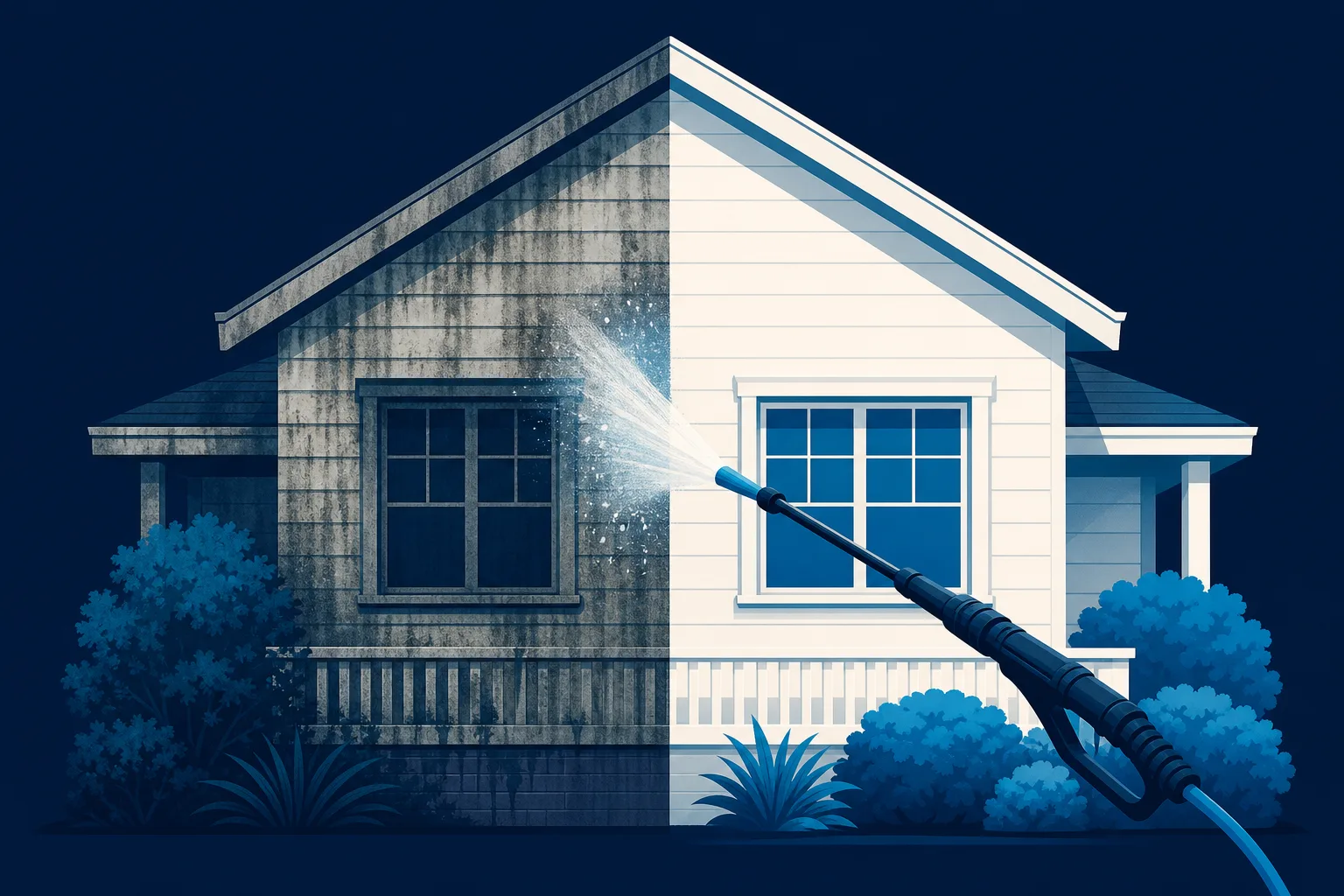
Search for pressure washing website ideas and you get galleries. Twenty screenshots of blue-and-white homepages, a note about how clean they look, and no real answer to the question you actually have: what should my site say and show so a stranger with a filthy driveway decides to book me instead of the guy two towns over. This post is built around that decision. Every idea here earns its place by moving someone from "that stain is bugging me" to "I sent the request."
The reader I am writing for runs the truck, not a marketing department. You wash houses, roofs, driveways, and the occasional restaurant drive-thru pad, and you want a website that sells while you are on a ladder with a wand in your hand. So these pressure washing website ideas are organized around the job at hand, not around design trends. At least half of this helps you even if you build the site yourself in a free tool and never spend a cent.
Lead with the transformation, not a logo
Pressure washing is one of the few trades where the product is a visible, dramatic change. Nobody gets emotional about a clean HVAC coil, but a black-streaked roof turned bright again, or a green-slimed patio gone back to tan concrete, stops the scroll. Your homepage should open with that, not with a stock photo of a pressure washer or a giant logo.
The single strongest move is a real before-and-after up top, ideally a slider or two images side by side, from a job in your own town. The industry write-ups agree on this even when they disagree on everything else: Jobber's roundup and Zarla's examples guide both put "bold before-and-after photos that prove your results" at the center of a good site. The reason is simple. A visitor is not asking "is pressure washing a good idea." They already know their surface is dirty. They are asking "will this person actually get it clean." A photo answers that faster than any paragraph.
Put four things on that first screen and nothing that fights them:
- One real before-and-after, big, from your service area.
- What you do and where, in plain words. "House, roof, and driveway washing across Tampa and Brandon." Not a slogan.
- A tappable phone number that dials on a phone with one press.
- One clear button: "Get a free quote." One, not five.
Give every surface its own page
The biggest mistake pressure washing sites make is cramming everything onto one "Services" page with a bullet list. That hurts you twice. It gives the visitor no confidence you specialize in their exact problem, and it gives Google almost nothing to rank. Someone worried about their shingles is typing "roof cleaning" or "soft wash roof," not "pressure washing services."
Build a separate page for each real service you sell. For most washers that means:
- House washing (soft wash siding, vinyl, stucco, brick).
- Roof cleaning, and say soft wash clearly, because homeowners are scared you will blast their shingles off.
- Driveway, sidewalk, and concrete flatwork.
- Deck and fence cleaning, and note if you also seal or stain.
- Gutter brightening and gutter cleanout, which are different jobs, so say which you do.
- Commercial flatwork: storefronts, sidewalks, dumpster pads, drive-thru lanes.
- Fleet and equipment washing, if you touch it.
Each page should carry photos of that exact surface, a short plain explanation of your process, what is included, and its own quote button. This is not busywork. It is how a homeowner finds you when they search their specific problem, and it is how you stop competing on price against washers who look identical from a one-line list.
Explain soft washing, because fear loses you jobs
A lot of your buyers have heard a horror story: a neighbor who let someone "pressure wash" their roof or old siding and ended up with gouged shingles or water forced behind the boards. If you soft wash, a plain paragraph explaining that you use low pressure and cleaning solution, not a firehose, removes a real objection. It also quietly separates you from the guy with a rented machine who does not know the difference. Educating instead of bragging is the kind of content the Servgrow guide points to as a differentiator, and it happens to build trust at the exact moment the reader is nervous.
Make the before-and-after gallery do sales work
Most galleries are a dumped folder of photos. A gallery that books jobs is organized and captioned. Small changes matter:
- Group by service, so a roof buyer sees roofs, not a driveway.
- Caption with the town and the problem solved. "Algae-streaked roof, Clearwater" builds local trust and quietly helps local search.
- Keep the before and after the same angle and crop. Mismatched shots read as fake.
- Add a few short videos. A ten-second clip of black runoff sheeting off a driveway is more convincing than any still, and it is easy to shoot on your phone between jobs.
One honest warning: do not steal stock before-and-afters or pull them from other companies. Buyers in this trade are sharp, and a reverse image search or a mismatched roofline can wreck your credibility. Your own average work beats someone else's spectacular work.
Write for the three buyers who hire pressure washers
Generic advice treats "the customer" as one person. In this trade you really have three, and they decide differently. A homepage that speaks to all three, and service pages that split them out, converts far better than one that assumes everyone is a homeowner.
- The homeowner. Often driven by a single eyesore (a green roof, a stained driveway) or by prepping to sell or host. Emotional, wants it to look good, and is quietly nervous about damage. Reassure with before-and-afters and the soft-wash explanation.
- The real estate agent or home seller. Wants curb appeal fast, before a listing photo or open house. Sells on speed and turnaround. A line like "listing next week? we can usually get out within a few days" speaks straight to them.
- The commercial or property manager. Storefronts, HOAs, restaurants, apartment complexes. Cares about liability, scheduling, recurring service, and being invoiced properly. They want a dedicated commercial page that mentions insurance, recurring maintenance plans, and after-hours work so you do not close their business.
Even a solo operator can serve all three. You just need the site to say so, because a property manager will not guess that the guy washing houses also does quarterly sidewalk cleaning for a strip mall.
Show pricing, or at least show the shape of it
Nobody expects an exact number for every job, but a page with zero pricing makes anxious buyers bounce. You do not have to publish a full price list. You can lower the fear a few ways:
- Give starting-at prices for common jobs. "Driveways from a set starting price" sets expectations and filters out tire-kickers.
- Explain what changes the price: square footage, roof pitch, how bad the buildup is, single versus two-story.
- Offer a fast quote path. A form where someone can describe the surface and attach a phone photo often beats making them wait for an in-person estimate. For urgent curb-appeal jobs, the fastest responder frequently wins.
The washer who answers a quote request within an hour usually beats the one with the prettier website who replies tomorrow. Speed is a feature. Build your site so a request reaches you the moment it is sent.
Build the site around your seasons
Pressure washing is deeply seasonal, and a smart site leans into that instead of sitting still all year. Your calendar is not the same as a plumber's, so your homepage message should not be either.
- Spring is your flood. Pollen, winter grime, and everyone waking up to a dirty house at once. Push house washing and driveways hard, and expect your quote form to carry the load.
- Summer holds steady with decks, fences, patios, and pool areas as people host and use their yards.
- Fall shifts to gutter cleanout, roof cleaning before winter, and pre-holiday house washing so the place looks sharp for guests and family photos.
- Winter, in colder regions, is your slow stretch. This is when commercial recurring work, gift certificates, and booking spring jobs early keep the lights on. In warmer states it is often just business as usual.
You do not need to rebuild the site four times a year. You need a homepage headline and a top offer you can swap in twenty minutes as the season turns. A site that still shouts "spring cleaning special" in October looks asleep. Being able to change the message the day the season changes is worth more than any single clever design.
The trust signals that matter for this trade
Cleaning someone's home means they have to trust a stranger with a machine that can, in the wrong hands, do damage. A few specific proofs carry more weight here than generic badges:
- Proof of insurance, stated plainly. Commercial buyers will not book without it, and homeowners relax when they see it.
- Real reviews with the town named, pulled from Google where possible.
- Your process, briefly. Saying you protect plants, test a small area, and use the right pressure for each surface signals you are not a weekend renter.
- A satisfaction or re-clean promise, if you offer one. Low risk to you, high reassurance to them.
Where a tool like Saynovo fits
If you already have a Google Business Profile with a stack of job photos on it, much of the raw material for the site above already exists: your service area, your hours, your reviews, and those before-and-after shots. Saynovo (saynovo.com) reads that profile and assembles a booking-focused site around it, then lets you adjust it by talking to it in plain language, so swapping a spring headline for a fall one or reordering your service pages does not mean hiring anyone or learning software. The first build from your profile costs nothing, so you can see your own photos turned into a real site before deciding to keep it. It will not give you pixel-level design control or an online store, and if you want fully hands-off custom work that lives with the SyntroAI agency (syntroai.com) instead.
A short build order that actually ships
Perfect sites do not get finished; shipped ones book jobs. If you do nothing else, do these in order:
- A homepage with one real before-and-after, your area, a tappable number, and one quote button.
- A separate page per service you actually sell, each with matching photos.
- A quote form that lets people attach a phone photo, wired to reach you fast.
- A gallery grouped by service with town captions.
- Proof of insurance and a handful of local reviews.
- One swappable seasonal headline you update as the calendar turns.
That is the whole list. Every one of these pressure washing website ideas points at the same outcome: a stranger looking at a dirty surface, seeing proof you can fix it, and booking you before they close the tab. Start with the photos, give each surface its own page, speak to the buyer who is actually reading, and keep the message moving with your seasons. Do that and the site earns its keep while you are out running the wand.
Sources worth reading: Jobber's pressure washing website examples, Zarla's pressure washing website guide, and Servgrow's pressure washing website features.