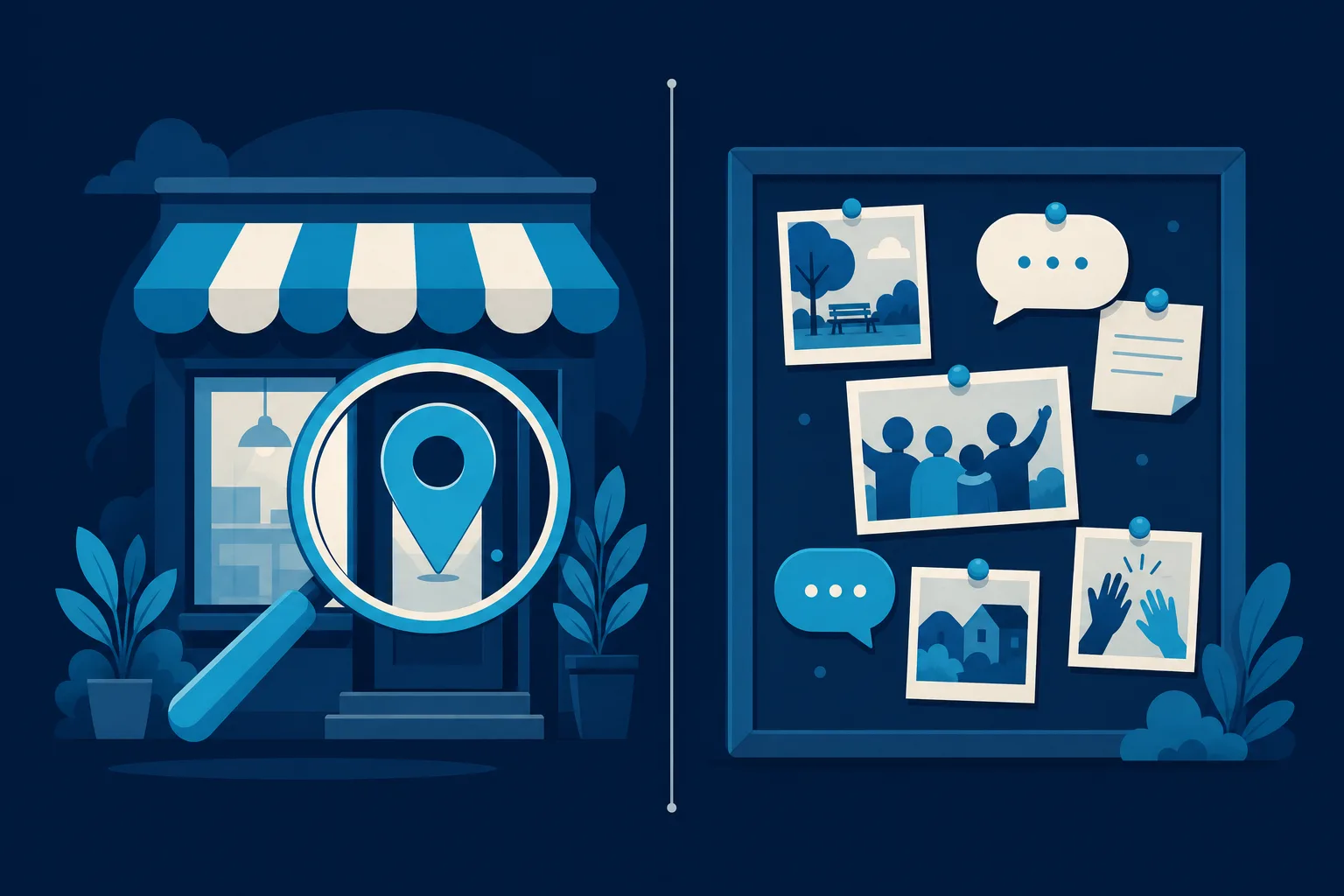
If you run a roofing company, an HVAC shop, or a cleaning crew, you have probably wondered whether to pour your limited time into your Google Business Profile or your Facebook page. The honest framing of Google Business Profile vs Facebook Page is not "which one do I keep." It is "which one earns the phone calls, and which one is the supporting act." Both are free listings, and both matter, but they do genuinely different jobs. Treating them as interchangeable is how owners waste hours posting into the void while the channel that actually books work sits half finished.
This post compares them the way a busy owner needs it: by how people find you, how fast they buy, how much control you keep, and how much weekly effort each one demands. We will give a clear verdict, route different readers to different picks, and cover one Google policy change from 2025 that quietly reshaped the whole question. At the end we will also name the one thing neither free listing can be, and when it is worth adding.
First, set expectations: these are listings, not websites
Before the head-to-head, get one thing straight, because it prevents a common mistake. A Google Business Profile and a Facebook page are both free listings on someone else's platform. Neither is a website you own. For plenty of small local businesses, a strong listing is genuinely enough to get calls, and you do not need anything more to start. So this is not a race to spend money. It is a question of where your free effort pays off first.
With that framed, here is how the two stack up.
How people find you: search intent vs the scroll
This is the core difference, and everything else follows from it.
Your Google Business Profile shows up when someone actively types "emergency plumber near me" or "roof leak repair" plus their town into Google. That person has a problem right now and is looking for someone to solve it. They see the map with three businesses pinned under it (the local pack), your reviews, your hours, and a call button. The intent is already there. You are not convincing anyone to want a plumber. You are convincing them to pick you.
A Facebook page reaches people while they scroll past photos of their cousin's vacation. Nobody opens Facebook thinking "I need to hire a restoration company today." So your post has to interrupt a passive browse and plant a seed for later. That is a harder job, and it is why the timelines differ so much. Industry data cited by DigiMan Marketing shows roughly 76 percent of people who run a local mobile search visit a business within 24 hours, and about 28 percent make a purchase. Social discovery rarely converts that fast, because the person was not shopping to begin with.
Winner for finding new, ready-to-hire customers: Google Business Profile, and it is not close.
Reach: who actually sees your stuff
Here is the number that surprises most owners. When you post to your Facebook page, only a small slice of your followers ever sees it. Organic reach on Facebook pages now averages in the low single digits, commonly cited around 1 to 6 percent of followers per post and trending lower, per benchmark data from Socialinsider. You could build an audience of 800 local followers and have a post reach only a few dozen of them unless you pay to boost it.
Your Google Business Profile has no such throttle. When someone searches your category in your area, Google decides whether to show you based on relevance, distance, and prominence, not on whether you paid to reach your own audience. A complete, active profile simply shows up. You are not renting access to people who already chose to follow you.
- Facebook page: you built the audience, but the platform meters how many of them see each post.
- Google Business Profile: you show up to strangers actively searching, with no pay-to-reach tax on visibility.
Winner for consistent visibility without ad spend: Google Business Profile.
Reviews and trust at the decision moment
Both platforms carry reviews, but they land at different points in the buying journey. Facebook reviews (now "recommendations") sit on your page, where someone has to already be looking at you. Google reviews show up inside the search results and the map, right when a person is comparing you against two competitors.
That placement matters. In the 2026 Local Consumer Review Survey from BrightLocal, the overwhelming majority of consumers read online reviews before choosing a local business, and Google is the platform they check most. Review volume and quality on your profile also feed directly into whether Google ranks you in that local pack. Facebook social activity, by contrast, has essentially no direct effect on your Google local ranking.
Winner for trust at the moment of decision: Google Business Profile.
Control: whose house are you building on
This is where a lot of owners get burned, and it deserves plain talk.
A Facebook page is space you rent, not space you own. The rules and the algorithm can change without notice, and as the Austin Area Chamber of Commerce puts it, the platform can remove, flag, or otherwise throttle your content, or your page could simply vanish, taking your followers and posts with it. You have little real recourse. People do get locked out of pages they spent years building.
A Google Business Profile is more stable, but it is still a listing inside Google's ecosystem, not something you own outright. Google controls how it looks, what features exist, and whether a competitor's spammy edit temporarily knocks your info sideways. It is a strong asset, but it is a listing, not property.
The only thing you truly own online is a website on your own domain. That is the ground neither Facebook nor Google can pull out from under you. Hold that thought, because a 2025 policy change made it more than a nice-to-have.
The 2025 rule change that settles part of the debate
For years, plenty of businesses put their Facebook page URL in the "website" field of their Google Business Profile and called it done. That loophole is closing.
In 2025, Google updated its Business Profile links policies and guidelines. As reported by Search Engine Land, the website field is meant to point to a dedicated page on the business's own site, while social accounts belong in the separate Social Profiles section that sits just below it. In practice, a Facebook page is treated as a social link, not as your main website, and links that once slipped into the website slot can be flagged or removed.
The practical takeaway: Google itself now draws a line between a social listing and a real website. Even a simple one-page site with your services, hours, and contact details satisfies the requirement. That reframes the comparison. It was never really Google Business Profile vs Facebook Page as the two ends of your online presence. It is your profile first, a real website when you are ready for one, and Facebook as a spoke off both.
Effort: what each one costs you in hours
Time is the scarcest thing a working owner has, so weigh this honestly.
- Google Business Profile: keeping it strong takes maybe 30 to 60 minutes a week. Answer new reviews, post a photo of a recent job, confirm your hours around holidays, and reply to questions. High return for low effort.
- Facebook page: running it well is a real content job, often several hours a week to post consistently, respond to comments and messages, and keep the audience warm. And because organic reach is throttled, some of that effort only pays off if you also spend on boosting posts.
If you have five focused hours a week for marketing, the smart split is not equal. Get the profile to excellent first, because it converts fastest, then invest whatever remains into Facebook for the people who already know you.
Winner for return on a busy owner's time: Google Business Profile.
So which free listing is right for you
Choose based on your actual situation, not a blanket rule. In the Google Business Profile vs Facebook Page decision, the right pick genuinely differs by business.
- You are just getting online and can only do one thing well: start with your Google Business Profile. It puts you in front of people searching to hire, it is free, and it converts fast.
- You already have a solid profile and want to stay top of mind with past customers and your community: add a Facebook page and post the human stuff, before-and-afters, team photos, seasonal reminders, quick tips.
- You do repeat or referral-heavy work (wellness, salons, trades with maintenance plans): Facebook earns its keep as a loyalty and word-of-mouth channel, but still behind a strong profile. This is the one segment where a page climbs closest to the profile in value.
- You sell products and want to take orders in-platform: Facebook and Instagram shops give you something the profile does not. If commerce is your model, weight social more heavily.
- You have been using your Facebook page as your "website": fix this now. Move Facebook into the social section of your profile and stop relying on it as your main site.
For most local service businesses the pattern is the same. Google Business Profile first and best. Facebook as a supporting channel for the audience you already have. It is a hierarchy, not a coin flip, and for a lot of owners those two free listings are all you need to keep the phone ringing.
When a free listing stops being enough
Notice what keeps coming up. Your profile is your best tool for getting found, but it is a listing with a fixed layout, a character limit, and no room to answer the questions that actually close a job: your full service list, financing, warranties, service areas, real project galleries, and the details that make a stranger trust you with their home. Facebook has the same ceiling. At some point a growing business wants a place online it fully controls, and after the 2025 changes Google expects that deeper information to live on a site you own.
Not every business hits that ceiling. If a strong profile books all the work you can handle, you do not need a website yet, and that is a legitimate place to stop.
If you decide you do want an owned site, that is a separate step, and there are many good ways to take it. You can use a DIY builder like Squarespace or Wix, hire a freelancer, or, if you want it done for you, there are two in-house paths worth knowing about, at different levels of service and cost. Both come from the same company.
The first is Saynovo, the fast, self-serve, done-for-you product. You connect the Google Business Profile you already keep updated, and its pipeline turns those details, categories, and photos into a full website on your own domain, which you then edit by telling it what to change in plain words. That first build from your profile is free, so you can see the result before committing to a subscription, after which it runs on subscription tiers plus metered AI edits. It is lower cost and quick because you still steer the edits yourself by voice.
The second is SyntroAI, the fully managed agency and the parent company behind Saynovo. Instead of steering it yourself, the team designs, builds, and can maintain a bespoke website for you, hands-off, and can go further than a website into custom software. It is higher touch and higher cost than the self-serve product, and it is the honest choice when you want the whole thing handled or you need a custom, complex, or brand-critical build.
Be clear about what these options are and are not, so you can judge the fit. Neither is a free social listing, so neither replaces the two options in this comparison. Saynovo is not a full-control, drag-every-pixel design tool, and it is not an online store platform. If you want total design control on your own, a DIY builder is the better path. If you need to sell products online, a commerce platform fits better. If you would rather hire out a bespoke build entirely, that is where the SyntroAI agency fits. And if you are a busy home services owner who wants an agency-quality site done for you, starting from the profile you already maintain, and are fine steering the edits yourself, that is where Saynovo is a genuinely good fit.
The bottom line
In the Google Business Profile vs Facebook Page matchup for local businesses, the profile wins on the things that pay the bills: it catches people at the moment they are ready to hire, it shows your reviews when it counts, it is not throttled, and it costs you less time. Facebook is a real asset for staying visible to people who already know you, and for product sellers it does more, but for most local service businesses it is the supporting player.
Get your Google Business Profile to excellent first. Keep Facebook warm for your existing audience. And if and when you outgrow what a free listing can do, add a real website you own as the foundation both of them point to. When that day comes, match the path to how you want it handled: if you want done-for-you but are happy steering the edits yourself, look at the self-serve Saynovo product; if you want it fully managed, bespoke, and hands-off, the SyntroAI agency is the better fit; and if you want total design control on your own or need to sell products, a DIY builder, a freelancer, or a store platform will serve you better than either. Do it in that order and you will spend your limited hours on the work that actually rings the phone.