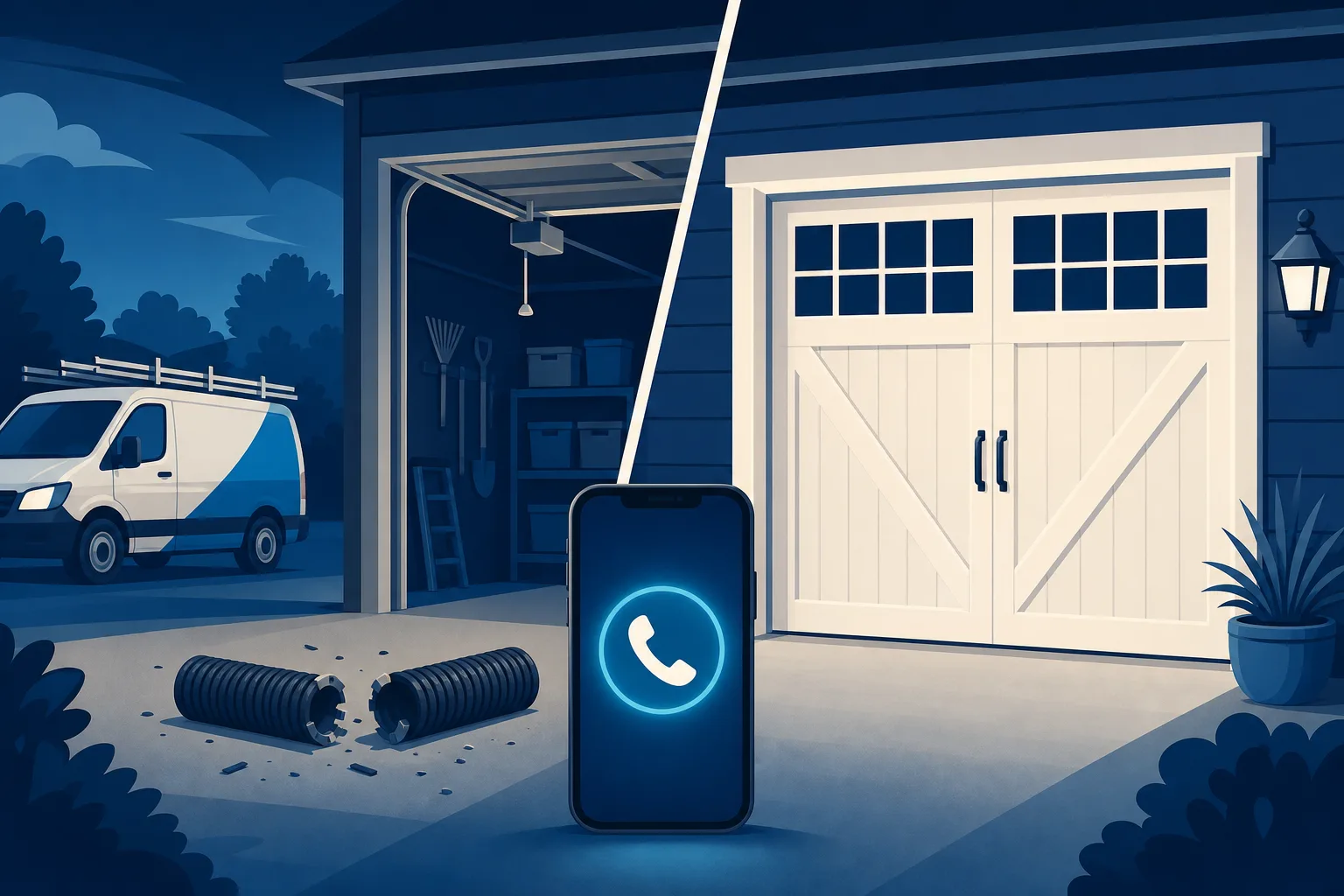
A garage door company website has one job most owners get wrong. It is not a brochure. It is a triage desk. Somebody's spring just snapped at 7am, their car is trapped inside, and they are standing in the kitchen searching "garage door repair near me" with a coffee getting cold. Your site has about eight seconds to prove you can be there today and that calling you is the obvious move. If it makes them read a mission statement first, they already tapped the next result.
Most advice for a garage door company website stops at "be mobile friendly" and "show reviews." True, and not enough. This is a trade with two completely different buyers, a brutal emergency clock, and a torsion spring that can hurt someone. The site has to handle all of that. Here is how to build one that actually earns the phone call.
The two buyers your site has to serve at once
Nearly every garage door lead is one of two people, and they want opposite things.
The emergency caller has a broken spring, a snapped cable, a door off its track, or a dead opener with a car stuck behind it. They are stressed, they are not comparing quotes, and they want one thing: how fast can you get here. Speed and reachability win this person. Price is almost secondary.
The planned buyer is replacing a tired door because it looks bad from the street, because they are selling the house, or because they finally want an insulated door and a quiet opener. This person is browsing, comparing styles and materials, and thinking about cost and financing. They may take two weeks to decide.
A single homepage that tries to speak to both usually speaks to neither. The fix is structure. Put the emergency path front and center, and give the planned buyer their own clear lane below it. One tappable phone number and an "emergency repair" line at the very top for the panic caller. Then a section with door styles, materials, and a "get a replacement quote" button for the shopper. Do not bury the phone number under a hero video. Do not make the shopper wade through spring-repair copy to see what a new door looks like.
Non-negotiable pages for a garage door company website
Generic small-business site checklists miss the pages that actually convert in this trade. These are the ones that matter.
- Emergency repair page. State your response window in plain terms, list what counts as an emergency (broken spring, door off track, car trapped, opener failure), and put a click-to-call button at the top and bottom. Same-day and after-hours availability should be impossible to miss.
- A page per core repair. Broken spring, broken cable, off-track door, opener repair, roller and hinge replacement, panel replacement. People search these exact phrases. A short page for each, with what it costs to diagnose, why it happens, and a safety note, ranks better than one bloated "services" page and answers the question the caller already has.
- New door and installation page. This is for the planned buyer. Show door styles by look (carriage house, modern flush, traditional raised panel) and by material (steel, insulated steel, wood, aluminum and glass). Insulation and R-value matter to anyone with a room over the garage.
- Service area pages, one per town. More on this below, because it is where most garage door sites leave money on the table.
- Financing page. A full door replacement is a real purchase. If you offer monthly payment options, say so on its own page. It removes the silent objection that kills planned jobs.
- Reviews and real photos. Not a stock family in a driveway. Your actual trucks, your actual technicians, and real before-and-after shots.
Photos that sell a garage door job
Photography does more heavy lifting here than in almost any other trade, because the product is the curb appeal. Yet most sites use manufacturer stock images that look nothing like the doors that neighborhood actually has.
Shoot and show these:
- Before and after on real homes. The sagging brown door next to the crisp new carriage-house door is the single most persuasive image you own. Homeowners picture their own house.
- Your technicians and trucks. A photo of a real person in a branded shirt tells the panic caller that a stranger showing up will be legitimate and safe.
- The repair itself. A snapped torsion spring, a frayed cable, a bent track. These make the problem feel real and make your diagnosis credible.
- Door styles grouped by material and look, so a shopper can browse the way they actually think ("I want something modern" or "I want it to match a farmhouse").
Every photo should be compressed so the page loads in under 3 seconds on a phone. Slow galleries are one of the top reasons mobile visitors leave a home-services site before the page finishes.
Service area pages are where you win or lose local search
A garage door company lives and dies by drive time. If you cover eleven towns, you need eleven pages, not one paragraph that lists them all with commas.
Each service area page should carry the town name in the heading, a couple of sentences about that community, the response time you realistically hit there, and a review or a job photo from that town if you have one. This is what lets you show up when someone in that specific suburb searches, instead of losing to the competitor who bothered to name the place. Generic "we serve the greater metro area" copy ranks for nothing.
A word of caution that the marketing agencies rarely mention: do not spin up fifty near-identical pages for towns you cannot actually reach same day. Search engines discount thin, duplicated pages, and a customer forty minutes away who books an emergency call you cannot honor becomes an angry review. Cover the areas you truly serve, and make each page genuinely about that place.
Say the safety part out loud
Garage door springs store enormous tension. A torsion spring can seriously injure someone who tries a DIY fix off a YouTube video. This is not just a liability footnote, it is a trust and conversion tool.
A garage door is the heaviest moving object in most homes, and the spring under it is under enough tension to break a bone. That is exactly why people should call a pro instead of guessing.
Put a short, plain safety note on your spring and cable pages. It does two things at once. It steers the do-it-yourselfer toward calling you, and it signals that you know the danger and take it seriously. Mentioning that your technicians are trained and insured belongs right next to it. For the anxious emergency caller, "insured" and "safe" are quiet reasons to pick you over the cheapest listing.
Build for the season, not for today
Garage door demand is not flat, and your website should flex with it.
- Cold snaps snap springs. The first hard freeze of the year sends spring and cable failures spiking, because metal contracts and worn springs give out in the cold. Emergency messaging should be loudest heading into and through winter.
- Spring and summer are replacement season. Warmer months and home-selling season drive the planned, curb-appeal, and new-installation jobs. Push door styles, insulation, and financing harder then.
- Storm season means damage. Wind, hail, and a stray backing-up car all produce panel and door damage. If you handle insurance-related repairs, a page that explains the claim process is a quiet lead magnet.
You do not need to rebuild the site four times a year. You need a homepage where the top message can shift between "broken today, we can help now" and "time for a new door" without a developer and a two-week wait.
The mobile and speed basics you cannot skip
None of the above matters if the site is slow or clumsy on a phone, which is where the majority of these searches happen.
- Phone number tappable in the header on every page.
- Emergency call button visible without scrolling.
- Pages that load in under 3 seconds on mobile data.
- A contact form short enough to finish one-handed: name, phone, problem, done.
- Navigation kept to a handful of clear items, not a drop-down maze.
- Your name, phone, and service area on every page and matching your Google Business Profile exactly, so search engines trust that you are one consistent business.
That last point matters more than it sounds. Inconsistent name, address, and phone details across your site and your listings quietly drag down local ranking.
Getting a site like this without a two-month build
Here is the honest problem. Everything above is straightforward to describe and slow to build, and most garage door owners are booked solid running actual jobs. Hiring an agency for a custom build takes weeks and real money, and template builders leave you fighting a page editor at 9pm instead of setting spring appointments.
This is the gap Saynovo is built for. You connect your Google Business Profile, and it stands up a garage door site with the emergency path up top, per-town service area pages, and repair pages already in place, pulling from the business details you have already published. When the first freeze hits and you want the homepage to shout "same-day spring repair," you tell the site in plain words and it changes, no ticket, no editor, no wait. It publishes on your own domain. The first build from your profile costs nothing to see, so you can look at a finished garage door company website before deciding anything. For owners who want a fully hands-off, bespoke build instead, the agency parent SyntroAI handles that end.
The takeaway
A garage door company website is not decoration. It is the front door for the panic call and the showroom for the planned replacement, and it has to do both at once. Lead with emergency reachability, give the shopper real photos and financing, build a genuine page for every town you cover, respect the spring-safety angle, and let the message move with the seasons. Do that and the site stops being a business card and starts being the technician who answers the phone before anyone else does.