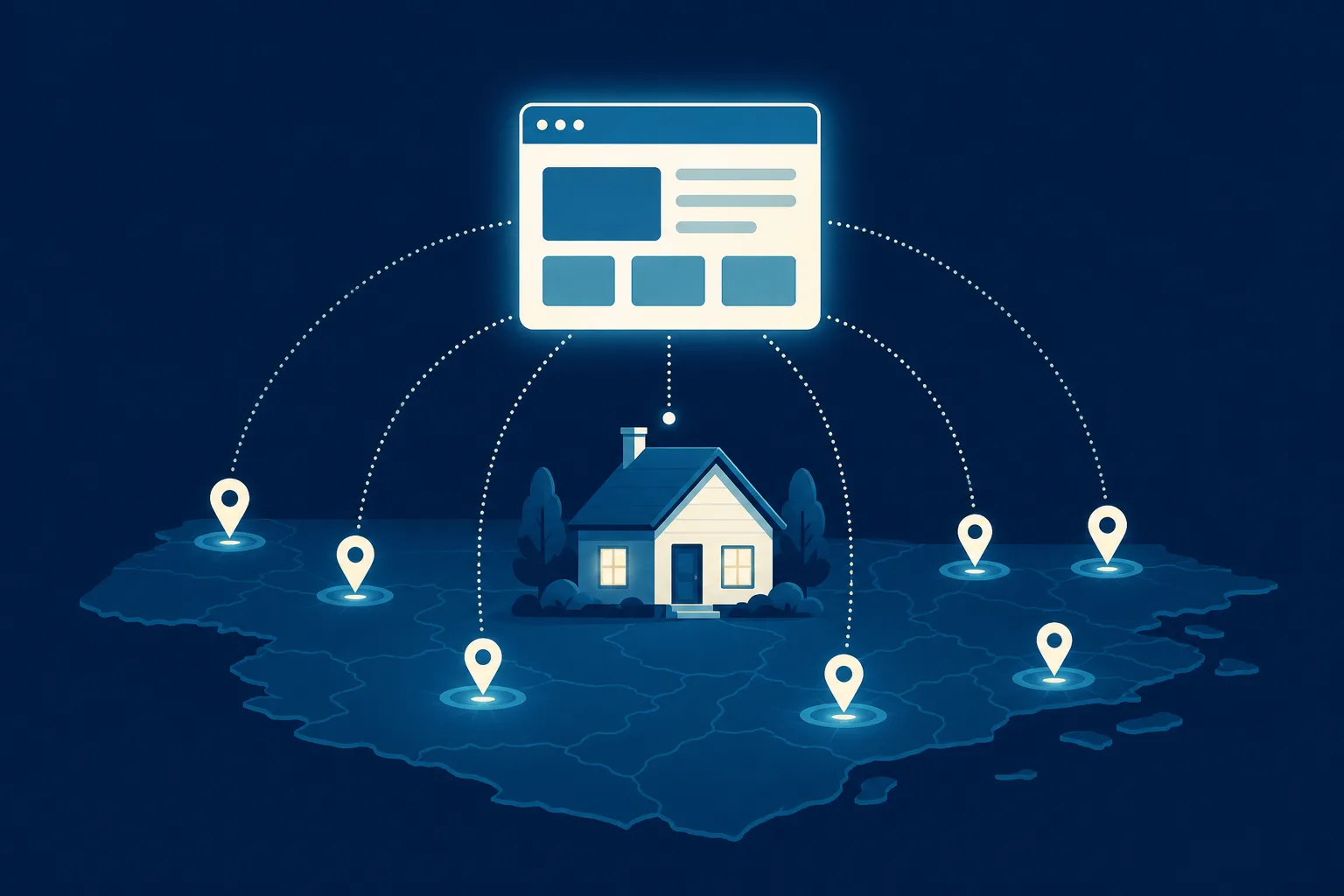
You run your business from a spare bedroom, the garage, or the kitchen table. There is no sign out front, no lease, no storefront with your name on the awning. So the question feels honest and a little nervous at the same time: do home-based businesses need a website, or is a website something only "real" companies with a building have?
Here is the short answer. A home-based business needs a website more than a storefront does, not less. A storefront gets a form of free advertising every time someone drives past it. Your business does not. Nobody drives past your kitchen table. A website is how a home-based business becomes visible, believable, and reachable to people who will never see where you actually work. And done right, it does all of that without ever putting your home address in front of a stranger.
This post is written for the owner who has no website yet. No jargon, no assumptions. Let us walk through what a website actually solves for a business run from home.
The privacy problem nobody warns you about
The first fear most home-based owners have is not about design or cost. It is about privacy. You do not want the whole internet knowing where you live. You picture a website and you picture your home address printed at the bottom of every page, and that stops you cold.
Good news: a proper business website does the opposite. It is the single best tool for serving customers without ever revealing your address.
Here is how that works in practice. Instead of an address, your site shows:
- The towns and neighborhoods you serve, listed by name, rather than a pin on a map at your house.
- A phone number and a contact form as the way people reach you, so the first contact happens on your terms.
- A line like "we come to you" or "serving the greater [your area] region," which tells customers exactly what they need to know and nothing they do not.
Compare that to the alternatives you might be using now. A personal Facebook page ties your business to your personal life and your real name. A free classifieds listing often wants an address. A Google Business Profile is powerful, but if you are not careful it can display your home. A website you control lets you decide precisely what is public. You show your service area. You hide your doorstep. That control is not a nice-to-have for a home-based business. It is the whole point.
Why "no address" makes people trust you less, and how a site fixes that
Now the flip side. The reason you want to hide your address is the same reason customers get nervous. When someone cannot see where a business is based, a small voice asks: is this a real, accountable business, or someone who will take my deposit and vanish?
This is the legitimacy gap every kitchen-table business faces. You are competing for trust against businesses with a visible location, and you are doing it from a bedroom nobody can see. A website is how you close that gap without giving up your privacy. It replaces "where are they located" with a stack of other proof that you are real:
- A clean, professional site that clearly explains what you do and who you do it for.
- Real reviews from named local customers, which do more for trust than any address ever could.
- Photos of your actual work, so people see results instead of a building.
- A business email address at your own domain, like [email protected], instead of a personal gmail.
- Clear service details, a real phone number, and honest answers to the questions customers actually ask.
None of that requires a storefront. All of it signals "this is a legitimate operation run by a professional." Legitimacy for a home-based business does not come from a location. It comes from how carefully you present the work. A website is where that presentation lives.
Serving an area, not an address
Storefront businesses think in terms of a location. People come to them. Home-based businesses think in terms of a service area. You go to people, or you serve them online, or they order and you ship. That difference should shape your entire website.
The centerpiece of a home-based business site is not a map to your door. It is a clear, confident statement of your reach:
- If you travel to customers (mobile pet grooming, in-home tutoring, a handyman, a photographer, house cleaning), name every town, suburb, and zip radius you cover. A customer in the next town over needs to see their own town's name before they will call.
- If customers ship to you or you ship to them (a maker, a baker taking pickup orders, an online shop run from the garage), say where you deliver and how pickup works, and where you are based at the regional level ("based in the [metro] area") without a street address.
- If you serve clients remotely (a bookkeeper, a coach, a virtual assistant), lean into that. "Serving clients across [state] and nationwide" turns having no location into a strength, not a gap.
This service-area framing does two jobs at once. It tells a human exactly whether you can help them. And it helps Google connect you with searches like "mobile dog groomer near [town]," which is how a huge share of local customers find home-based businesses in the first place. Without a website naming those areas, you are invisible to that search. With one, you show up for towns your competitors forgot to list.
If you serve several towns, it is worth giving each important one its own attention on the site rather than burying them in a single sentence. A customer searching for your service plus their town should land on a page that speaks to that town by name.
Competing with the business that has a storefront
Let us be direct about the fear underneath all of this. Somewhere near you, a competitor has a real shop, a sign, a Google listing with a photo of the building. You are working out of your house. It feels like they start ten steps ahead.
On a website, that gap shrinks fast, and sometimes it flips in your favor. Here is why. A visitor to your website has no idea whether the polished, well-organized site they are reading belongs to a company with a twenty-person office or one person at a kitchen table. They judge what is in front of them. If your site is clearer, your reviews are warmer, your photos are better, and your service area is more specific than the storefront's neglected website, you win the click. Many established local businesses have terrible websites or none at all. That is your opening.
Home-based businesses also have real advantages worth putting front and center:
- Lower overhead often means fairer pricing, and you can say so honestly.
- You are the person doing the work, so "you talk to the owner every time" is a genuine selling point a chain cannot match.
- You come to them or fit around their schedule, which a fixed storefront cannot always do.
The storefront's advantage is that people can see it. Your website is how you become just as visible, on a screen instead of a street. Once you are both a search result away, the location on the ground matters a lot less than the quality of what shows up.
When a website is not the first thing you need
An honest answer means admitting there are cases where a full website can wait a little.
If you are testing an idea this month, selling to a handful of friends and family, and not yet sure you will keep going, do not stall the launch building a website first. Start with a free Google Business Profile so you exist in Google and Maps, and go get a few paying customers. If your business lives entirely on a marketplace that handles everything (an Etsy shop, an Upwork profile, a booth at a weekend market) and you have no ambition beyond that channel, the platform is doing the website's job for now.
But treat those as a starting line, not a finish line. The moment you want customers to find you on their own, the moment you want to look more established than a social profile allows, the moment a customer asks "do you have a website" and you feel that small flush of embarrassment, it is time. For most home-based owners who are serious about growing, that moment is right now.
What your first website actually needs
You do not need anything fancy. A home-based business website that works can be short. Aim for these pieces:
- A homepage that says what you do, who you help, and the areas you serve, in the first screen.
- A services page that lists what you offer and roughly what each thing is (you can talk about price ranges without pinning exact numbers if you prefer).
- A service-area section or page naming your towns, so both people and Google know your reach.
- Photos of your real work, taken on your phone in good light, not stock images.
- Reviews, even just three or four to start, with the customer's first name and town.
- A contact method front and center: a tappable phone number, a simple form, and a business email. No street address required.
- An about section that puts a face and a story to the business, which matters more for a solo, home-based operation than almost anything else.
That is a complete, credible website. Everything past it is a bonus you can add later.
Getting it built without it becoming a project
The reason many home-based owners never launch a site is not doubt about whether they need one. It is time. You are the one doing the work, answering the phone, and running the books. Learning a website builder and fighting with templates is a project you do not have room for.
There are a few honest paths. If you enjoy tinkering and have the evenings to spare, a builder like Wix or Squarespace can get you there. If you want a professional to handle the whole thing hands-on, a local web designer or a fully-managed agency like SyntroAI will do it for you.
There is also a middle path built for exactly this situation. Saynovo imports what your existing Google Business Profile already holds, your hours, service area, photos and reviews, and generates a complete, agency-quality website around that base, and your first site generation is free. From there you edit the site by talking to it: you say "hide my address and list the towns I serve" or "add a section about in-home visits," and it changes. For a home-based owner who wants a real website without giving up an entire weekend, that is the difference between meaning to do it and having it done.
The bottom line
Do home-based businesses need a website? Yes, and here is the version to remember. A website is how a business with no storefront becomes real to strangers. It gives you legitimacy without a location, it reaches your whole service area without publishing your home address, and it lets you compete head-to-head with businesses that have a sign out front. You get to keep your privacy and still be found.
Your one next step: write down every town you serve and pull together five photos of your work. That short list is the seed of your homepage, and it is the moment your kitchen-table business starts looking like the professional operation it already is.