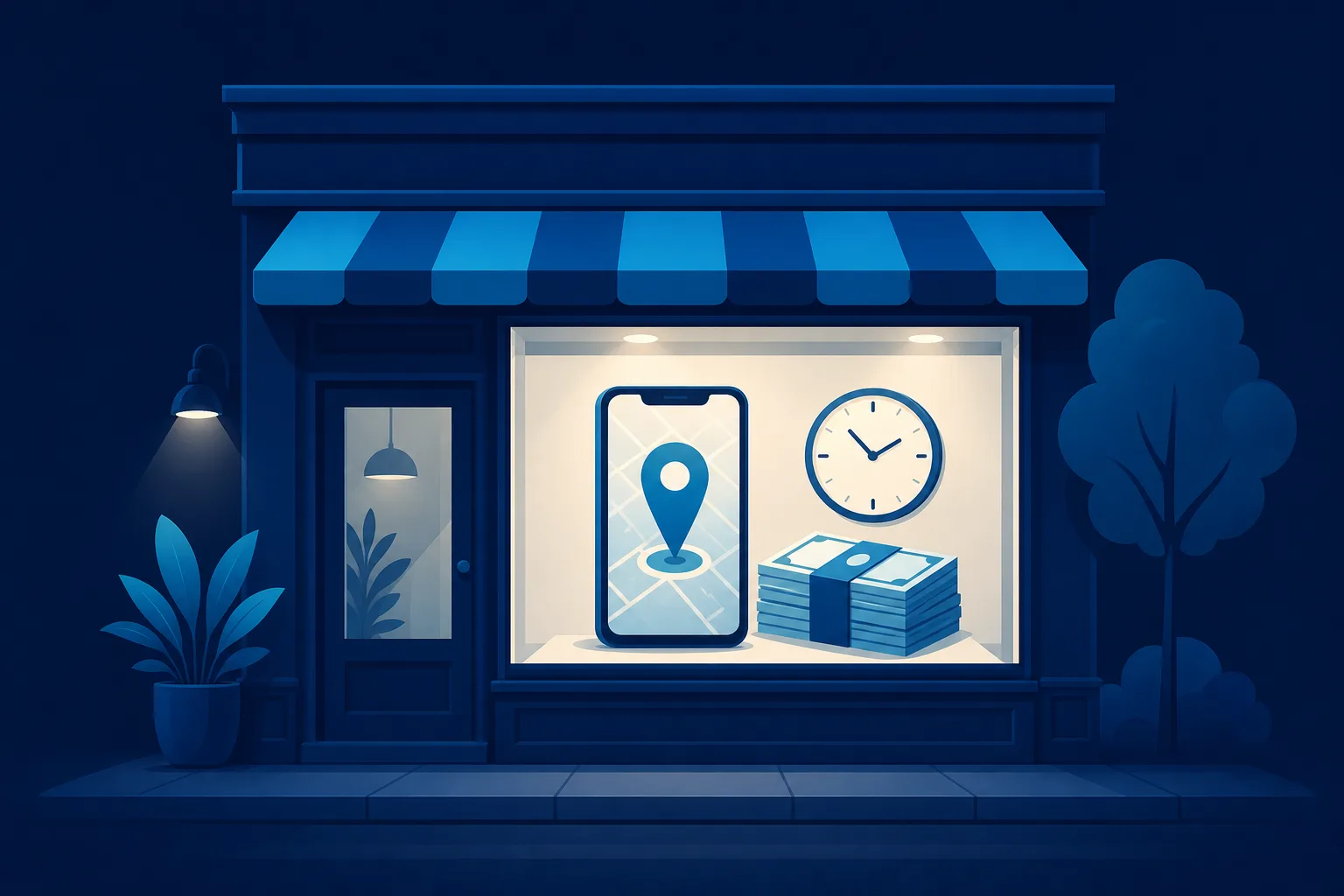
Here is the honest answer up front: yes, a cash-only business still needs a website. Not because you want to sell anything online, and not because you are about to start taking cards. You need one because the website does a different job entirely. It helps people find you, decide you are the real deal, and figure out how to give you their money in person - which for you means cash.
A lot of cash-only owners assume a website is only for stores that check out online. That is the part most articles get backwards. A website is not a cash register. It is a front window. And a front window is exactly what a cash-only business tends to be missing.
The confusion: a website is not a payment system
When people picture a business website, they picture a shopping cart, a "buy now" button, and a card form. If you run cash-only on purpose, all of that sounds like the opposite of what you do. So the logic goes: no online payments, no need for a website.
But a website and a payment system are two separate things. Most local businesses with a website never take a single dollar through it. The site answers questions. The transaction still happens at your counter, in your chair, or on your customer's driveway - in cash, same as always.
So when you ask "do cash-only businesses need a website," you are really asking two questions that got tangled together:
- Do I need to accept online payments? For a cash-only business, no. That is your choice, and it is a valid one.
- Do I need a place online where people can find me and check me out? Almost certainly yes.
Keep those two apart and the whole thing gets simpler.
How people actually look for a cash-only business
Think about how someone finds you today. They ask a friend, or they type something into their phone. "Barber near me." "Laundromat open now." "Cheap oil change [your town]." Even for the most walk-in, word-of-mouth business, the phone is now the first stop.
Here is what happens next, and it is the part that costs cash-only owners real money. Someone hears about you, then does a quick search to check you out before driving over. If nothing comes up - no website, no hours, no photos, no address they can tap for directions - they do not assume you are a hidden gem. They assume something is off, and they go to the place that showed up with a clean page and a phone number.
You never see this happen. There is no bounced check, no angry customer, no sign of the loss at all. The person just quietly picks someone else. That is the specific trap of being invisible when you are cash-only: your business can be busy and beloved by regulars and still bleed new customers who never made it through the door.
Why "cash-only" makes a website more important, not less
There is a second thing going on, and it is unique to cash businesses. In a lot of people's minds, "cash-only" quietly raises a question. Is this place legit? Are they hiding something? Is it sketchy? That is not fair to you, but it is a real reaction, especially with younger customers who almost never carry bills.
A simple, professional website is the fastest way to answer that unspoken question before it turns into a "no." When someone sees a real page with your name, your storefront photo, your hours, your years in business, and a few honest reviews, the "cash-only" label flips from suspicious to charming. Now you are the trusted local spot that keeps prices low by skipping card fees, not the place that seems to be dodging something.
And you get to say the cash-only part on your own terms. One clear line - "We accept cash and there is an ATM two doors down" - turns a possible dealbreaker into a heads-up. The customer arrives with bills in hand instead of getting to your counter, realizing they cannot pay, and leaving frustrated. That single sentence on a website saves you awkward moments every week.
What a cash-only business website actually needs
You do not need a big site. You need a small, honest one that loads fast on a phone and answers the handful of things people check before they visit. For a cash-only business, that list is short and specific:
- Your name and what you do, in plain words, at the very top. "Family-owned laundromat in East Rockford. Open 6am to 11pm, every day."
- Cash-only, stated plainly and positively. Say it, explain why if you want to (lower prices, no card surcharge), and point to the nearest ATM. Do not bury it.
- Hours you actually keep. For walk-in cash businesses this is the single most-checked fact. Keep it current, especially around holidays.
- Address with a tap-to-open map, plus a note on parking or which door to use. If you are mobile - a mechanic, a handyman, a lawn crew - list the towns you cover instead.
- A phone number people can tap to call. Many cash-only businesses are one-person or counter-run, so a call is worth more than a contact form.
- Real photos. The storefront so they recognize it, the inside so it feels safe, and a few shots of your work or your space. Phone photos in good daylight are plenty.
- A few reviews or a line about how long you have been around. This is your trust anchor, and it does the heavy lifting against the "is cash-only sketchy" worry.
That is a genuinely complete website for a cash-only business. Notice what is not on the list: no shopping cart, no checkout, no payment form, no account logins. You are not building a store. You are building a front window that happens to be open at 2am when someone is searching.
But I already have a Google listing - is that enough?
Good instinct, and if you have claimed your Google Business Profile, you are already ahead of a lot of cash-only owners. It shows your hours, your map pin, your reviews, and your phone number right in search. For some very simple walk-in businesses, that alone might carry you for a while.
Here is where the listing runs out of room, though. Google controls the layout, so you cannot fully explain the things that matter to a cash business - why you are cash-only, what the ATM situation is, the story that makes "cash-only" feel trustworthy instead of odd. You also cannot really show your personality or your best work the way a page you own can. And a profile can get suspended or have its info scrambled by a random "suggested edit" from a stranger, with no backup anywhere.
The strongest setup is both, working together: keep the Google Business Profile sharp for discovery, and have a simple website it links to for the fuller picture and the trust. They feed each other. The listing gets you seen; the website closes the doubt. If you only ever do one, do the listing. But do not stop there and assume the job is done.
The real objection: I do not have time for this
This is the honest reason most cash-only owners skip a website, and it is fair. You are running the counter, cutting hair, fixing cars, or folding towels. You are not going to sit down and learn a website builder, wrestle with hosting, hunt for a template, and keep tinkering with it. That project just never rises to the top of the pile, and it should not have to.
So be practical about how you get one. A few routes that genuinely work for a busy, hands-on owner:
- A drag-and-drop builder like Wix or Squarespace if you actually enjoy that kind of thing and have a weekend. Real control, real learning curve.
- A local freelancer or small agency if you would rather hand it off and are fine paying for a custom build. For a very hands-off owner, a fully-managed agency such as SyntroAI can run the whole thing so you never touch it.
- A done-for-you tool if you want a real site without the project. This is where Saynovo fits a cash-only business well: it can pull straight from your existing Google Business Profile - your name, hours, photos, and reviews - and generate a complete site around that base, free on your first generation, so you are not starting from a blank page you do not have time to fill. What Google never stored, like the fact that you are cash-only and where the nearest ATM is, you add by saying it.
The one that matters most is the one you will actually finish. A plain website that is live beats a beautiful one that stays a someday project.
When you do want to change something, say it
Cash-only businesses change the small, time-sensitive stuff constantly. Holiday hours. "Closed Tuesday for a family thing." A price bump because supplies went up. A new ATM went in across the street. These are the exact updates that go stale on most small-business sites because editing them is a hassle, and stale hours are worse than no website at all - nothing burns trust faster than a customer driving over to a "closed" that your site said was "open."
This is the part of Saynovo built for someone who does not want to fight with software. You talk to the site to change it. Say "update Thursday hours to close at 8," and it changes. No dashboard to relearn every few months, no template to fight. For an owner whose hands are literally full most of the day, being able to fix a wrong hour from your phone in one sentence is the difference between a site that stays true and one that quietly starts lying to your customers.
The bottom line for a cash-only business
You can absolutely keep taking only cash. That is your call, and plenty of great local businesses run that way on purpose - lower prices, no card fees, simple books. A website does not threaten any of that. If anything, it protects it, by making sure the people who would love your cash-only spot can actually find it, trust it, and show up with bills in their pocket.
So the answer to "do cash-only businesses need a website" is yes - just not the kind you were picturing. Not a store. A front window. Something simple that says who you are, where you are, when you are open, that you take cash, and that you are the real thing.
If you already have a Google Business Profile, the shortest path is to turn that into a proper page - the discovery and the trust in one place, without a weekend lost to a builder. Point your listing at it, keep your hours honest, and let the people who are already searching for you actually find the door.